The G7 now views land degradation as a global security risk. For India, where degradation costs 2.5% of GDP, prioritizing sustainable management and UNCCD COP17 is vital. Success requires bridging international frameworks and reforming domestic policies toward climate-resilient, productive agriculture.
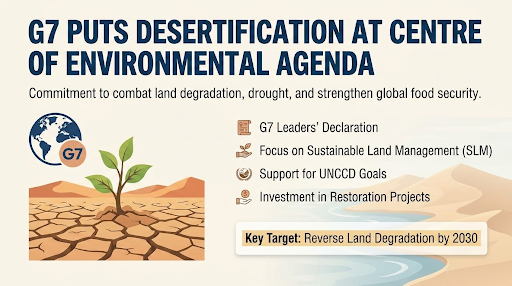
The Group of Seven (G7) has elevated desertification to a top-tier global security threat, acknowledging the land crisis as a driver of migration, food insecurity, and conflict.
While often used interchangeably, these terms have distinct meanings as defined by the United Nations Convention to Combat Desertification (UNCCD).
|
Term |
Definition |
Key Characteristics |
|
Land Degradation |
A reduction or loss of the biological or economic productivity of land, resulting from land uses or from a process or combination of processes, including those arising from human activities. |
It is a broad concept that includes soil erosion, nutrient depletion, and salinization. It can occur in any ecosystem. |
|
Desertification |
Land degradation specifically in arid, semi-arid, and dry sub-humid areas (known as "drylands"). |
It is a type of land degradation caused by various factors, including climatic variations and human activities. It does not refer to the expansion of existing deserts. |
|
Drought |
A prolonged period of abnormally low rainfall, leading to a shortage of water. |
It is a natural, recurring climatic phenomenon. While it can exacerbate desertification, it is not the same thing. |
Global: Currently, 40% of the world's land is degraded, impacting nearly half the global population; projections suggest an additional area the size of South America will degrade by 2050. (Source: UNCCD)
India: During 2018-19, 97.85 million hectares (29.7% of Total Geographical Area) underwent degradation, with Rajasthan, Maharashtra, and Gujarat being the most affected states. (Source: ISRO)
Resource Scarcity & Conflict: It intensifies competition for scarce resources like fertile land and water, leading to conflicts between communities and even across borders.
Food Insecurity: Degraded soil loses its productivity, leading to reduced agricultural output, crop failures, and increased food prices, which can trigger social unrest and political instability.
Forced Migration: When land can no longer support livelihoods, people are forced to migrate. These "environmental refugees" can place immense strain on resources in their new locations, potentially causing social tensions.
Economic Instability: Loss of agricultural GDP, rural unemployment, and reduced economic growth are direct consequences, weakening state capacity and stability.
Recruitment by Extremist Groups: In many vulnerable regions, terrorist and extremist groups exploit local grievances arising from resource scarcity and loss of livelihood to gain recruits and control.
|
Initiative |
Key Objective |
Latest Update / Status |
|
The sole legally binding international agreement linking environment and development to sustainable land management. |
The 17th Conference of the Parties (COP17) is scheduled to be held in Ulaanbaatar, Mongolia in August 2026. |
|
|
A global goal to bring 150 million hectares of degraded and deforested landscapes into restoration by 2020, and 350 million hectares by 2030. |
India has pledged to restore 26 million hectares of degraded land by 2030. |
|
|
Great Green Wall Initiative |
An African-led movement to grow an 8,000 km natural wonder of the world across the entire width of Africa. |
Aims to restore 100 million hectares of degraded land, sequester 250 million tons of carbon, and create 10 million green jobs. Progress has been slow, with funding and implementation challenges. |
|
A global call to action to prevent, halt, and reverse the degradation of ecosystems worldwide. |
Led by UNEP and FAO, it aims to build a global movement to ramp up restoration efforts. |
Pradhan Mantri Krishi Sinchayee Yojana (PMKSY): Its Watershed Development Component (WDC-PMKSY 2.0) focuses on soil and water conservation, rainwater harvesting, and afforestation.
Soil Health Card Scheme: Aims to provide farmers with information on the nutrient status of their soil, enabling them to make judicious use of fertilizers and improve soil health.
National Afforestation Programme (NAP): Focuses on the afforestation of degraded forest lands through active community participation.
National Mission for a Green India (GIM): One of the eight missions under the National Action Plan on Climate Change (NAPCC), it aims to protect, restore, and enhance India's forest cover.
The G7's designation of desertification as a security threat marks a policy shift, emphasizing land health's role in global peace and stability. For India, mitigating degradation is crucial for climate goals, agricultural resilience, and sustainable growth.
Source: DOWNTOEARTH
|
PRACTICE QUESTION Q. Consider the following statements regarding desertification and land degradation: 1. The Group of Seven (G7) recently declared desertification as a "systemic global challenge" and a "security risk multiplier." 2. According to the Desertification and Land Degradation Atlas of India (2021), nearly 50% of India's total geographical area is undergoing degradation. 3. The upcoming UNCCD COP17 is scheduled to be held in Ulaanbaatar, Mongolia. Which of the statements given above is/are correct? a) 1 and 2 only b) 2 and 3 only c) 1 and 3 only d) 1, 2, and 3 Answer: c Explanation: Statement 1 is correct: The G7 has recognized desertification and land degradation as a systemic challenge, often framing it in the context of security risks (a "risk multiplier"). Statement 2 is incorrect: According to the Desertification and Land Degradation Atlas of India (2021) published by ISRO, approximately 29.77% of India's total geographical area was undergoing land degradation/desertification, not 50%. Statement 3 is correct: The 17th session of the Conference of the Parties (COP17) to the United Nations Convention to Combat Desertification (UNCCD) is scheduled to be held in Ulaanbaatar, Mongolia, in August 2026. |
Shrinking arable land and water resources drive social and political instability. Rivalry over resources is linked to over 40% of intrastate conflicts, such as the Darfur crisis. Additionally, degraded lands cause rural livelihoods to collapse, triggering mass climate-induced displacement and migration that can destabilize nations.
According to the Desertification and Land Degradation Atlas of India (2021) by ISRO, approximately 97.85 million hectares—which constitutes 29.77% of India's total geographical area—is actively undergoing degradation. Rajasthan, Maharashtra, and Gujarat are the most critical hotspots.
The Bonn Challenge is a global effort to bring degraded and deforested landscapes into restoration. India committed at UNCCD COP14 to restore 26 million hectares of degraded land by the year 2030 to achieve land degradation neutrality.



© 2026 iasgyan. All right reserved