Section 69A of the Information Technology Act, 2000 empowers the Indian government to block public access to digital content to defend national security and public order. Despite procedural safeguards upheld by the Supreme Court, concerns persist regarding transparency and due process.
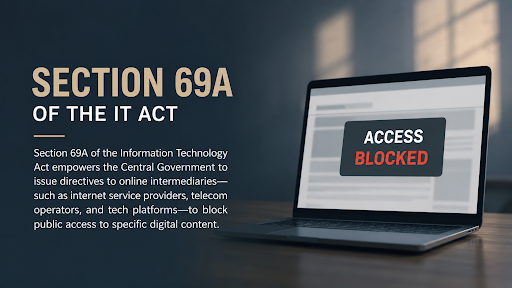
Temporary ban on Telegram following concerns over the NEET-UG paper leak brings Section 69A of the IT Act, 2000 back into the spotlight.
Origin: Parliament introduces this provision via a 2008 amendment to the Information Technology Act, 2000, creating a formal mechanism to regulate digital spaces.
Core Objective: The Union Government utilizes this statute to block public access to digital information that threatens national interests or public order.
Scope of Authority: The government directs any agency or intermediary to block content generated, transmitted, or hosted on any computer resource within India.
Blocking Authority: The state restricts access to specific URLs, websites, or entire applications, as seen in the 2020 ban on 59 Chinese apps.
Statutory Grounds: The law permits blocking only for:
Emergency Powers: The Designated Officer submits requests to the Secretary, Department of Information Technology, who issues interim blocks without prior hearings. The government must present these to the Review Committee within 48 hours.
Intermediary Compliance: Platforms failing to comply lose their Section 79 safe harbour immunity, exposing them to criminal liability.
|
Significance in the Digital Age National Security: The government uses Section 69A to combat cyber-terrorism and foreign propaganda via the Indian Cybercrime Coordination Centre (I4C). Combating Misinformation: The state targets platforms facilitating organized fraud, such as the criminal networks exploiting Telegram’s message-editing features for exam leaks. Digital Governance: Centralized tools like the Sahyog portal streamline coordination between law enforcement and intermediaries. Individual Protection: The law enables the swift removal of non-consensual intimate imagery (NCII) and incendiary hate speech. |
Fundamental Rights: Article 19(1)(a) protects digital free speech, while Article 19(2) allows the state to impose "reasonable restrictions" on these rights.
Shreya Singhal vs Union of India (2015): The Supreme Court upholds Section 69A as a "narrowly drawn provision" while striking down the vague Section 66A.
Tanul Thakur vs Union of India (2022): The Delhi High Court mandates the disclosure of original blocking orders, challenging the blanket confidentiality of Rule 16.
X Corp vs Union of India (2023): The Karnataka High Court rules that foreign companies cannot claim Article 19 rights to challenge blocking orders.
Blocking Rules 2009: These rules establish the procedural roadmap, requiring complaints from a Nodal Officer or a competent court.
Designated Committee: A panel comprising Joint Secretaries from the Ministries of Law, Home Affairs, Ministry of Information & Broadcasting, and CERT-In evaluates the content.
Review Mechanism: A Review Committee (under Rule 419A of the Indian Telegraph Rules, 1951) meets every two months to verify if blocking directions align with the law.
Transparency Deficit: Rule 16 mandates strict confidentiality, preventing public accountability and hindering RTI requests.
Due Process Gaps: The process lacks mandatory pre-decisional hearings for content creators and suffers from a lack of independent judicial oversight in the Review Committee.
Proportionality Failures: Blanket bans on platforms like Telegram punish millions of legitimate users to target a small fraction of criminals, failing the proportionality test.
Enforcement Limitations: Tech-savvy users frequently bypass ISP-level blocks using VPNs, rendering the measures ineffective.
Enhanced Transparency: Reform Rule 16 to publish aggregate data and the specific rationale behind blocking orders.
Judicial Integration: Include independent jurists or retired judges in the Review Committee to eliminate executive bias.
Proportionality Application: Prioritize targeted URL blocking over blanket application bans to minimize collateral damage to users.
Statutory Rights: Guarantee a "right to be heard" for content creators before the government issues permanent takedown orders.
Legislative Modernization: Enact the proposed Digital India Act to replace the outdated IT Act 2000 and provide precise definitions for ambiguous terms.
While Section 69A is vital for national security, it needs reform. Implementing judicial oversight, transparency, and proportionality will allow the government to protect the nation while preserving digital free speech.
Source: THEHINDU
|
PRACTICE QUESTION Q. With reference to the 'Safe Harbour' provision for internet intermediaries in India, which of the following statements is correct? (a) It provides absolute immunity to social media platforms from any legal action regarding third-party content. (b) It is governed by Section 66A of the IT Act, 2000. (c) Intermediaries lose this protection if they fail to expeditiously remove unlawful content upon receiving a valid government or court order. (d) The provision guarantees that foreign internet companies possess fundamental rights under Article 19 of the Indian Constitution. Answer: (c) Explanation: Under Section 79(3)(b) of the Information Technology (IT) Act, 2000, the safe harbour protection is strictly conditional. If an internet intermediary receives "actual knowledge" in the form of a valid court order or a directive from a government agency to remove content restricting Article 19(2) violations (such as threats to national security or public order), it must expeditiously remove or block access to that content. Failure to comply results in the immediate forfeiture of its legal immunity. |
Section 69A of the Information Technology Act is a legal provision that explicitly empowers the Central Government to issue directives to online intermediaries—such as internet service providers, telecom operators, and tech platforms—to block public access to specific digital content.
The government can block online content only when it deems the restriction strictly necessary in the interest of India's sovereignty and integrity, state security, national defence, friendly relations with foreign states, public order, or for preventing the incitement of cognisable offences related to these grounds.
In the Shreya Singhal vs Union of India case, the Supreme Court upheld the constitutional validity of Section 69A, distinguishing it from the struck-down Section 66A by concluding that 69A is a narrowly tailored provision backed by robust procedural safeguards.
Section 69A balances national security with free speech by anchoring its blocking grounds directly within the reasonable restrictions of Article 19(2), mandating that officials record detailed written justifications, providing content originators a 48-hour hearing window, and ensuring all orders remain subject to judicial review.



© 2026 iasgyan. All right reserved