The Indian government temporarily restricted Telegram and disabled its message-editing feature to curb massive cyber fraud related to the NEET-UG paper leaks. The crisis highlights the urgent tension between End-to-End Encryption (E2EE), platform accountability under IT Rules 2021, and the "going dark" challenge for law enforcement.
Why In News?
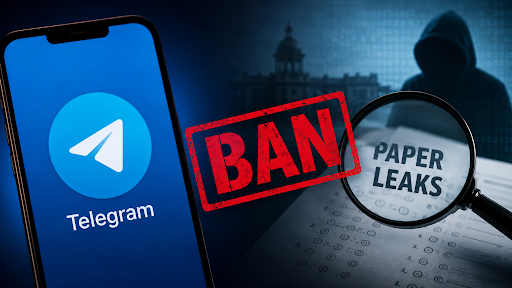
The Indian government invokes Section 69A of the IT Act to temporarily block Telegram and disable its message-editing features following massive cyber fraud linked to NEET-UG 2026 paper leaks.
What is Telegram?
Messaging Architecture: Telegram functions as a cloud-based instant messaging application, serving approximately 150 million users in India.
Cloud-Based Synchronization: Unlike standard peer-to-peer apps, it utilizes a cloud architecture that enables seamless multi-device access and massive data storage.
Encryption Protocols: The platform offers End-to-End Encryption (E2EE) exclusively through its "secret chats" feature, where it claims to store no metadata logs, effectively rendering interception impossible for third parties.
Why Is Telegram Popular?
Massive Broadcasting: The platform supports channels with millions of subscribers and groups with hundreds of thousands of members, facilitating rapid, wide-scale information dissemination.
File Sharing Limits: It permits the transmission of large files, which criminals exploit to distribute high-resolution PDFs of fabricated exam papers.
Privacy Features: The ability to edit messages post-delivery allows malicious actors to manipulate historical content, creating fake "evidence" of leaks after exams conclude.
|
Legal Framework in India IT Act, 2000: The Ministry of Electronics and Information Technology (MeitY) utilizes Section 69A to restrict public access to platforms in the interest of national security and public order. IT (Intermediary Guidelines and Digital Media Ethics Code) Rules, 2021: These rules mandate that platforms appoint compliance officers and perform due diligence to maintain their legal protections. Digital Personal Data Protection Act: This framework attempts to balance user privacy with the state’s need for lawful interception, though implementation regarding encrypted intermediaries remains a point of contention. |
Issues with Platform Accountability
Non-Responsiveness: The Indian Cyber Crime Coordination Centre (I4C) reports that Telegram executives consistently fail to provide metadata required to trace the origins of criminal activity.
Safe Harbour Risks: Experts argue that Telegram risks losing its Safe Harbour immunity under Section 79 of the IT Act due to its failure to implement proactive content moderation against criminal networks.
Criminal Exploitation: The Ahmedabad Cyber Crime Branch recently dismantled an inter-state gang that funneled ₹1.5 crore through fraudulent bank accounts, using Telegram to sell fake NEET-UG 2026 papers.
Global Law Enforcement Concerns: International agencies link the platform to the proliferation of Child Sexual Abuse Material (CSAM), drug trafficking, and organized cyber fraud.
|
The Encryption vs Accountability Debate Right to Privacy: Privacy advocates maintain that E2EE serves as a fundamental safeguard for journalists and activists against state surveillance. The "Going Dark" Phenomenon: Law enforcement agencies struggle to prevent imminent threats or dismantle terror networks because encryption prevents access to plaintext data. Traceability Demands: Government seeks to identify the "first originator" of malicious messages, while tech giants argue that such requirements fundamentally destroy the security architecture of the entire platform. Regulatory Challenges: Regulators face significant hurdles due to cross-border jurisdiction, as many tech companies maintain headquarters outside India, complicating the retrieval of server logs. |
Way Forward
Calibrated Restrictions: Prioritizes feature-specific restrictions—such as disabling message editing—over blanket bans to minimize collateral damage to the 150 million legitimate users.
Advanced Cyber Investigation: Agencies like the I4C must deploy AI-driven network analysis to preemptively identify and dismantle financial fraud rings.
Transparency and Cooperation: Platforms must integrate transparency reporting and collaborate with law enforcement through privacy-respecting aggregate telemetry rather than hiding behind absolute non-compliance.
Structural Vulnerability Targeting: Regulators must shift focus from "whack-a-mole" channel takedowns toward addressing the structural design flaws that facilitate large-scale criminal operations.
Conclusion
India must enforce agile regulations to hold intermediaries accountable for cybercrime. The goal is to prevent platforms from evading responsibility for illegal acts while maintaining essential encryption-based privacy rights.
Source: INDIANEXPRESS
|
PRACTICE QUESTION Q. "End-to-End Encryption (E2EE) creates a dual-edged sword: it safeguards individual privacy but plunges law enforcement into the 'going dark' dilemma." Analyze. 150 words |
The platform faces severe international and domestic pressure due to its minimal content moderation, lack of default end-to-end encryption for group chats, and recent massive exploitation by criminal syndicates to distribute leaked national competitive exam papers (like NEET-UG 2026), host illegal gambling, and execute financial extortion rackets.
Encrypted applications heavily handicap law enforcement investigations because their absolute user anonymity, hidden phone number features, distributed data storage networks, and retroactive message-editing capabilities allow bad actors to coordinate large-scale cybercrimes and fabricate evidence without leaving traceable digital footprints.
India regulates online platforms through the Information Technology Rules, 2021 (amended in February 2026), which strip platforms of their "safe harbour" legal immunity if they fail to:
This core digital friction pits an individual's fundamental constitutional right to unmonitored, secure personal communication against the sovereign duty of the state to intercept threats, protect national security infrastructure, and track underground criminal networks that exploit absolute data privacy as a shield against accountability.

© 2026 iasgyan. All right reserved