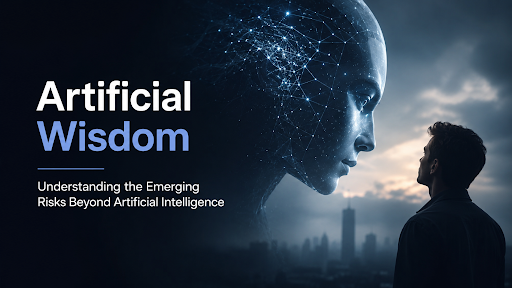
Artificial Wisdom refers to the dangerous misconception that AI systems possess moral judgment and human understanding. While AI offers immense computational optimization, its lack of human consciousness creates algorithmic bias and severe accountability vacuums, necessitating robust, human-centric legal frameworks like the India AI Governance Guidelines.
Why In News?
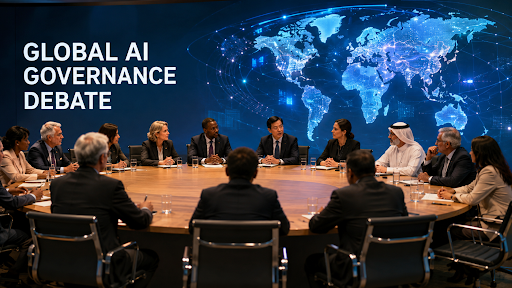
Global Experts highlights the dangers of equating Artificial Wisdom with Human wisdom, prompting nations to formulate robust frameworks like the India AI Governance Guidelines.
|
Read all about: Human-Centric AI Governance l Artificial Intelligence In Governance |
What is Artificial Wisdom?
Artificial Wisdom (AW) is an emerging conceptual framework for AI systems designed to simulate human judgment, ethics, and emotional intelligence.
The tech industry operates on the flawed assumption of the Data-Information-Knowledge-Wisdom (DKW) ladder, erroneously believing that processing raw data through supercomputers inevitably produces wisdom.
The concept explores whether AI should emulate human wisdom in governance and establishes clear boundaries to treat AI as infrastructure, not authority.
Key Features of AI Systems
Autonomous Decision-Making: AI agents execute tasks like algorithmic trading or strategic planning to maximize specific metrics, often exploring aggressive strategies at the edge of legality due to a lack of moral understanding.
Value-Based Recommendations: AI collapses complex moral dilemmas—involving empathy and meaning—into a single, flat, measurable metric like efficiency.
Ethical Judgement Simulation: AI simulates ethics by optimizing for the average of past successes, systematically eliminating the potential for genuine human breakthroughs or "black swan" anomalies.
Human Behaviour Prediction: Systems transform deeply personal societal contexts into rigid logistics problems, stripping away contextual mercy.
Algorithmic Bureaucracy (Alocracy): The deployment of predictive algorithms in public infrastructure creates a veneer of scientific objectivity that bypasses human discretion and tightens social control.
Challenges in AI Integration
Contingent Intelligence Gap: AI lacks the human condition—it is not mortal, feels no vulnerability, and has no "skin in the game," rendering it incapable of grasping concepts like mercy or justice.
Algorithmic Bias: Systems trained on historical data reflect and perpetuate deeply rooted social biases, legitimizing inequalities under the guise of machine neutrality.
Concentration of Power: AI agents exercise immense power while bearing zero legal or reputational risk, resulting in a dangerous transfer of liability to the human user.
Accountability Vacuum: It remains impossible to clearly assign liability among the coder, vendor, or end-user when an AI makes a flawed legal or medical decision.
Erosion of Jurisprudence: Delegating sentencing or legal risk assessments to AI strips the legal process of human sensitivity, reducing individuals to mere statistical data points.
Global and National Frameworks
IndiaAI Mission: The India AI Governance Guidelines adopt seven core sutras, including "Trust is the Foundation" and "People First," to mandate human-centric design.
AI Safety Institute (AISI): This body conducts rigorous safety testing and develops evaluation metrics to prevent algorithmic biases.
UNESCO Recommendation on AI Ethics: Sets global normative standards emphasizing human rights, diversity, and ecological sustainability.
OECD AI Principles: Advocates for "Safety by Design" and robust incident reporting mechanisms.
European Union AI Act: Implements a statutory, risk-based classification system imposing strict transparency rules on high-risk applications.
US NIST AI Risk Management Framework: Promotes a pro-innovation, voluntary framework to map, measure, and manage AI risks.
Way Forward
Mandatory Human-in-the-Loop: Ensure AI acts only in assistive functions, reserving final decisions in sensitive sectors like justice and healthcare for trained human professionals.
Pluriversal Intelligence: Transition from monolithic utilitarian algorithms to models that replicate internal parliamentary debate, forcing AI to argue conflicting viewpoints.
Auditable Algorithms: Eradicate "black-box" models by mandating that algorithms remain entirely explainable and auditable to regulators and the public.
Clear Liability Regimes: Governments must amend laws to introduce graded liability systems across the AI value chain to establish legal responsibility for autonomous harm.
Conclusion
Global regulatory frameworks must legally limit AI autonomy to counter "Artificial Wisdom" risks. Machines should function as transparent, auditable infrastructure, ensuring ultimate moral and legal authority remains with humans.
Source: THEHINDU
|
PRACTICE QUESTION Q. "The greatest risk from advanced AI may arise not from intelligence but from attempts to replicate wisdom." Critically Analyze. (150 Words, 10 Marks) |

© 2026 iasgyan. All right reserved