The UK government announced a comprehensive social media ban for children under 16. Aimed at curbing severe algorithmic harm, cyberbullying, and screen addiction, the policy forces platforms to use strict age verification, sparking intense global privacy debates.
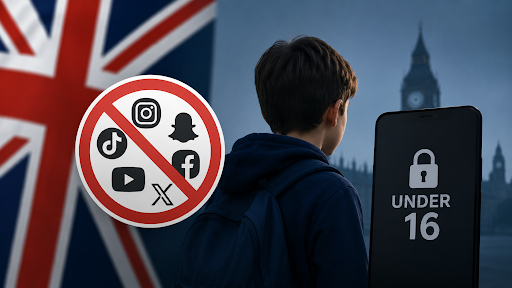
UK Prime Minister Keir Starmer announces ban on social media platforms for children under 16.
|
Read all about: LEGALITY AND FEASIBILITY OF STATE-LED SOCIAL MEDIA BANS l SOCIAL MEDIA REGULATION EXPLAINED |
Age Verification: The government mandates Highly Effective Age Assurance (HEAA) measures, moving beyond simple self-declaration to prevent minors from bypassing platform safeguards.
Platform Restrictions: The ban prohibits under-16s from establishing profiles on major platforms including TikTok, Snapchat, Instagram, YouTube, Facebook, and X.
Livestreaming & AI: The legislation outlaws livestreaming for all under-16s and bans the use of AI "romantic companion" chatbots for individuals under 18 to prevent simulated sexual relationships.
Enforcement Timeline: The communications regulator, Ofcom, oversees the enforcement strategy, with the first targeted protections taking legal effect by Spring 2027.
Mental Health Crisis: Ofcom’s 2025 report reveals that 96% of 13-15-year-olds maintain social media profiles, exposing them to toxic content that correlates with depression and body image dissatisfaction.
Cyberbullying: Algorithmic feeds amplify bullying, with 41% of disabled children aged 8-17 reporting exposure to distressing online material.
Predatory Risks: Digital environments facilitate stranger pairing, exposing minors to grooming, sextortion, and radicalization through multiplayer games and livestreaming features.
Addictive Design: Tech giants utilize infinite scrolling and reward loops to maximize engagement, a practice US courts increasingly identify as deliberately harmful to young users.
Children’s Wellbeing and Schools Act 2026: The government utilizes this act to enact secondary legislation rapidly, granting the Secretary of State power to enforce digital curfews and switch off addictive functionalities.
Online Safety Act (OSA): Passed in October 2023, this act places a legal duty of care on companies to prevent access to pornography and self-harm instructions.
Ofcom Authority: The regulator investigates non-compliant platforms, evidenced by a £950,000 fine issued in May 2026 against a suicide forum linked to over 130 deaths.
Privacy Risks: Critics, including Elon Musk, argue that HEAA measures necessitate mass collection of sensitive identification data, potentially creating a "government surveillance state."
Circumvention: Tech-savvy youth frequently bypass age gates using VPNs, potentially driving them toward darker, encrypted, and less regulated corners of the internet.
Disempowerment: Academics warn that blanket bans isolate marginalized groups, such as LGBTQ+ and neurodiverse youth, who rely on social media for community solidarity and support resources.
The UK's social media ban for under-16s marks a major shift toward strict regulation of Big Tech. Aimed at shielding youth from algorithmic harms, the policy's efficacy depends on reconciling robust age verification with user privacy and the digital rights of vulnerable adolescents.
Source: INDIATODAY
|
PRACTICE QUESTION Q. "A blanket ban on social media for children may offer the illusion of protection but can deepen existing social inequalities and undermine child rights." Critically Analyze. 150 words |
UK Prime Minister Keir Starmer announced the sweeping nationwide ban on June 15, 2026, to protect children's fundamental mental well-being and systematically dismantle the overreaching power of big technology firms over younger generations.
The policy responds to alarming spikes in teenage anxiety and depression caused by addictive design features, cyberbullying, data exposure, and unrestricted stranger contact on user-to-user applications.
The UK communications regulator, Ofcom, will compel tech companies to deploy robust "highly effective age assurance" infrastructure, which leverages facial age estimation software, credit card verification, and localized digital identity checks.
The legislation demonstrates that democratic states must transition from basic content moderation to holding tech firms legally and financially liable via multi-million dollar penalties for failing to keep minors off high-risk platforms.

© 2026 iasgyan. All right reserved