To protect minors from severe digital addiction, cyberbullying, and mental health risks, India is exploring social media regulations. Experts argue against ineffective blanket bans, advocating instead for graded restrictions, strict age checks, robust platform governance, and comprehensive digital literacy programs.

Why In News?
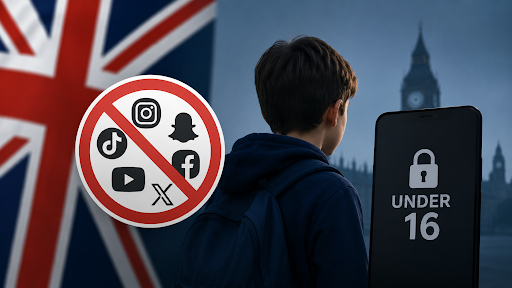
Prime Minister Narendra Modi praised Australia’s legislation banning social media for minors under 16, signaling a potential shift toward "graded" digital restrictions in India.
What is Australia's Social Media Ban?
Australia’s social media ban is a world-first law—the Online Safety Amendment (Social Media Minimum Age) Act—that legally prohibits children under 16 from holding social media accounts.
The law places the burden of enforcement entirely on tech companies, imposing heavy fines (up to ~AUD 50 million) for non-compliance while exempting children and parents from penalties.
Core Features of the Ban
Objectives: The Australian government enacted the ban to shield minors from the negative impacts of social media, such as cyberbullying, exposure to harmful content, and algorithm-driven addiction.
Criticisms: Major tech companies and privacy advocates argue the law may isolate vulnerable teenagers, push them to unregulated parts of the web, and create data privacy risks.
Why Social Media Regulation Become a Global Concern?
Rising Digital Addiction: Digital platforms exploit neurological reward mechanisms via dopamine stimulation, mirroring substance addiction. UNICEF’s 2021 Report notes that post-pandemic screen time surges lead to behavioral instability.
Cyberbullying: The online disinhibition effect empowers anonymous perpetrators, causing severe emotional trauma. The McAfee Cyberbullying in India Survey Report 2022 reveals that over 40% of Indian children experience cyberbullying.
Harmful Content: Unrestricted algorithms expose minors to violence, explicit material, self-harm trends like the Blue Whale Challenge, and online grooming.
Data Exploitation: Platforms harvest personal data for behavioral monitoring and targeted advertising, compromising minors' digital footprints.
Mental Health: A "phone-based childhood" correlates with anxiety and sleep disorders. Pew Research Centre data indicates 42% of teens feel anxious and 25% feel lonely when separated from their smartphones.
What is India's Current Regulatory Framework for Child Online Safety?
Information Technology Act, 2000: Penalizes identity theft (Section 66C), electronic fraud (Section 66D), and the publication of obscene material (Section 67).
Digital Personal Data Protection Act, 2023: Defines a "child" as anyone under 18. Section 9 mandates verifiable parental consent and prohibits behavioral monitoring or targeted advertising, with penalties reaching ₹250 crore.
POCSO Act, 2012: Provides safeguards against digital sexual abuse, online grooming, and child pornography.
IT Rules, 2021: Imposes due diligence on intermediaries to remove harmful content and maintain grievance redressal mechanisms.
NEP 2020: Integrates digital ethics and critical media consumption into school curricula to empower young users.
What are the Arguments in Favour of Restricting Social Media Access for Minors?
Protection from Harm: Shields immature users from cyber predators and coordinated harassment.
Mental Health: Reduces screen time to mitigate insomnia and aggression, aligning with World Health Organization guidelines on sedentary behavior.
Algorithmic Control: Severs connections to "endless scroll" mechanics and loot-box gaming. A tragic case in Ghaziabad involving three sisters highlights the dangers of unregulated online gaming addiction.
Academic Performance: Minimizes distractions to restore cognitive patience and focus.
Privacy: Enforces the "right to an open future" by preventing the accumulation of permanent digital footprints.
What are the Concerns Regarding Such Restrictions?
Age Verification: Simple checkboxes fail, while linking IDs like Aadhaar or DigiLocker creates implementation hurdles.
Privacy Risks: Mandating government IDs for verification risks mass surveillance and data breaches.
Digital Divide: Blanket bans restrict access to creative expression and educational resources, potentially marginalizing students.
Enforcement: Jurisdictional issues, encryption, and a lack of technical expertise make policing difficult.
Circumvention: Tech-savvy adolescents bypass bans using VPNs, fake identities, or unregulated dark-web platforms.
What Could Be India's Balanced Approach?
Graded Governance: Adopt age-cohort models (e.g., restricted access under 13, guided access 13-16) rather than uniform bans.
Parental Controls: Embed verifiable parental consent architectures directly into account creation processes.
Platform Standards: Force tech giants to implement "safety-by-design," default to high privacy settings, and ensure algorithm transparency.
Digital Literacy: Launch nationwide campaigns to educate children, parents, and teachers on safe navigation.
AI-Driven Detection: Mandate intermediaries to deploy AI filters that detect deepfakes, grooming, and self-harm content.
Legal Balance: Utilize the Doctrine of Parens Patriae to balance Article 19(1)(a) (Freedom of Speech) and Article 21 (Right to Mental Wellbeing) without resorting to unconstitutional paternalism.
India must replace easily circumvented blanket bans with stringent platform governance, mandatory verifiable parental consent, and robust digital literacy programs to truly safeguard youth from the attention economy.
Source: THEHINDU
|
PRACTICE QUESTION Q. "The rapid expansion of social media has created new opportunities as well as significant risks for children." Examine. (250 Words, 15 Marks) |
Australia enacted the Online Safety Amendment Act 2024 to block children under 16 from social media to protect them from the adverse mental health impacts of digital addiction, cyberbullying, and exposure to harmful algorithms.
Section 9 of the DPDPA 2023 mandates that tech platforms must obtain verifiable parental consent before processing the data of anyone under 18. It strictly prohibits tracking children's behavior or targeting them with personalized advertisements.
A blanket ban is difficult to enforce due to technological circumventions like VPNs and fake IDs. Furthermore, it risks violating children's digital participation rights and restricting access to vital educational networks. Experts suggest platform governance and graded restrictions are more effective.
Excessive use stimulates dopamine responses causing addiction. It leads to severe anxiety, sleep deprivation, shortened attention spans, and depression due to cyberbullying and unrealistic social comparisons.


© 2026 iasgyan. All right reserved