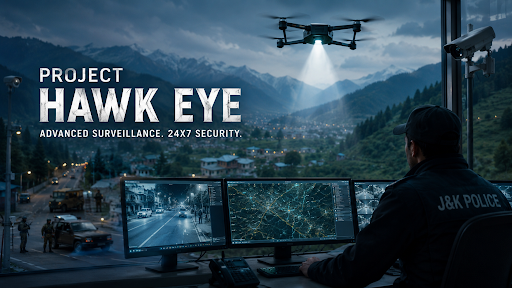
Project Hawk Eye is a comprehensive, technology-driven security initiative by the J&K Police for the 2026 Amarnath Yatra. Utilizing AI, drones, Facial Recognition Systems (FRS), 416 CCTVs, and sniper teams, it establishes a foolproof, predictive security grid in the Himalayas.
Why In News?
The Jammu and Kashmir Police launches Project Hawk Eye, an AI-driven surveillance framework, to secure the Shri Amarnath Ji Yatra.
What is Project Hawk Eye?
Background: The government shifts from manual policing to a technology-linked security cover to mitigate vulnerabilities from cross-border terrorism and rugged terrain, following historical tragedies like the 2017 terror attack and the 2000 massacre.
Objectives: The project ensures continuous, round-the-clock vigilance, enables early detection of suspicious activities for rapid response, and optimizes crowd management for thousands of devotees.
Technology Framework: It fuses high-altitude aerial tracking with ground-level biometrics, utilizing portable RCIED jammers, deep search metal detectors, and non-linear junction detectors (NLJDs).
Multi-Agency Coordination: The project acts as a technological backbone, unifying the Central Reserve Police Force (CRPF), Border Security Force (BSF), ITBP, Army, and local police into a cohesive response grid.
Key Features of Project Hawk Eye
AI-Based Surveillance: Agencies integrate Facial Recognition System (FRS) software at critical choke points to cross-reference traveler profiles and flag blacklisted entities in real-time.
Drone Monitoring: Authorities deploy five dedicated drone units at strategic locations to feed live aerial footage to command centers.
Real-Time Intelligence: A network of 416 high-resolution CCTV cameras provides continuous ground-level tracking across sensitive transit sections.
Integrated Command and Control: Joint Control Rooms centralize data feeds to manage traffic, medical services, and quick response teams.
Machan Morchas and Snipers: Police establish 28 'Machan Morchas' for elevated observation and deploy 22 specialized sniper teams for high-altitude counter-terror cover.
Digital Identity Verification: The "Pahchan App" utilizes QR-based technology to verify and track workers and vendors, effectively eliminating infiltration risks.
Role of Technology in Internal Security
Predictive Surveillance: AI and FRS shift the security paradigm from reactive to predictive, neutralizing threats before they materialize.
Threat Detection: Forces utilize X-Ray Baggage Inspection Systems (XBIS), contraband busters, and explosive detectors to scan all luggage and vehicles.
Emergency Response: Real-time drone feeds assist Mountain Response Teams (MRTs) in conducting weather-based evacuations and medical rescues.
RFID and GPS Tracking: The Shri Amarnathji Shrine Board employs Radio Frequency Identification (RFID) and GPS-based tracking to monitor pilgrim convoys and prevent individuals from going missing.
Source: DDNEWS
|
PRACTICE QUESTION Q. Consider the following statements regarding 'Project Hawk Eye', recently seen in the news: 1. It is a technology-driven surveillance initiative launched by the Jammu and Kashmir Police to secure the Shri Amarnath Ji Yatra. 2. The project exclusively uses human intelligence and explicitly bans the use of Facial Recognition Systems (FRS) due to privacy concerns. 3. It involves the deployment of 'Machan Morchas' which are elevated observation posts at vulnerable locations. Which of the statements given above is/are correct? A) 1 only B) 1 and 3 only C) 2 and 3 only D) 1, 2, and 3 Answer: B Explanation: Statement 1 is correct: Project Hawk Eye is a comprehensive, technology-driven security and surveillance initiative launched by the Jammu and Kashmir Police to secure the Shri Amarnath Ji Yatra. Statement 2 is incorrect: The project does not exclusively rely on human intelligence, nor does it ban Facial Recognition Systems (FRS). Instead, it integrates advanced technology, including CCTV networks, drones, and Facial Recognition Systems (FRS) to cross-reference traveler profiles and flag suspicious activities in real-time. Statement 3 is correct: The security framework involves the deployment of 28 'Machan Morchas,' which are strategically established elevated observation posts set up at vulnerable and sensitive locations to strengthen area domination. |
Project Hawk Eye is an advanced, technology-linked security and multi-layered surveillance framework launched by the Jammu and Kashmir Police in Anantnag district to maintain round-the-clock vigilance from air to ground.
The project is highly critical to safeguard vulnerable religious transit corridors during the 2026 pilgrimage by eliminating blind spots across difficult Himalayan terrain, securing crowd management, and facilitating rapid response against terror threats.
AI drives security management by powering Facial Recognition System (FRS) software across 416 high-resolution cameras to instantly flag blacklisted entities, while automating continuous threat detection through real-time feeds from an aerial grid of five advanced drone units.
The primary limitations include severe signal dropouts caused by volatile mountain weather, physical damage to hardware from extreme sub-zero temperatures, high operational costs of processing continuous HD data feeds in remote locations, and potential vulnerabilities to cyber jamming or spoofing.

© 2026 iasgyan. All right reserved