BGP Hijacking occurs when a rogue Autonomous System falsely advertises internet routes, redirecting traffic for espionage, data theft, or censorship. Highlighted by the recent India-Telegram incident, mitigating this core vulnerability requires global cooperation and the universal adoption of cryptographic frameworks like RPKI.
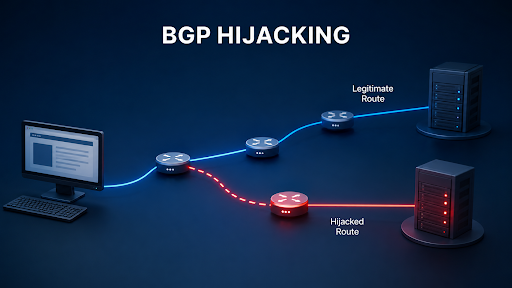
The recent temporary block on Telegram in India triggered a global internet disruption, highlighting Border Gateway Protocol (BGP) hijacking as a critical cybersecurity vulnerability.
BGP functions as the internet’s global map, directing data traffic across interconnected networks.
Without BGP, individual networks fail to determine data packet destinations, rendering global connectivity impossible.
The protocol dictates how Internet Service Providers (ISPs) and enterprises exchange route information to identify the most efficient data paths.
The system relies on implicit trust, where networks automatically accept routing paths without built-in cryptographic authentication.
The internet partitions into thousands of independent network blocks called Autonomous Systems (AS), each identified by a unique Autonomous System Number (ASN).
BGP Hijacking involves a network operator falsely advertising IP address space it does not legally own, confusing the global routing directory.
Accidental vs Malicious: Operators cause accidental hijacks through configuration errors (route leaks), while attackers execute malicious hijacks to steal data, hold networks hostage, or conduct state-level espionage.
Mechanism: Attackers inject highly specific false announcements, exploiting BGP algorithms that prioritize the most specific IP prefixes or shortest paths.
Traffic Redirection: Upstream transit providers blindly accept false map entries, funneling traffic into rogue networks where operators deploy Man-in-the-Middle (MitM) mechanisms to inspect or log unencrypted data.
Service Disruptions: Operators execute Traffic Blackholing by dropping diverted packets, causing immediate Denial of Service (DoS).
Data Theft: Cybercriminals expose personal information and execute large-scale extortion against enterprises.
Surveillance Risks: State actors leverage hijacked traffic to conduct silent, untraceable surveillance of foreign citizens and governments.
Financial Losses: Misdelivery of traffic undermines IP-address-based reputation systems and disrupts security-critical financial transactions.
Source: INDIANEXPRESS
|
PRACTICE QUESTION Q. Consider the following statements regarding the Border Gateway Protocol (BGP) and Internet routing:
Which of the statements given above are correct? (a) 1 and 2 only (b) 2 and 3 only (c) 1 and 3 only (d) 1, 2, and 3 Answer: (b) Explanation: Statement 1 is incorrect: The original Border Gateway Protocol (BGP) was built on mutual trust and does not inherently require cryptographic authentication. By default, routers blindly accept routing announcements from neighboring networks. Cryptographic security mechanisms (like BGPsec) are add-ons that are not universally deployed across the entire internet. Statement 2 is correct: BGP path selection favors the longest matching IP prefix (the most specific route) and the shortest AS path. Malicious actors exploit this by announcing highly specific (e.g., smaller) subnets or faking short paths to trick other networks into misrouting traffic (a technique known as BGP hijacking). Statement 3 is correct: The Resource Public Key Infrastructure (RPKI) framework solves BGP's trust issue by employing Route Origin Authorizations (ROAs). A ROA functions like a digital certificate that proves an Autonomous System (AS) is officially authorized by the IP address owner to announce a specific IP prefix. |
BGP hijacking occurs when a malicious or misconfigured Autonomous System (AS) illegitimately broadcasts IP prefix ownership, tricking global routing directories into misdirecting internet traffic through an incorrect network path.
The Border Gateway Protocol (BGP) operates as the core postal system of the internet by exchanging routing and reachability maps between massive, independent network blocks called Autonomous Systems to find the most efficient path for data travel.
BGP is inherently vulnerable because it was designed around implicit trust without built-in cryptographic authentication, meaning networks automatically accept and propagate unverified path advertisements from neighboring routers.
Network administrators prevent route hijacking by deploying Resource Public Key Infrastructure (RPKI) for cryptographic origin validation, enforcing strict Internet Routing Registry (IRR) prefix filtering, and maintaining continuous, real-time BGP route monitoring systems.

© 2026 iasgyan. All right reserved