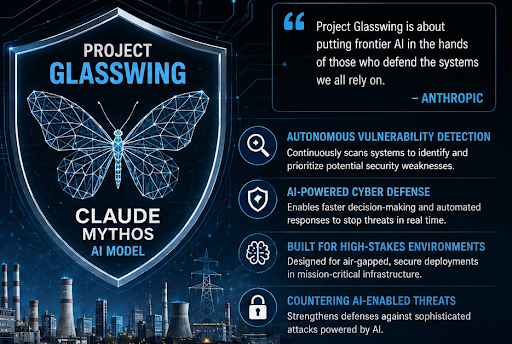
Anthropic launched Project Glasswing to secure critical infrastructure using the Claude Mythos AI model. It grants select organizations, including Indian agencies, access to advanced AI for autonomous vulnerability detection and cyber defense, significantly countering rapid AI-enabled cyber threats
Why In News?
Anthropic expands its global cybersecurity initiative, Project Glasswing, to India, granting key agencies access to its advanced Claude Mythos Preview AI model to secure critical digital infrastructure.
What is Project Glasswing?
Anthropic launches Project Glasswing as a global cybersecurity initiative in partnership with a coalition of Western tech giants, including AWS, Google, and Microsoft.
The program grants vetted organizations strictly controlled access to an unreleased, highly advanced frontier AI model named Claude Mythos Preview.
The initiative expands to India and 15 other nations, encompassing nearly 150 organizations that manage critical infrastructure such as power, water, telecom, and healthcare.
Indian state agencies—such as CERT-In, NCIIPC, I4C, and the Digital Intelligence Platform (DIP)—actively participate in this framework to test and fortify India's Digital Public Infrastructure (DPI)
Objectives of Project Glasswing
The initiative secures global open-source software and digital networks against sophisticated, AI-enabled cyber threats.
Claude Mythos autonomously hunts and remediates complex zero-day vulnerabilities overnight, long before malicious actors can exploit them.
The project fosters inter-agency collaboration, bringing together governments, researchers, and tech vendors to build a Total Resilience operating model.
The program spurs global institutions to develop new operating norms and upgrade defenses in response to the rapid emergence of cheap, fast AI models possessing offensive cyber capabilities.
Role of Artificial Intelligence in Cybersecurity
Artificial Intelligence (AI) plays a dual role in cybersecurity, acting as both a powerful defense mechanism and a tool for advanced cyber threats.
Defensive AI
AI enables organizations to move from reactive security to proactive, automated defense.
Offensive AI
While AI strengthens defense, cybercriminals also leverage machine learning to bypass traditional security.
Conclusion
Integrating advanced frontier AI models like Claude Mythos into national cybersecurity frameworks ensures proactive defense mechanisms against rapidly evolving, automated cyber threats.
Source: INDIANEXPRESS
|
PRACTICE QUESTION Q. With reference to "Project Glasswing", recently seen in the news, consider the following statements:
Which of the statements given above is/are correct? (a) 1 only (b) 2 only (c) Both 1 and 2 (d) Neither 1 nor 2 Answer: (b) Explanation: Statement 1 is incorrect: Project Glasswing is not an initiative of the Indian government. It is a collaborative global cybersecurity initiative launched by the AI company Anthropic, which provides controlled access to advanced AI tools to safeguard critical software. Statement 2 is correct: Project Glasswing provides vetted organizations with access to Anthropic's Claude Mythos AI model to help identify critical software vulnerabilities. The program has been expanded to organizations globally, including key Indian critical infrastructure and cybersecurity agencies. |
Project Glasswing is a restricted global initiative led by Anthropic that grants vetted nations and corporations access to the powerful Claude Mythos AI model to detect and fix critical software vulnerabilities before hackers exploit them.
The initiative deploys frontier AI to autonomously scan vast codebases, having already identified over 10,000 high-severity security flaws in major operating systems and browsers that human auditors missed for decades.
The primary danger lies in the dual-use nature of these models, as the same speed and precision used to patch systems can be weaponized by adversaries to discover zero-day exploits and launch automated, large-scale cyberattacks.
Cyber resilience is non-negotiable because AI-driven threats now target "national survival infrastructure"—such as power grids, banking networks, and telecom systems—where a single breach could instantly paralyze an entire country's economy.

© 2026 iasgyan. All right reserved