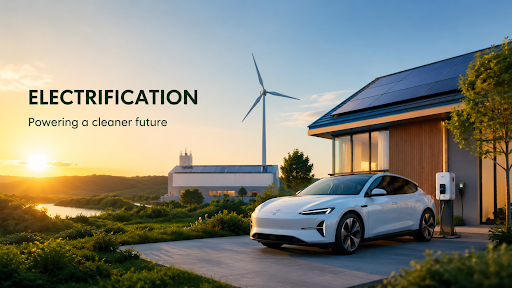
Electrification replaces fossil-fuel combustion with clean electricity to drastically cut greenhouse gas emissions. While electric vehicles and heat pumps offer immense efficiency gains, achieving global climate goals requires overcoming severe grid bottlenecks, scaling battery storage, and securing critical mineral supply chains.
Why In News?
According to the International Energy Agency (IEA), global emissions hit a record 38.2 gigatonnes in 2024, requiring rapid electrification in industry, transport, and buildings to achieve COP28 renewable targets and Net Zero by 2050.
What is Electrification?
Systemic Transformation: Electrification replaces diffuse fossil-fuel combustion sources, such as vehicle tailpipes and industrial stacks, with a power system driven by clean electricity, green hydrogen, and modern bioenergy.
The Age of Electricity: Electricity currently accounts for 20% of global energy consumption; however, meeting Net Zero Emissions (NZE) goals requires this share to rise to 40% by 2040 and 55% by 2050.
Bypassing the Fossil: India leverages cheap electrotech, specifically solar and batteries, to transition directly to an electricity-dominated system, avoiding the coal-heavy industrialization path taken by other nations.
Peak Fossil Fuel: Under the NZE Scenario, fossil fuel use in power generation drops from 60% today to less than 40% by 2035 and approximately 20% by 2050.
Emissions Reduction Lever: Electrifying end-use sectors, which account for over half of total energy-related CO2 emissions, delivers nearly 40% of the required emissions reductions by 2050.
|
India's Electrification Journey Universal Access: India achieved universal household electricity access in 2021 via the Saubhagya Scheme. Electric Mobility: The PM E-DRIVE scheme (outlay of Rs 10,900 crore) accelerates adoption for 2-wheelers, 3-wheelers, and e-buses. Renewable Milestones: India met its target of 50% non-fossil electric power capacity by 2030 five years early, in 2025. Prosumer Growth: The PM Surya Ghar Scheme targets 30 GW of rooftop solar across 1 crore households. Efficiency Programs: The UJALA and PAT (Perform, Achieve and Trade) schemes aggressively reduce industrial emission intensities. |
Why is Electrification Important for Climate Goals?
Reducing Greenhouse Gas Emissions: Low-emissions technologies deployed since 2019 already prevent 2.6 Gt CO2 annually.
Grid Carbon Intensity: India aims to reduce its grid emission factor from 0.71 kgCO₂/kWh in 2025 to near zero in the 2060s.
Supporting Renewable Energy Integration: Electrification creates the demand to absorb the massive influx of Variable Renewable Energy (VRE) required to meet the COP28 target of tripling renewable capacity by 2030.
Improving Energy Efficiency: Electric vehicles (EVs) use 70-80% less energy than internal combustion engines, while heat pumps operate at three-to-five times the efficiency of gas boilers.
|
Implications for Energy Security Economic Resilience: Transitioning to electrotech curtails India’s dependency on oil (89% imports) and gas (47% imports), with projected savings of 0.5% of GDP by 2050–2070. Strategic Autonomy: Domestic renewable power insulates the economy from global fossil fuel price volatility. Managing New Dependencies: Establishing domestic manufacturing via Production-Linked Incentive (PLI) schemes is mandatory to secure supply chains for battery cells and critical minerals. |
Sectors Requiring Electrification
Transport Sector: The global EV fleet expands more than sixfold by 2035, avoiding over 10 million barrels per day (mb/d) of oil demand. India targets a 100% electrified broad-gauge railway network by 2030.
Industrial Sector: Non-energy-intensive industries deploy Industrial Heat Pumps (IHPs) to save energy, while hard-to-abate sectors like steel and cement utilize Green Hydrogen and iron ore electrolysis for high-temperature heat.
Buildings and Heating: Rising cooling demand adds 330 GW to global peak electricity demand by 2035, while heat pumps increase their share in space heating from 12% today to 45% by 2050.
Agriculture: Programs like PM-KUSUM promote solar feeders and mini-grids to reduce reliance on diesel generators.
Challenges to Rapid Electrification
Investment Mismatch: Global grid spending lags at USD 400 billion, less than half of the USD 1 trillion invested annually in electricity generation.
Grid Modernisation: Global grids must expand by 30% (adding 25 million km) by 2035, while 2,800 GW of renewable projects currently face delays due to unavailable grid connections.
Critical Mineral Dependence: Scaling batteries requires vast volumes of lithium, cobalt, nickel, neodymium, and dysprosium, creating supply chain vulnerabilities.
Supply Chain Bottlenecks: Lead times for power transformers and high-voltage cables have doubled, with HVDC system wait times extending into the 2030s.
Financing and Permitting: Developing nations face high costs of capital, while fragmented planning and slow environmental clearances delay transmission line construction.
Demand Flexibility: Systems must manage a two-to-tenfold increase in short-term flexibility requirements by 2035 to prevent blackouts.
Way Forward
Digitalization: Implement AI-based predictive maintenance, "digital twins," and smart meters to manage bi-directional flows.
Energy Storage: Combine hybrid solar-wind projects with Pumped Hydro and BESS for round-the-clock clean energy.
Demand Response: Operationalize the Unified Energy Interface (UEI) to enable smart appliances to shift consumption to off-peak periods.
Just Transition: Execute massive workforce reskilling programs in coal-dependent districts to shift labor into renewable and EV sectors.
Circular Economy: Enforce Extended Producer Responsibility (EPR) to create recycling ecosystems for batteries and solar panels.
Conclusion
To prevent catastrophic climate change, nations must reconstruct energy architectures by expanding grid infrastructure and leveraging systemic electrification's efficiency.
Source: INDIANEXPRESS
|
PRACTICE QUESTION Q. Consider the following statements regarding the role of Electrification in achieving Global Climate Goals:
Which of the statements given above is/are correct? A) 1 and 2 only B) 2 and 3 only C) 1 and 3 only D) 1, 2, and 3 Answer: D Explanation: Statement 1 is correct: According to the International Energy Agency (IEA), electric vehicles use about 70-80% less energy overall (from well-to-wheel) compared to equivalent internal combustion engine vehicles. Statement 2 is correct: At the COP28 climate summit in 2023, nearly 200 nations signed the Global Renewables and Energy Efficiency Pledge, committing to triple global installed renewable energy capacity to at least 11,000 GW by 2030. Statement 3 is correct: India achieved its Nationally Determined Contribution (NDC) target of having 50% of its cumulative electric power installed capacity come from non-fossil fuel sources in mid-2025, five years ahead of its original 2030 schedule. |
Electrification is critical because it replaces fossil-fuel combustion with clean electricity across cars, homes, and factories, serving as the single most viable pathway to cap global warming at 1.5°C and meet global net-zero emissions targets.
Electrification cuts emissions by substituting highly efficient electric drivetrains and heat pumps for internal combustion engines and gas boilers, drastically reducing carbon output as the underlying electricity grid transitions to renewable energy sources like wind and solar.
The sectors requiring urgent electrification are transportation (via electric vehicles), building systems (via electric water and space heating), and low-to-medium temperature manufacturing industries (via electric arc furnaces and industrial heat pumps), which combined generate the vast majority of global greenhouse gases.
The main hurdles include severe transmission grid capacity constraints, high upfront capital costs for retrofitting older industrial systems, a lack of raw materials for large-scale battery storage, and the technical difficulty of electrifying hard-to-abate sectors like aviation, heavy shipping, and high-heat steel manufacturing.

© 2026 iasgyan. All right reserved