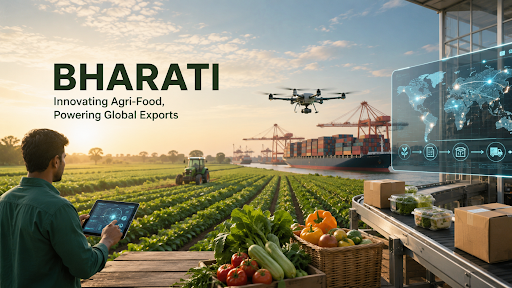
APEDA’s BHARATI programme successfully trained 100 startups to accelerate India's agri-food exports. The initiative integrates tech-driven solutions to overcome SPS compliance challenges, promotes high-value GI-tagged products, and aims to achieve India’s USD 50 billion agricultural export target by 2030.
Why In News?
The Agricultural and Processed Food Products Export Development Authority (APEDA) concludes the inaugural cohort of the BHARATI (Bharat's Hub for Agritech, Resilience, Advancement and Incubation for Export Innovation) programme.
What is the BHARATI Programme?
Core Vision: The programme operates under the 'Farm to Foreign' agenda, aiming to cultivate an export-first mindset among young entrepreneurs to support the Make in India for the World and Atmanirbhar Bharat missions.
Strategic Objectives: APEDA targets USD 50 billion in agri-food exports by 2030 through this initiative.
Key Goals: The programme catalyzes innovation in GI-tagged products, organic foods, and superfoods, while mitigating Sanitary and Phytosanitary (SPS) risks to meet global safety standards.
Implementation: APEDA, a statutory body under the Ministry of Commerce and Industry, funds and implements the initiative to institutionalize a replicable export incubation model.
Key Features of the Programme
Export Readiness Training: Startups complete a 120-hour acceleration curriculum covering product development, regulatory compliance, smart packaging, and sustainability benchmarks.
Market Access Support: APEDA facilitates international exposure, notably taking top startups to Gulfood 2026 in Dubai, where they conducted over 100 high-value B2B meetings within the USD 8.5 trillion global food market.
Capacity Building: The programme creates a dynamic ecosystem connecting Farmer Producer Companies (FPCs), tech-driven solution providers, and academic institutions like IITs and NITs to navigate Technical Barriers to Trade (TBT).
Mentorship: Industry experts provide 1-to-1 mentorship and masterclasses to refine business models, pitch decks, and investor readiness.
Importance for India's Export Sector
Diversification: The initiative shifts focus from bulk commodities to high-value processed foods, including AYUSH products, millets (Shree Anna), and plant-based alternatives.
MSME Empowerment: The programme supports entrepreneurs aged 17 to 75, filling critical incubation gaps. For example, a Karnataka-based startup exported 40 MT of GI-tagged Indrayani rice and pulses to the UAE and EU markets.
Technological Integration: Startups leverage Artificial Intelligence (AI), Internet of Things (IoT), and Blockchain to optimize cold chains and ensure product traceability.
About APEDA
APEDA (Agricultural and Processed Food Products Export Development Authority) is a statutory body under the Ministry of Commerce and Industry.
Established in 1985, it is responsible for developing, promoting, and regulating the export of designated agricultural and processed food items—known as "scheduled products"—from India.
Nodal Ministry: Ministry of Commerce & Industry.
Headquarters: New Delhi, with regional offices across India’s major agro-potential states.
Composition: It consists of a Chairman appointed by the Central Government, Members of Parliament, and representatives from relevant ministries, Niti Aayog, and state governments.
Core Functions & Responsibilities
Export Promotion: Develops industries relating to scheduled products and offers financial assistance, market intelligence, and global branding to exporters.
Registration of Exporters (RCMC): Issues mandatory Registration-cum-Membership Certificates (RCMC) to businesses exporting scheduled commodities.
Setting Quality Standards: Fixes mandatory specifications and enforces international sanitary and phytosanitary (SPS) measures.
Organic Certification: Functions as the official Secretariat for the National Accreditation Board (NAB), regulating the certification of organic products under the NPOP (National Programme for Organic Production).
Key Covered Products (Scheduled Products)
APEDA does not cover all agricultural products (for example, tea, coffee, rubber, and spices are handled by separate boards). APEDA's primary list includes:
Source: NEWSONAIR
|
PRACTICE QUESTION Q. Consider the following statements regarding the 'BHARATI' Initiative: 1. It is a programme launched by the Ministry of Agriculture and Farmers Welfare. 2. It provides financial grants to large corporate food processors to expand European market access. 3. It aims to integrate technologies like Blockchain and IoT to mitigate Sanitary and Phytosanitary (SPS) challenges in exports. Which of the statements given above is/are correct? (a) 1 and 2 only (b) 3 only (c) 2 and 3 only (d) 1, 2, and 3 Answer: (b) Explanation: Statement 1 is incorrect. The initiative was launched by the Agricultural and Processed Food Products Export Development Authority (APEDA), which functions under the Ministry of Commerce and Industry, not the Ministry of Agriculture and Farmers Welfare. Statement 2 is incorrect. The programme focuses on supporting and empowering agri-food startups, not large corporate food processors. Its specific target is to identify and accelerate a cohort of 100 startups to boost exports. Statement 3 is correct. The initiative explicitly aims to integrate advanced technologies such as Blockchain (for traceability), IoT (for supply chain monitoring), and AI to address export challenges, specifically including Sanitary and Phytosanitary (SPS) risks and compliance barriers. |




© 2026 iasgyan. All right reserved