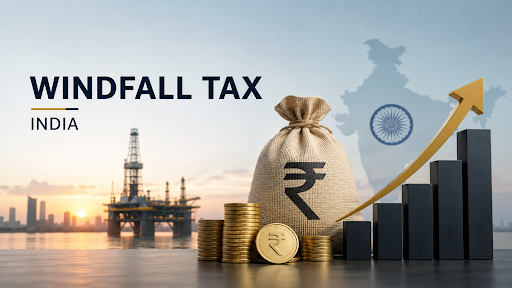
A windfall tax (SAED) targets supernormal corporate profits arising from external crises. Recently hiked to ₹14/litre on diesel, India utilizes this tool to stabilize domestic fuel supplies, offset excise cuts, and curb inflation amidst the 2026 global energy crisis.
Why In News?
The Indian Government raises the Special Additional Excise Duty (SAED) on diesel exports to ₹14 per litre and Aviation Turbine Fuel (ATF) to ₹12.5 per litre, effective June 16, 2026.
What is Windfall Tax?
A Windfall Tax represents a higher tax rate that the government levies on specific industries experiencing sudden, unexpected, and "supernormal" profits.
Implementation: Indian authorities implement this mechanism through the Special Additional Excise Duty (SAED).
Core Objective: The state redistributes "unearned" excess profits from corporations to the public exchequer to fund social welfare and control inflation.
Extraordinary Profits: These gains stem from external shocks—such as geopolitical tensions or global supply chain disruptions—rather than internal corporate efficiency or innovation.
International Precedents: The European Union utilized Regulation 2022/1854 during the 2022-2023 energy crisis, imposing a 33% solidarity contribution on fossil fuel surplus profits.
Windfall Tax in India
India launched the windfall tax in 2022 to mitigate the surge in global fuel prices following the Russian invasion of Ukraine.
Review Mechanism: The government employs a dynamic fortnightly review to recalibrate tax rates based on international crude oil trends and refining margins.
Crude Oil Production: While the 2022 regime taxed domestic crude production up to ₹23,250 per tonne, the current 2026 regime sets this levy to zero to encourage upstream exploration by firms like ONGC and Vedanta.
Why Does the Government Impose Windfall Tax?
Capturing Extraordinary Gains: The government claims a share of "supernormal" refining margins (cracks) inflated by instability in the Strait of Hormuz.
Revenue Generation: The tax recovers the estimated ₹7,000 crore revenue hole created when the government slashes domestic excise duties to shield citizens from price shocks. The export tax generates approximately ₹1,500 crore per fortnight.
Consumer Price Stabilization: High export taxes make overseas sales less lucrative, forcing private refiners like Reliance Industries and Nayara Energy to prioritize the domestic market, thereby preventing local fuel shortages.
Impact on Oil Companies
Refining Margins: The tax directly lowers profit margins for downstream oil marketing and refining companies by capturing premiums generated by geopolitical events.
Export Competitiveness: The ₹14/litre burden undermines Indian refiners, making their products less competitive against unburdened Middle Eastern rivals in Asian and European markets.
Investment Uncertainty: Frequent rate adjustments create policy unpredictability, which deters Foreign Direct Investment (FDI) and delays capital-intensive capacity expansion projects.
Impact on the Economy
Fiscal Revenue: The tax functions as a fiscal stabilizer, channeling corporate wealth into the exchequer to sustain energy subsidies without widening the fiscal deficit.
Inflation Management: By restricting private refiners from chasing international prices, the tax ensures steady domestic supply, effectively curbing imported inflation.
Energy Security: The tax builds a firewall against maritime disruptions in the Strait of Hormuz, ensuring India retains adequate strategic reserves of diesel and aviation fuel.
Source: MONEYCONTROL
|
PRACTICE QUESTION Q. Consider the following statements regarding the 'Windfall Tax' imposed in India:
Which of the statements given above is/are correct? A) 1 only B) 2 only C) Both 1 and 2 D) Neither 1 nor 2 Answer: B Explanation: Statement 1 is incorrect: A windfall tax is levied to tax sudden, extraordinary profits resulting from external global conditions (such as geopolitical tensions or supply chain disruptions), not from a company's internal technological innovations. Statement 2 is correct: The tax rates on petroleum exports and crude oil in India are reviewed and revised on a fortnightly basis, depending on international crude oil prices and refining margins. |
A windfall tax is a higher, targeted tax rate that governments levy on an industry or company experiencing a sudden, massive surge in unearned profits due to unexpected external market conditions rather than corporate expansion.
India imposes this tax to recoup hyper-normal profits from domestic crude oil producers and fuel exporters who rake in extraordinary margins from global supply crises while consumers face steep energy inflation.
The levy directly reduces the net profit margins and short-term stock valuations of domestic extraction and refining giants like ONGC and Reliance Industries by diverting their sudden cash surpluses into the government treasury.
The tax successfully generates vital non-tax state revenue to fund public welfare subsidies, but it simultaneously discourages long-term private capital investments in high-risk domestic oil exploration due to policy unpredictability.





© 2026 iasgyan. All right reserved