India amended the FDI policy under Press Note 3 (2020), defining “beneficial ownership” as per PMLA Rules, allowing up to 10% non-controlling investments via the automatic route, and introducing a 60-day fast-track approval for key manufacturing sectors to balance national security with economic growth and support Make in India.
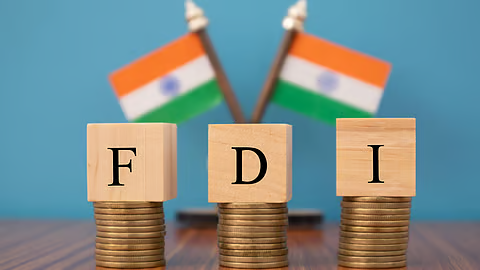
Copyright infringement not intended
Picture Courtesy: FORTUNEINDIA
Context
The Union Cabinet relaxed certain provisions of Press Note 3 (2020), which requires government approval for investments from India's land-border sharing neighbors like China.
|
Read all about: Why Net FDI Falling in India? Explained l India 15th in Global FDI Rank |
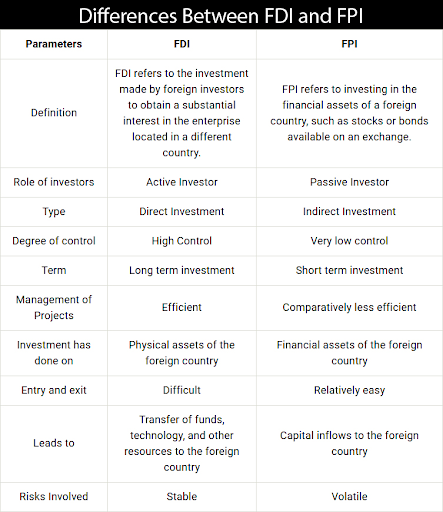
What is Foreign Direct Investment (FDI)?
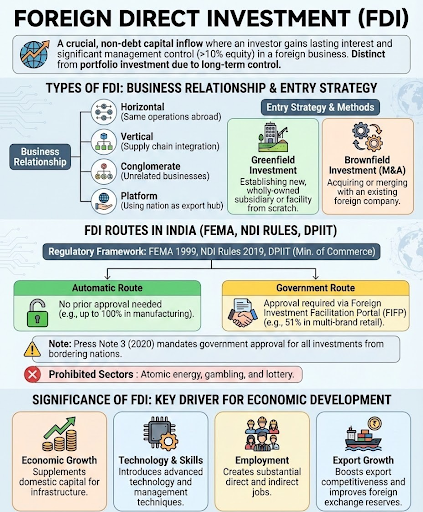
FDI is a long-term investment made by an individual or entity from one country into a business based in another country, to establish a lasting interest and management control.
Core Components
FDI is comprised of three primary financial elements:
Major Types of FDI
Entry Strategies
FDI Routes in India
Automatic Route: No prior government or RBI approval is required for the investment; the investor only needs to notify the authorities after the transaction.
Government Route: Prior approval from the relevant Ministry or Department is mandatory, especially for sensitive sectors or investments from countries sharing a land border with India; introduced in 2020 by Press Note 3.
Why was Press Note 3 (2020) Introduced?
Press Note 3 was a strategic policy measure introduced in 2020 during the COVID-19 pandemic, to curb "opportunistic takeovers" of Indian companies whose valuations had fallen due to the economic crisis.
The policy mandated that any FDI from countries sharing a land border with India (including China, Pakistan, Bangladesh, etc.) must receive prior government approval.
What Challenges Are Created by the Original PN3 Framework?
Decline in Capital Inflows
Structural Break in FDI
Post-PN3, cumulative FDI inflows from China and Hong Kong dropped from nearly $7 billion (2000–2020) to under $450 million between 2021 and 2025. (Source: Alvarez & Marsal)
Stalled Growth for Startups
Many Indian startups and smaller enterprises, which previously relied heavily on Chinese venture capital, now face funding shortages and valuation pressures.
Operational and Procedural Bottlenecks
High Rejection Rates
Out of 526 total proposals received since the policy's inception, only 124 were approved while 201 were outright rejected. (Source: SNR Law)
Transparency Gaps
There is a lack of public data regarding the rationale for rejections, making it difficult for investors to make informed future applications. (Source: SNR Law)
Legal and Regulatory Ambiguities
Undefined "Beneficial Owner"
The framework does not clearly define what constitutes a "beneficial owner," leading to subjective interpretations and legal uncertainty for global funds with complex investor bases.
Overreach into Indirect Transfers
The policy currently regulates indirect offshore transfers that have no direct impact on the Indian entity, obstructing routine global corporate restructurings.
Supply Chain and Strategic Risks
Missing Global Value Chain Integration
Rigidity in PN3 caused India to miss opportunities to become a preferred node in global supply chains as Southeast Asian competitors more actively attract Chinese capital for electronics and EV assembly.
Difficulty in Tech Transfers
Barriers to minority-stake investments have slowed the acquisition of specialized manufacturing technologies required for "Atmanirbhar Bharat" goals.
Key Features of the Recent Amended FDI Policy
Clear Definition of 'Beneficial Owner'
The policy now aligns the definition with the Prevention of Money Laundering (PMLA) Rules, 2005. A beneficial owner is a person holding over 10% of shares/profits or exercising control through other means, providing legal clarity.
Threshold for Automatic Route
Investments are allowed via the automatic route if the beneficial ownership from a land-bordering country is non-controlling and does not exceed 10%.
Expedited 60-Day Approval
A fixed 60-day timeline for government approval has been set for investments in specified manufacturing sectors like electronic components, capital goods, and solar cells.
Safeguards for Domestic Control
For investments using the fast-tracked route, the majority shareholding and control of the Indian company must remain with resident Indian citizens or Indian-owned and controlled entities.
Mandatory Disclosure
Indian companies receiving funds under the 10% threshold must disclose the investment details to the Department for Promotion of Industry and Internal Trade (DPIIT) to ensure oversight.
Way Forward
The amendments to the FDI policy represent a pragmatic evolution. To maximize its benefits, the focus must be on:
Source: FORTUNEINDIA
|
PRACTICE QUESTION Q. What was the primary objective behind the introduction of Press Note 3 to amend India's Foreign Direct Investment (FDI) policy in 2020.. (a) Promote investment in the technology sector from all countries. (b) Prevent opportunistic takeovers of Indian companies. (c) Align India’s FDI policy with WTO regulations. (d) Fast-track all FDI proposals pending with the government. Answer: (b) Explanation: In April 2020, the Department for Promotion of Industry and Internal Trade (DPIIT) issued Press Note 3 to amend India's Foreign Direct Investment (FDI) policy to curb "opportunistic takeovers/acquisitions" of Indian companies by foreign entities, especially those from neighboring countries, whose valuations had dropped during the pandemic. |
Press Note 3 (PN3) was a government directive issued in April 2020 that made prior government approval mandatory for any Foreign Direct Investment (FDI) from countries sharing a land border with India. It was introduced to prevent opportunistic takeovers of Indian companies that were financially vulnerable due to the COVID-19 pandemic.
The policy now aligns the definition of "Beneficial Owner" with the Prevention of Money Laundering (PMLA) Rules, 2005. Under these rules, it refers to a natural person who holds a controlling ownership interest (e.g., more than 10% of shares/profits) or exercises control through other means.
This 10% *de minimis* threshold is significant because it allows passive, non-strategic investments from global funds (which may have limited partners from land-bordering countries) to flow into India without lengthy government scrutiny. This helps unlock capital for startups and other sectors without ceding strategic control.



© 2026 iasgyan. All right reserved