Launched by NITI Aayog, the Atal Innovation Mission promotes entrepreneurship and scientific innovation across India. Upgraded to AIM 2.0, it utilizes Atal Tinkering Labs, incubators, and grants to empower startups, significantly boosting India’s global innovation index ranking and economic development.
Atal Innovation Mission (NITI Aayog) held AIM SUMVAAD in Mohali to strengthen state-centre collaboration.
It was launched under the guidance of NITI Aayog (National Institution for Transforming India) in 2016.
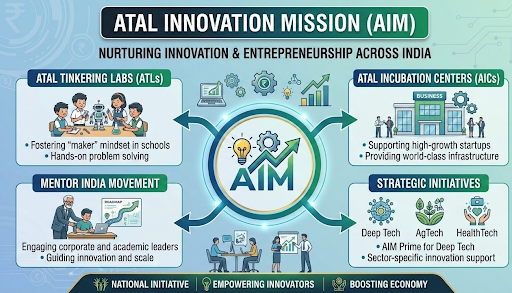
Objectives: Develop a problem-solving mindset in students and build an entrepreneurial ecosystem across schools, universities, research institutions, and the MSME sector.
Atal Tinkering Labs (ATLs): Dedicated workspaces in schools designed to foster curiosity, creativity, and STEM (Science, Technology, Engineering, Mathematics) skills among students in grades 6-12.
Atal Incubation Centres (AICs): Business incubators that provide infrastructure, startup capital, and mentorship to support innovative entrepreneurs.
Atal Community Innovation Centres (ACICs): Centers focused on building a robust innovation ecosystem in underserved and unserved regions, including Tier 2/3 cities and tribal areas.
Atal New India Challenge (ANIC): A grant-based mechanism supporting innovators in creating technology-based products that address areas of national and social relevance.
Atal Research and Innovation for Small Enterprises (ARISE): A program aimed at promoting research, technology-driven initiatives, and job creation within the MSME and startup sectors.
Mentor India: A national network of professionals who volunteer to guide students and entrepreneurs across AIM's programs.
AIM 2.0 Specific Components: New initiatives including the Language Inclusive Program of Innovation (LIPI), Industrial Accelerator Program, and Atal Sectoral Innovation Launchpads (ASIL).
The "Valley of Death": Innovators often fail when transitioning from prototype to a market-ready product due to a lack of resources for testing and piloting.
Rural Infrastructure: Keeping high-tech tools like 3D printers operational in remote Atal Tinkering Labs (ATLs) is a major logistical struggle.
Stagnant R&D Spending: India’s low R&D investment (0.64% of GDP) creates a glass ceiling for large-scale innovation.
Operational Gaps: Many incubators lack the specialized teams and capacity needed to turn ideas into high-performing businesses.
Deep-Tech Adoption: Moving complex, novel technologies from the lab to their first set of paying customers remains a significant hurdle.
Empower ATL Clusters: Deepen the integration of schools into the ATL Sarthi initiative to provide collective guidance and ensure optimal utilization of regional labs.
Community Ownership: Encourage local communities and schools to take active ownership of innovation spaces to ensure long-term maintenance and relevance.
Balance Urban-Rural Support: Provide rural ATLs with equitable operational support, shared resources, and consistent mentorship.
Promote Vernacular Innovation: Accelerate the Language Inclusive Program of Innovation (LIPI) to establish innovation centers across 22 scheduled languages, supporting non-English speakers.
Strengthen Public-Private Partnerships: Roll out the Industrial Accelerator Program to scale up advanced startups in critical sectors.
Enhance Startup Procurement: Expand platforms like the Atal Sectoral Innovation Launchpads (ASIL) to seamlessly integrate and procure from startups across central ministries.
Deepen Global Collaborations: Partner with advanced nations (like Germany) and international bodies to adopt global best practices and expand India's global innovation footprint.
The Atal Innovation Mission acts as a transformative catalyst, building a robust, inclusive, and globally competitive knowledge economy across India.
Source: PIB
|
PRACTICE QUESTION Q. Despite having the world's third-largest startup ecosystem, India continues to face weaknesses in business sophistication and infrastructure. Discuss. 150 words |
AIM is an initiative set up by NITI Aayog in 2016 to promote a culture of innovation and entrepreneurship across India.
ATLs aim to foster curiosity, creativity, and STEM skills in students from grades 6-12 using advanced tech tools like 3D printing.
ANIC is a grant-based mechanism designed to support innovators in creating tech-based products for national causes, effectively helping them overcome the early-stage funding "Valley of Death".





© 2026 iasgyan. All right reserved