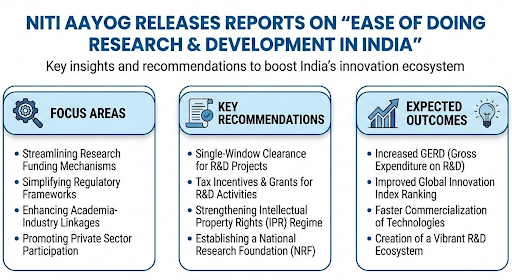
NITI Aayog recommends overhauling India’s research ecosystem to enhance global leadership. Despite ranking 38th in innovation, India's 0.64% GDP R&D spending remains stagnant. The report urges reducing bureaucracy, utilizing the ₹1 Lakh Crore ANRF fund, and boosting private investment.
Why In News?
NITI Aayog released two key reports titled “Ease of Doing Research & Development in India” and the “Survey Report on Ease of Doing R&D in India”.
|
Read all about: R&D EXPENDITURE IN INDIA l INDIA'S INNOVATION ECOSYSTEM: CHALLENGES AND WAY FORWARD |
What are the highlights of the NITI Aayog report?
The report provides a strategic roadmap for India to become a global innovation hub by addressing systemic research bottlenecks.
Core Objective
Transition from a rigid bureaucracy to a trust-based, outcome-oriented environment to prioritize innovation over administrative hurdles.
Key Pillars of the Reports
Funding Architectures: Adopting flexible financial norms to prevent research delays caused by slow disbursements.
Private Sector Integration: Expanding participation by leveraging Corporate Social Responsibility (CSR) funds for startups and advanced research.
Institutional Governance: Developing responsive systems in labs and universities to promote multi-domain collaboration.
Early-Career Support: Implementing mechanisms for early-stage scientists to drive long-term innovation.
Research Translation: Prioritizing mission-mode R&D to convert lab findings into market-ready applications.
What is the Current State of India's R&D Ecosystem?
Improved Innovation Ranking
India advanced to 38th in the Global Innovation Index (GII) 2025, leading all lower-middle-income economies.
Low R&D Investment
India's Gross Domestic Expenditure on R&D (GERD) is stagnant at a low 0.64% of its GDP, lower than major economies like the USA (approx. 3.4%) and South Korea (approx. 4.9%). (Source: World Bank)
Public Sector Dominance
Unlike developed nations where the private sector drives R&D, in India, the government contributes over 50% of R&D expenditure. This structural imbalance hinders the commercialisation of deep-tech research.
Key Bottlenecks in the Indian R&D Ecosystem
Restrictive Procurement Rules: Obsolete General Financial Rules (GFR) create bureaucratic hurdles in acquiring lab equipment, hindering research progress.
Governance Gaps: A lack of Technology Transfer Offices (TTOs) in academic centers deprives scientists of the legal and commercial support needed to patent and monetize inventions.
Researcher Constraints: Delayed grant funding and administrative loads burden early-career scientists, suppressing overall innovation and productivity.
Steps taken to Boost Private Sector Participation
Anusandhan National Research Foundation (ANRF) & Research, Development, and Innovation (RDI) Scheme: Government approved a ₹1 Lakh Crore RDI Scheme on July 1, 2025. Managed by the ANRF, it provides low-interest 'patient capital' to de-risk private deep-tech investments.
Corporate Social Responsibility (CSR) Funding: Firms are encouraged to utilize CSR funds (Companies Act, 2013) for R&D and university incubators.
Biotechnology Industry Research Assistance Council (BIRAC) Case Study: This successful PPP accelerated vaccine and diagnostic development during COVID-19 by linking academia with pharma companies.
Strategic Sectors: Space and Nuclear Energy are now open to private players to boost commercial R&D.
BioE3 Policy: Approved in 2024, this policy establishes private sector hubs for biomanufacturing and bio-AI.
Way Forward
Decentralising Financial Autonomy: Granting research institutions more flexibility to manage funds and procurements without rigid bureaucratic hurdles.
Deployment of the RDI Fund: Swiftly operationalising the ₹1 Lakh Crore fund through the ANRF to catalyse private sector investment.
Strengthening Industry-Academia Linkages: Creating more platforms and incentives for collaboration, modeled on successes like the IIT Madras Research Park.
Shifting the Bureaucratic Mindset: Moving from a paradigm of 'control and compliance' to one of 'facilitation and trust' to empower researchers and innovators.
Learn from Global Best Practices
|
Country |
Approach |
Key Features & Outcomes |
|
South Korea |
Private-Led Model |
Offered tax incentives to private conglomerates (Chaebols) to invest in R&D. Today, the private sector contributes nearly 80% of the country's GERD. |
|
Israel |
Risk-Sharing Approach |
The government's Yozma program co-invested with private venture capitalists in high-tech startups, bridging the early-stage funding gap and building the "Startup Nation". |
|
USA |
Mission-Mode Research |
Agencies like DARPA (Defense Advanced Research Projects Agency) operate with high autonomy, flexible hiring, and outcome-driven goals, serving as a model for strategic research missions. |
Conclusion
India must reform its research ecosystem and boost private investment to transform scientific potential into global innovation leadership.
Source: PIB
|
PRACTICE QUESTION Q. "Transitioning to a knowledge-based economy requires a shift from 'control and compliance' to 'facilitation and trust' in the R&D sector." Discuss. 150 words |
India is ranked 38th globally in the GII 2025 and impressively holds the 1st position among lower-middle-income economies.
India's GERD currently stands at a stagnant 0.64% of its GDP, which is significantly lower than global leaders like the USA (approx. 3.4%) and South Korea (approx. 4.9%).
ANRF is a newly operationalized body that manages the ₹1 Lakh Crore Research, Development, and Innovation (RDI) Scheme. Its primary goal is to provide long-term, low-interest patient capital to de-risk private investments in deep-tech projects.



© 2026 iasgyan. All right reserved