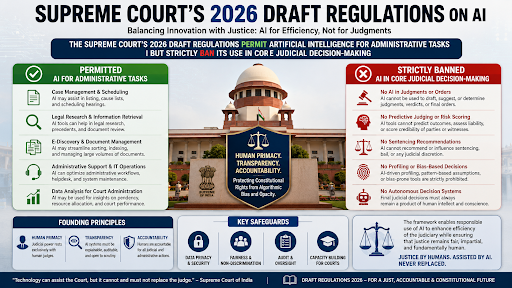
The Supreme Court's 2026 draft regulations permit artificial intelligence for administrative tasks but strictly ban its use in core judicial decision-making. The framework emphasizes human primacy, transparency, and accountability to protect constitutional rights from algorithmic bias and opacity.
Why In News?
The Supreme Court released the draft 'Regulations for Use of Artificial Intelligence in Courts 2026'.
|
Read all about: ROLE OF AI IN JUDICIARY l AI INTEGRATION IN JUDICIARY |
What are the highlights of the draft Supreme Court rules on AI?
The Draft 'Regulations for Use of Artificial Intelligence (AI) in Courts, 2026' enforce absolute human primacy to ensure AI remains strictly assistive and never overrides judicial authority.
The rules strictly ban AI from determining judicial outcomes, performing adjudicatory functions, or deciding bail and sentencing.
Lawyers and litigants must disclose AI use in their submissions and take full legal responsibility for any AI hallucinations or fabricated evidence.
The framework prohibits AI-based risk scoring to predict flight risk or recidivism, and forbids the surveillance of judges, lawyers, or litigants.
The Supreme Court establishes an Apex Body, dedicated AI Committees, and the Centre of Research and Excellence on Artificial Intelligence (CoRE-AI) to regulate nationwide adoption and ensure continuous oversight.
Why the judiciary want to prevent AI from determining judicial outcomes?
AI models exhibit algorithmic bias by learning from flawed historical data, which systematically discriminates against marginalized communities.
The "black box" opacity of AI prevents explainability, directly violating the fundamental legal requirement for reasoned, transparent decision-making.
Automated judgments threaten judicial independence and undermine the constitutional separation of powers by transferring interpretative authority to machines.
Over-reliance on algorithms causes value lock-in, which stagnates progressive legal evolution by rigidly enforcing past precedents without considering evolving social values.
AI systems generate hallucinations that invent fake case laws and incorrect facts, which destroys the integrity of the adjudicatory process.
|
Can AI improve court administration? AI deployment enhances administrative efficiency to combat a backlog of over 55 million pending cases. Smart algorithms automate repetitive administrative tasks like case management, cause-list preparation, e-filing, and hearing scheduling. AI tools like SUVAAS and SUPACE translate judgments into regional languages, automate legal research, and transcribe live court proceedings. |
How other countries are regulating AI in courts?
The European Union (EU) enforces a rigid rights-based regulatory model through its AI Act, demanding strict transparency and mandatory human oversight for high-risk judicial AI.
The United States (US) applies a fragmented, innovation-friendly sector approach featuring localized rules and non-binding guidelines, despite controversies over biased risk-assessment tools like COMPAS.
China operates a state-guided governance system that relies heavily on "Smart Courts" for legal research and evidence organization, though humans formalize the final adjudication.
Canada forces public agencies to conduct mandatory Algorithmic Impact Assessments (AIA) to evaluate bias and guarantee explainability in automated public decision-making.
What safeguards should India adopt for responsible AI in the judiciary?
Enact a comprehensive Judicial AI Regulation Act to establish clear liability, enforce algorithmic accountability, and codify transparency.
Institutionalize the Human-in-the-Loop (HITL) protocol to guarantee that human judges retain ultimate decision-making authority in all matters.
Independent algorithmic audits and pre-deployment bias testing using representative datasets.
Mandate AI literacy training for judges and court staff to prevent automation bias and ensure critical technical oversight.
Enforce privacy by design and strictly comply with the Digital Personal Data Protection Act, 2023 to protect sensitive judicial records from data breaches.
Conclusion
The Supreme Court Judicial AI framework accelerates administrative efficiency and legal research while utilizing strict human oversight to protect constitutional justice from algorithmic bias.
Source: THEHINDU
|
PRACTICE QUESTION Q. Analyze the potential of Artificial Intelligence in tackling the massive pendency of cases in Indian courts. What are the key limitations? 150 words |
The draft regulations completely prohibit Artificial Intelligence from determining judicial outcomes, delivering sentences, or deciding bail eligibility to protect human judicial authority. The framework treats all algorithmic outputs related to adjudication strictly as advisory.
Lawyers must execute a formal mandatory disclosure when they submit AI-assisted pleadings or evidence. If the algorithm generates hallucinations, fabricated case laws, or inaccurate facts, the person submitting the document bears full legal responsibility and cannot use the technology as a defense.
The Human-in-the-Loop (HITL) protocol requires a human judge to constantly review, supervise, and verify all AI-generated outputs. This protocol guarantees that human adjudicators retain the final decision-making authority over any recommendation, ensuring algorithms never usurp judicial discretion.




© 2026 iasgyan. All right reserved