The PM Family Care Tracker is a revolutionary digital public infrastructure launched in Gujarat to integrate health, nutrition, and education data. By consolidating 16 welfare schemes and utilizing smart triggers, it ensures holistic, life-cycle-based monitoring of children and mothers.
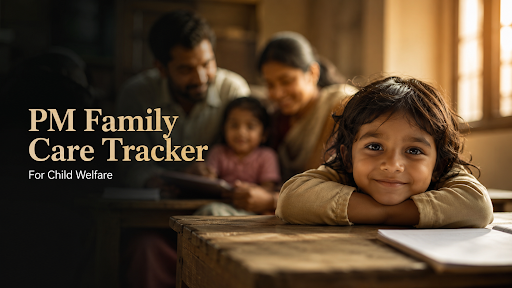
The Union Government inaugurated the PM Family Care Tracker (PM-FCT) pilot project in Gandhinagar, Gujarat.
It is an integrated digital platform designed to ensure pregnant women, mothers, and children receive government welfare benefits through continuous monitoring and timely intervention.
The system consolidates legacy data silos, including TeCHO+ (health), Poshan Tracker (nutrition), and the Child Tracking System (CTS) (education), into a single platform.
DBT Evolution: It advances India’s 12-year trajectory of transparent governance via Direct Benefit Transfer (DBT), ensuring welfare funds reach beneficiaries directly.
Objectives: The platform provides lifelong monitoring of welfare outcomes from pregnancy until the child reaches 18 years of age.
Zero-Tolerance Goals: It guarantees that no child misses essential immunization, nutrition, or formal schooling.
Digital Identification: The system creates consolidated profiles using the Birth Registration Number (BRN) or Ayushman Bharat Health Account (ABHA) ID.
Real-Time Analytics: It furnishes taluka, district, and state-level authorities with real-time dashboards for evidence-based planning.
Health Passports: The government issues physical or digital Health Passports to maintain comprehensive medical records, including hereditary diseases.
Pulse Polio Integration: The launch aligns with the statewide Pulse Polio campaign to demonstrate mass immunization capabilities.
Real-Time Child Tracking: The platform monitors educational transitions and retention. It flags dropouts (e.g., girls leaving after Class 3) for immediate intervention by school principals and local representatives.
Scheme Aggregation: It consolidates 16 state and central schemes, including Pradhan Mantri Matru Vandana Yojana, Mission Indradhanush, and Sukanya Samriddhi Yojana.
Nutritional Surveillance: It uses anthropometric data to identify stunting and wasting, prescribing targeted interventions like the Balshakti scheme.
Integrated Protection: The system monitors high-risk pregnancies and low-birth-weight newborns, while tracking haemoglobin levels and body mass index (BMI) in girls aged 14 to 18 to combat anaemia.
Smart Triggers: Automated alerts notify district health officers when risk indicators are breached.
Standardized Assessments: The system evaluates academic performance via standardized testing, flagging low-performing schools for administrative action.
Inclusive Coverage: It incorporates schemes from the Department of Social Justice and Empowerment and the National Child Labour Scheme to rehabilitate vulnerable children.
Combating Malnutrition: It addresses the "double burden of malnutrition" (undernutrition and obesity) using National Family Health Survey-6 data.
Eradicating Anaemia: It ensures compliance with Iron and Folic Acid supplementation under the Anaemia Mukt Bharat strategy.
Proactive Governance: The system shifts welfare from reactive to proactive, rescuing children from developmental deficits early.
Antyodaya Approach: It prioritizes the most vulnerable households, honoring the spirit of serving the "last person in the queue."
Demographic Dividend: By protecting adolescent health, it prepares a healthy workforce for Viksit Bharat @2047.
Source: ddnews
|
PRACTICE QUESTION Q. Regarding the newly launched "PM Family Care Tracker" (PM-FCT), consider the following statements: 1. It is a digital platform designed solely by the Ministry of Education to track school dropouts. 2. It assigns a unique digital identity to beneficiaries using the ABHA ID or Birth Registration Number. 3. The platform features an automated "smart trigger" mechanism that alerts local MPs and MLAs if a child misses critical vaccinations. Which of the statements given above is/are correct? A) 1 and 2 only B) 2 and 3 only C) 1 and 3 only D) 1, 2, and 3 Answer: B Explanation: Statement 1 is incorrect: The platform is not designed solely by the Ministry of Education nor is it limited to tracking school dropouts. It is an integrated digital platform developed through the collaboration of multiple departments, including Health, Women and Child Development (WCD), and Education. It tracks a beneficiary's lifecycle from pregnancy to age 18, covering health, nutrition, and vaccination status alongside education. Statement 2 is correct: The platform assigns a unique digital identity to every child. This identity is linked to the Birth Registration Number (BRN) or ABHA ID (Ayushman Bharat Health Account) to integrate data from birth and death registration, health, and other welfare databases. Statement 3 is correct: The PM-FCT features an automated alert mechanism (often described as "smart" or "automated triggers") that sends notifications to local officials, MLAs, and MPs if a child misses critical vaccinations or drops out of school, ensuring immediate follow-up by public representatives. |
The PM Family Care Tracker (PM-FCT) is a newly launched, integrated digital governance platform that links birth and death registration data to provide every child with a unique ID, ensuring seamless, automated delivery of government benefits.
It improves welfare by creating a unified lifecycle monitoring system that automatically tracks health milestones like vaccination, nutrition status, and school enrolment, sending real-time alerts to local officials if a child drops out of school or misses critical health interventions.
Mission Vatsalya is a centrally sponsored umbrella scheme focused on child protection services and family-based care, aiming to secure a healthy and happy childhood for every child in India by prioritizing non-institutional care like adoption and foster care.
Children are protected under strong legal frameworks including Article 21A (Right to Education), the POCSO Act (protection from sexual offences), the Juvenile Justice Act, 2015, and the Prohibition of Child Marriage Act, 2006.




© 2026 iasgyan. All right reserved