The Ayushman Bharat Digital Mission creates a federated digital health ecosystem across India using the 14-digit ABHA ID. While it ensures seamless healthcare access and interoperable records, data privacy concerns and cyber-attacks necessitate robust cybersecurity frameworks for enhanced patient protection.
Why In News?
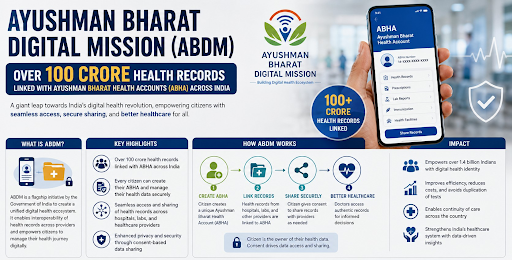
The Ayushman Bharat Digital Mission (ABDM) linked over 100 crore health records with Ayushman Bharat Health Accounts (ABHA) across India.
What is Ayushman Bharat Health Account (ABHA)?
The Ayushman Bharat Health Account (ABHA) is a central component of the Ayushman Bharat Digital Mission (ABDM).
Unique Identity: ABHA is a 14-digit unique health number assigned to individuals to identify them across India's digital health ecosystem.
Digital Health ID: It functions as a unique digital identity that allows citizens to securely access and share medical records across hospitals, clinics, and laboratories.
Voluntary Enrollment: Any individual can enroll in the ABDM to generate an ABHA free of cost using their Aadhaar number or driving license.
How ABHA Works?: The system operates on a federated architecture; health records remain at the location where they are created (e.g., the specific hospital or lab), while the ABDM provides the platform to link and access them.
Significance of ABHA
Interoperability: It facilitates the seamless exchange of data between different hospitals and clinics, ensuring continuity of care even when patients change doctors.
Longitudinal Health Records: It creates a comprehensive digital medical history, including prescriptions, diagnostic reports, and discharge summaries.
Informed Clinical Decisions: Access to previous diagnoses and treatment histories allows healthcare providers to make more accurate and safer clinical decisions.
Efficiency and Transparency: Digitization reduces the risk of losing physical reports and enhances accountability within the healthcare system.
Data-Driven Policy: Anonymized and aggregated data insights help the government formulate evidence-based policies and address public health challenges effectively.
Central Government Health Scheme (CGHS) Integration: For government employees, ABHA allows the digital carry-forward of records between hospitals and facilitates digital OPD appointments.
Source: NEWSONAIR
|
PRACTICE QUESTION Q. Consider the following statements regarding the Ayushman Bharat Health Account (ABHA) and the Ayushman Bharat Digital Mission (ABDM):
Which of the statements given above is/are correct? A) 1 and 2 only B) 1 and 3 only C) 2 and 3 only D) 1, 2, and 3 Answer: B. Explanation: Statement 1 is correct: The Ayushman Bharat Health Account (ABHA) is a unique 14-digit identification number designed to link and access a person's medical records digitally across various healthcare providers. Statement 2 is incorrect: Health records under the Ayushman Bharat Digital Mission (ABDM) are not stored in a centralized government database. Instead, the system uses a decentralized architecture where medical records remain securely with the respective healthcare providers (e.g., hospitals and clinics), while the ABDM only facilitates secure, consent-based data exchange between them. Statement 3 is correct: The National Health Authority (NHA) is the apex body and the nodal implementing agency for the ABDM. |
ABHA is a unique 14-digit number used to link all the electronic health records of a person, enabling seamless, hassle-free access and sharing of medical history with healthcare providers based on informed consent.
Getting an ABHA number does not mean mandatory enrollment in the Ayushman Bharat – Pradhan Mantri Jan Arogya Yojana (AB-PMJAY). It is a unique identifier for your health records and operates as a voluntary digital add-on.
The National Health Authority (NHA), an agency of the Government of India, is the implementing body for the Ayushman Bharat Digital Mission (ABDM).






© 2026 iasgyan. All right reserved