Recent studies show a 20% rainfall decline in India's eastern Indus basins and a 450 cubic km loss of northern groundwater since 2002. Driven by extreme weather and warming, this threatens food security, hydropower, and transboundary water treaties.
Why In News?
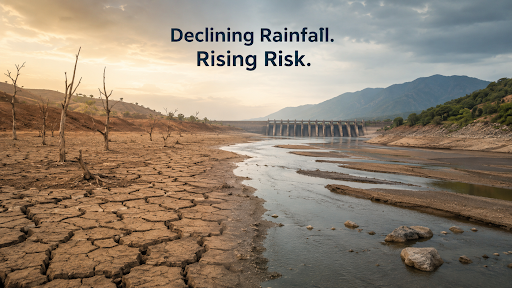
A recent IIT-Gandhinagar study reveals a 20% decline in precipitation across eastern Indus river basins since 1951, while North India faces a loss of 450 cubic kilometers of groundwater between 2002 and 2021.
Highlights of the Report
Precipitation Drop: The catchment areas of the Ravi, Beas, and Sutlej rivers recorded a 20% decline in precipitation between 1951 and 2024.
Monsoon Deficits: Summer monsoon rainfall in North India shrank by 8.5% during the 1951–2021 period, disrupting the regional hydrological balance.
Western Basin Stability: Western rivers, including the Indus, Jhelum, and Chenab, maintained relative stability with a statistically non-significant 6% reduction.
Streamflow Anomalies: The Ganga basin faces a sharp, sustained decline in streamflow, contrasting with the overall annual increase recorded in the broader Indus basin between 1980 and 2021.
Reservoir Depletion: Annual water inflows into major reservoirs show pronounced declines, with the Pong dam witnessing a 34% drop between 1951 and 2020.
Treaty Viability: These climate-induced shifts provide a data-backed foundation for India to argue for a review of the 1960 Indus Waters Treaty.
Importance of Rainfall for Water Security
Basin Lifeline: The Indus River system sustains over 300 million people and dictates the agricultural layout of South Asia.
River Rejuvenation: The monsoon functions as the primary engine for annual riverine flows and the central heat source for the country’s ecology.
Agricultural Dependence: Warmer winters and erratic monsoons disrupt Kharif and Rabi crop cycles, forcing farmers to increase groundwater extraction.
Groundwater Recharge: Effective recharge requires low-intensity, distributed rainfall; however, current extreme weather patterns cause high runoff, preventing natural absorption.
Future Projections: Drier monsoons and warmer winters threaten a 6–12% decline in future groundwater recharge.
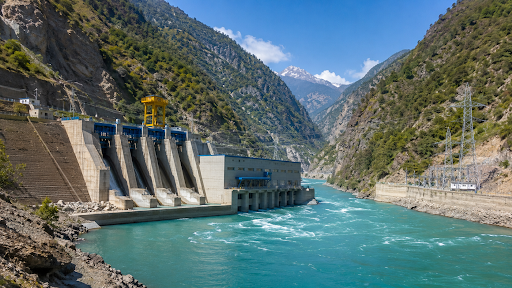
Hydropower Vulnerability: Reduced flows threaten energy security, particularly for the 5,000 MW potential of the Beas River Basin and projects like Pakal Dul (1,000 MW) and Ratle (850 MW).
What Factors Are Contributing to Declining Rainfall Trends?
Climate Change: Global warming drives erratic monsoons, shifting rainfall from distributed showers to concentrated, extreme events.
Glacial Melt: Hindu Kush-Karakoram-Himalaya glaciers melt at a rate of 0.6 meters annually, threatening long-term river flows.
Rising Temperatures: North Indian winters warmed by 0.3°C since 1951, increasing soil moisture loss and irrigation demands.
Land Use Changes: Soil degradation, reduced forest cover, and rapid urbanization limit water retention and increase surface runoff.
Extreme Weather: El Niño events suppress monsoon activity, while rising sea surface temperatures increase the intensity of destructive cyclones.
What are the Implications of Reduced Rainfall?
Groundwater Loss: The 450 cubic kilometers of lost groundwater is equivalent to 37 times the capacity of the Indira Sagar Dam.
Agricultural Vulnerability: A 20% drier monsoon (as seen in 2009) triggers a 10% reduction in groundwater storage, immediately impacting wheat and mustard yields.
Food Security: Decreased rainfall and pre-monsoon heatwaves suppress crop yields, fueling food inflation.
Hydropolitical Strain: Reduced flows escalate tensions regarding transboundary water frameworks, as the Indus Waters Treaty relies on static 1960s data.
Disaster Management and Climate Risks
Drought Frequency: Prolonged rainfall deficits escalate into agricultural droughts, particularly in regions like Marathwada.
Urban Water Scarcity: Diminished groundwater leads to acute drinking water shortages in major centers like Delhi and Bengaluru.
Siltation: Siltation reduces the buffer capacity of major dams, specifically the Bhakra (26% loss) and Pong (14% loss) reservoirs.
Migration Risks: Compounding climate disasters, including floods and droughts, force rural populations to migrate to urban slums.
Measures for Strengthening Water Security
Integrated Management: Projects like the Chenab-Beas Link Tunnel aim to rebalance water distribution across basins.
Rainwater Harvesting: Decentralized harvesting captures concentrated rainfall to force recharge into aquifers.
Climate-Resilient Agriculture: Scaling micro-irrigation saves up to 30% of water, reducing extraction pressure.
Monitoring Systems: The Ministry of Earth Sciences (MoES) utilizes the FloodWatch India app and GIS-based Decision Support Systems for real-time warnings.
India must adopt basin-wide climate adaptation, efficient governance, and data-driven forecasting to secure water future against climate threats.
Source: INDIANEXPRESS
|
PRACTICE QUESTION Q. "Changes in rainfall patterns are emerging as one of the most critical challenges to India's long-term water security." Examine (250 Words, 15 Marks) |
North India lost a staggering 450 cubic kilometers of groundwater between 2002 and 2021, an amount roughly 37 times the total capacity of the Indira Sagar Dam.
The eastern rivers of the Indus system (Ravi, Beas, and Sutlej) have experienced a significant 20% decline in precipitation between 1951 and 2024, whereas the western rivers have remained relatively stable.
Climate change causes rainfall to occur in brief, intense extreme events rather than prolonged, low-intensity showers. This leads to heavy surface runoff, drastically reducing the earth's ability to absorb and recharge groundwater.
It is an 8.7 km proposed tunnel in Himachal Pradesh that will divert surplus water from the Chandra River (a tributary of the Chenab) into the Beas River basin to alleviate water scarcity and boost hydropower generation.
The treaty was designed around static climatic conditions of the mid-20th century. With glacial melt, severe precipitation drops, and massive groundwater depletion, the physical availability of water has changed fundamentally, leading to calls for treaty modernization.


© 2026 iasgyan. All right reserved