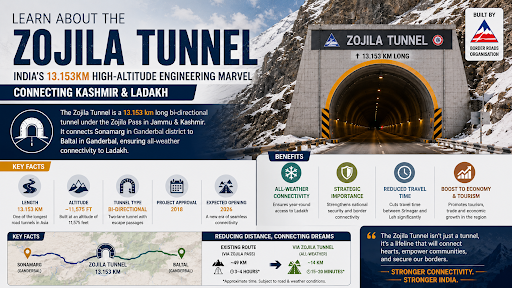
The 13.153-km Zojila Tunnel provides all-weather connectivity between Kashmir and Ladakh at 11,578 feet. Utilizing NATM, it cuts travel time to 15 minutes, drastically enhancing India’s military logistics, regional economic integration, and tourism in the fragile Himalayan frontier
.
Why In News?
The Zojila Tunnel achieves its final breakthrough blast, paving the way for India’s longest high-altitude, all-weather road connecting Kashmir and Ladakh.
What is the Zojila Tunnel?
The Zojila Tunnel is an under-construction 13.153-kilometre-long, single-tube, bi-directional road tunnel located in the harsh terrain of the Himalayas.
It stands at an extraordinary altitude of 11,578 feet, establishing it as the world's longest single-tube bi-directional road tunnel at this extreme elevation.
The tunnel physically links Baltal (near Sonamarg) in Kashmir to Minamarg (near Drass) in Ladakh, completely bypassing the treacherous Zojila Pass.
The National Highways and Infrastructure Development Corporation Limited (NHIDCL) oversees the project, while Megha Engineering & Infrastructures Ltd (MEIL) executes the complex construction.
Key Features of the Zojila Tunnel
Advanced Construction Method: Engineers utilize the New Austrian Tunnelling Method (NATM), a highly flexible technique suited to tackle the fragile Himalayan geology and Seismic Zone IV vulnerabilities.
Travel Time Reduction: The tunnel slashes the crossing time of Zojila Pass from three hours to only 15 to 20 minutes.
Project Cost & Scale: Government sanctions a budget of over Rs 6,800 crore.
State-of-the-Art Safety: Design incorporates a Smart Tunnel (SCADA) system, CCTV, fire alarms, and three gigantic vertical ventilation shafts to maintain international safety standards.
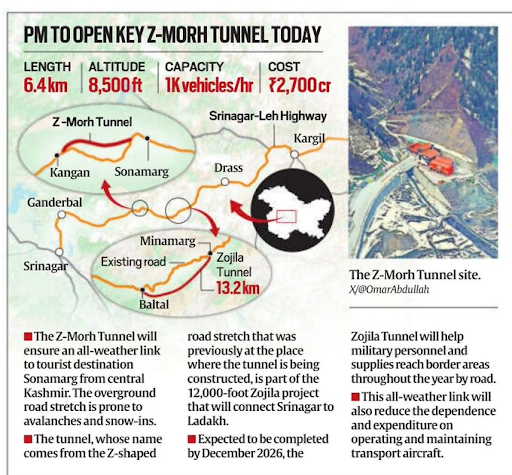
Expanded Infrastructure Corridor: The project integrates into a larger 30.894-km network, linking with the Z-Morh tunnel and the Nilgrar twin tunnels to construct an impenetrable all-weather transport corridor.
Strategic Importance for India
Uninterrupted Military Logistics: The tunnel provides 365-day connectivity, empowering the Indian Armed Forces to rapidly deploy troops, fuel, and heavy military hardware to strategic frontiers bordering Pakistan and the Line of Actual Control (LAC) with China.
Economic Integration: Continuous year-round road access eliminates the severe winter isolation of Ladakh, accelerating local trade, ensuring essential supplies reach civilians, and stimulating the broader regional economy.
Tourism Catalyst: The infrastructure transforms regional tourism by offering safe, uninterrupted travel to destinations like Sonamarg, Drass, Kargil, Zanskar, and Leh, creating local employment opportunities.
Safety & Fuel Conservation: By avoiding the treacherous, avalanche-prone mountain passes, the tunnel drives fatal accident rates down to zero and saves millions in national fuel expenditures.
Conclusion
The Zojila Tunnel is an engineering marvel and vital security asset that bridges the geographical divide between Kashmir and Ladakh, fortifying India's strategic northern frontiers.
Source: THEHINDU
|
PRACTICE QUESTION Q. Consider the following statements regarding the Zojila Tunnel:
Which of the statements given above are correct? A) 1 and 2 only B) 2 and 3 only C) 1 and 3 only D) 1, 2, and 3 Answer: D. Explanation: Statement 1 is correct: The tunnel connects Baltal in Jammu & Kashmir to Minamarg in Ladakh, bypassing the treacherous Zojila Pass to provide year-round all-weather connectivity. Statement 2 is correct: The Zojila Tunnel is being constructed using the advanced New Austrian Tunnelling Method (NATM). Statement 3 is correct: At an altitude above 11,500 feet, the 13.15 km-long Zojila Tunnel holds the distinction of being the world's longest single-tube bi-directional road tunnel at its elevation. By surpassing the Atal Tunnel (which is located at roughly 10,000 feet), it sets a new global high-altitude record. |
The Zojila Tunnel is located along the National Highway 1 (NH 1) in the Himalayas, cutting through the high-altitude Zojila Pass to connect Srinagar in Jammu & Kashmir directly with Kargil and Leh in Ladakh.
The engineering project is strategically critical because it creates India's longest bi-directional road tunnel at 14.15 kilometers, completely bypassing an avalanche-prone mountain pass that sits at an altitude of over 11,500 feet.
The infrastructure directly benefits Ladakh by providing safe, all-weather socio-economic connectivity to the rest of India, replacing the traditional six-month winter isolation that routinely paralyzes local trade, healthcare access, and essential supply lines.
The tunnel fortifies national security by allowing the Indian Armed Forces to rapidly deploy heavy military hardware, troops, and logistical rations to front-line borders facing China and Pakistan throughout the entire year without weather delays.


© 2026 iasgyan. All right reserved