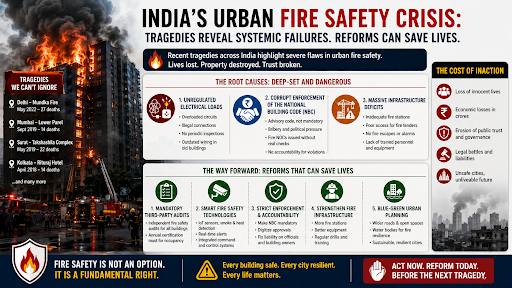
Recent tragedies highlight severe flaws in India's urban fire safety. Unregulated electrical loads, corrupt enforcement of the advisory National Building Code, and massive infrastructure deficits demand urgent reforms, including mandatory third-party audits, smart technologies, and blue-green urban planning.
Why In News?
Urban fire hazards in India are rapidly escalating due to high population density, unplanned urbanization, and poor compliance with building safety codes.
|
Read all about: India's Electrical Fire Risks and Safety Standards |
What are Urban Fire Accidents?
Urban fire accidents represent instances where uncontrolled burning endangers life, property, and infrastructure within densely populated city environments.
These hazards strike public and commercial spaces like hospitals, coaching centers, high-rise residential buildings, and informal slum settlements.
The National Crime Records Bureau (NCRB) data highlights that approximately 1,85,383 people lost their lives in fire accidents between 2010 and 2019; an average of 65 deaths per day.
What Factors Trigger Large-Scale Fires in Indian Cities?
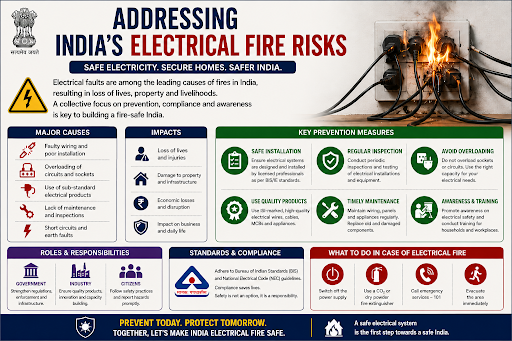
Electrical Overloads: Citizens plug heavy non-linear loads (like 1.5-tonne ACs, EV chargers) into obsolete wiring originally sized for basic fans and bulbs.
Harmonic Distortion: Modern appliances inject current distortions that silently overheat neutral conductors and ignite insulation.
Hazardous Material Mismanagement: Businesses illegally store flammable fuels and chemicals without proper Petroleum and Explosives Safety Organization (PESO) licenses (e.g., thousands of liters of petrol stored in the Rajkot gaming zone).
Ignored Hot Works Protocol: Unregulated welding and hot metal works generate explosive splatters near combustible materials.
Why Do Fire Safety Norms Often Fail in Practice?
Fragmented Constitutional Jurisdiction: The Constitution lists 'Fire Services' as a State Subject (12th Schedule), which restricts the Central Government to providing advisory "Model Laws" rather than enforcing uniform national rules.
Advisory Nature of Codes: The National Building Code (NBC) remains a mere guideline until individual states officially adopt it into their local municipal bye-laws.
Corruption and Collusion: Corrupt officials issue 'No Objection Certificates' (NOCs) to unsafe buildings, enabling violators to bypass critical safety inspections.
Cultural Apathy: Building managers display a 'Chalta Hai' attitude, routinely locking fire exits to prevent theft or converting basement parking lots into commercial shops.
How Does Unplanned Urbanization Increase Fire Risks?
Vertical Growth vs Stunted Equipment: Cities construct 50-floor skyscrapers, however, local fire departments lack hydraulic ladders capable of reaching beyond the 10th floor.
Impenetrable Informal Settlements: Slums and unauthorized colonies feature extremely narrow lanes, making it physically impossible for fire trucks to enter during emergencies.
Traffic Congestion: Gridlocked city streets trap fire engines, resulting in the loss of the critical 'Golden Hour' necessary to save trapped victims.
Modern Architectural Traps: Modern glass-facade buildings utilize HVAC (Heating, Ventilation, and Air Conditioning) systems that instantly spread lethal smoke across all floors, suffocating occupants before flames even reach them.
How Prepared are Indian Cities for Fire Emergencies?
Severe Infrastructure Deficit: India has 97% shortage in fire service manpower & equipment (NDMA 2022). To meet global standard (1:50,000), India needs 18,000 stations & 5 lakh firefighters.
Forensic Incapacity: The system lacks specialized fire-forensic engineers, leading authorities to rely on provisional explanations rather than scientifically analyzing root causes.
Technological Lag: Indian residences completely lack modern preventative technologies like Arc-Fault Circuit Interrupters (AFCI), which automatically cut power before an electrical arc ignites a fire.
Way Forward to Strengthen Urban Fire Resilience
Mandate NBC Compliance: State governments must integrate NBC 2016 Part IV legally into municipal bye-laws and penalize non-compliance stringently.
Implement Third-Party Audits: Replace corruptible internal inspections with mandatory annual fire audits conducted by independent, certified private agencies.
Adopt Blue-Green Infrastructure: Urban planners must design cities using water bodies (blue) and parks (green) to act as natural firebreaks and emergency water reservoirs.
Leverage Smart Technology: Integrate IoT-automated fire suppression, AI-guided surveillance for early heat detection, and GIS-based mapping to drastically cut emergency dispatch times.
Establish Periodic Electrical Inspections: Emulate Japan and the EU by mandating home electrical inspections every four years to fix outdated wiring.
Conclusion
To build fire-resilient cities, India must shift from a reactive compensation-based approach to a proactive framework driven by strict accountability, mandatory third-party audits, and smart technology.
Source: THEHINDU
|
PRACTICE QUESTION Q. "Fire disasters don't start with flames, they start with neglect." Discuss. 150 words |
The National Building Code acts purely as an advisory guideline published by the Bureau of Indian Standards (BIS). It gains mandatory legal enforcement only when State Governments officially integrate it into their local municipal bye-laws.
Modern glass-facade buildings utilize Heating, Ventilation, and Air Conditioning (HVAC) systems that instantly spread lethal smoke across all floors. This suffocates occupants long before the actual flames reach them.
Urban planners use 'Blue-Green Infrastructure' to design water bodies (blue) and parks (green) to act as natural firebreaks. These features stop the spread of urban fires and provide emergency water reservoirs for firefighters.




© 2026 iasgyan. All right reserved