The 2026 ICIMOD report warns that doubling glacial melt in the Hindu Kush Himalaya threatens 1.9 billion people. To secure water and food, India must pivot from reactive disaster response to proactive cryosphere management and transboundary cooperation.
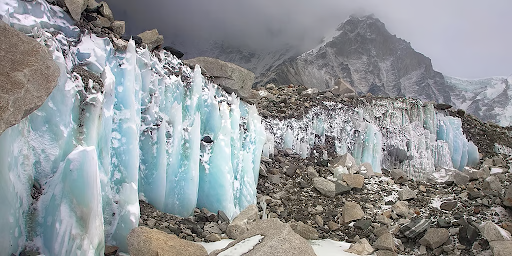
Copyright infringement not intended
Picture Courtesy: DOWNTOEARTH
Why In News?
According to the International Centre for Integrated Mountain Development (ICIMOD) report, the Hindu Kush Himalaya (HKH) region, often called the 'Third Pole of the Earth', is facing an unprecedented climate crisis.
What is the Hindu Kush Himalaya (HKH) Region?
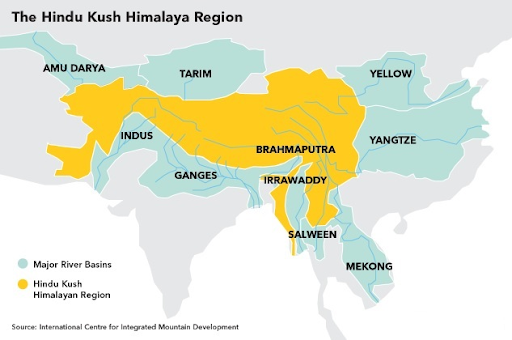
The Third Pole: Spanning across eight countries (Afghanistan, Bangladesh, Bhutan, China, India, Myanmar, Nepal, and Pakistan), the HKH contains the largest volume of ice outside the polar regions.
Lifeline of Asia: It is the source of 10 major river basins that support the drinking water, irrigation, and energy needs of nearly 2 billion people downstream. (Source: UN Water Report).
Biodiversity Hotspot: The region hosts four of the world's 36 global biodiversity hotspots, making it critical for global ecological balance. (Source: World Wildlife Fund).
What are the Key Findings of the ICIMOD 2026 Report?
Massive Ice Loss: The HKH region lost 12% of its overall glacial area and 9% of its total ice reserves between 1990 and 2020.
Accelerated Melting: The rate of ice loss has accelerated significantly since 2010, with smaller glaciers in the eastern and central HKH being the most affected.
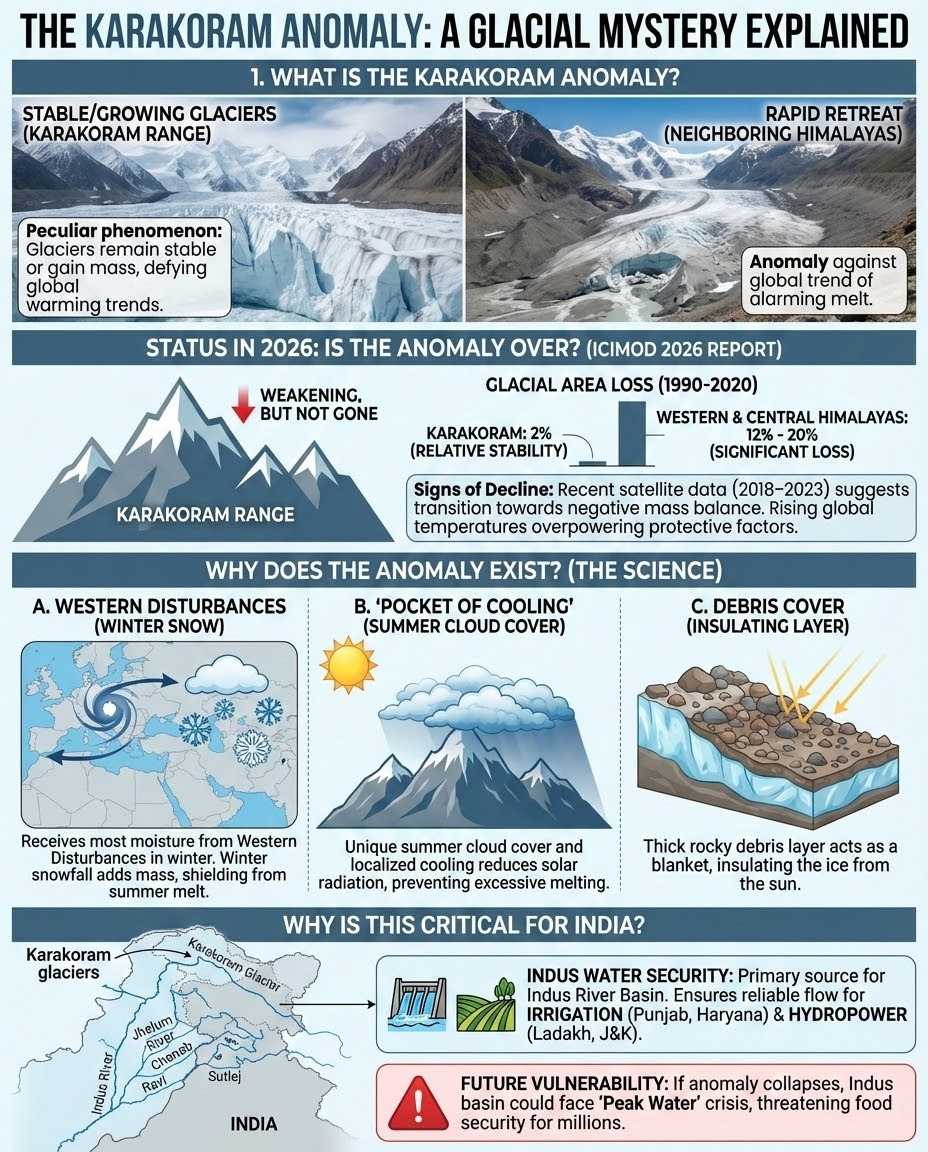
The Karakoram Exception: The Karakoram range showed a marginal loss of only 2%, a phenomenon known as the 'Karakoram Anomaly'.
Glacial Area Reduction in Key Regions & River Basins
|
Region / River Basin |
Glacial Area Reduction (%) |
|
Salween River |
33% |
|
Yangtze River |
23% |
|
Yellow River |
22% |
|
Ganga River Basin |
21% |
|
Central Himalayas |
>20% |
|
Brahmaputra River Basin |
16% |
What are the Potential Impacts of Glacial Retreat?
Environmental & Disaster Risks: GLOFs
As glaciers retreat, they leave behind depressions that fill with meltwater, forming unstable glacial lakes. The breach of these lakes causes catastrophic Glacial Lake Outburst Floods (GLOFs).
Case Study (South Lhonak Lake, Sikkim): In 2023, a GLOF released 270 million cubic meters of water and sediment, killing over 90 people, and washing away the 1,200 MW Teesta-III hydropower dam. This highlights the extreme vulnerability of Himalayan infrastructure.
Socio-Economic and Food Security Disruptions
Glacial melt initially increases river flow but will lead to severe water scarcity as ice reserves are depleted.
Economic Contraction: Climate change-induced water scarcity could reduce the GDP of regions like South Asia by up to 6% by 2050 due to impacts on agriculture, health, and income. (Source: World Bank 'High and Dry' Report).
Agricultural Crisis: The Indo-Gangetic plain depends on glacial meltwater for irrigation during the dry pre-monsoon season. A 21% glacial reduction in the Ganga basin directly threatens the food security of over 400 million Indians. (Source: ICIMOD Report)
Geopolitical and Strategic Tensions
Water scarcity acts as a threat multiplier, increasing the risk of transboundary conflicts. As river flows become erratic, lower riparian states (e.g., India, Bangladesh) face risks from water diversion projects by upper riparian states (e.g., China).
Energy Security Deficits
India’s renewable energy goals are heavily dependent on Himalayan hydropower. However, the destruction of the Teesta-III dam shows that erratic flows, heavy sediment loads, and GLOFs threaten the viability of this entire sector.
Roadmap for Action
Establish an 'Arctic Council' for the Himalayas
India should lead the creation of a multilateral body for all eight HKH nations to legally bind them to share real-time hydrological and meteorological data for managing transboundary risks.
Deploy Decentralized Early Warning Systems (EWS)
Empower vulnerable communities with localized, sensor-based GLOF warning systems, modeling them on successful community-led initiatives in Nepal.
Reassess Infrastructure Carrying Capacity
Governments must enforce strict carrying capacity assessments for eco-sensitive zones before approving new hydropower, road, or tourism projects to ensure climate resilience.
Conclusion
The Hindu Kush Himalaya crisis demands a unified regional paradigm shift that treats the "Third Pole" as a shared global commons to ensure the socio-economic and geopolitical security of two billion people.
Source: DOWNTOEARTH
|
PRACTICE QUESTION Q. The accelerating retreat of glaciers in the Hindu Kush Himalaya region poses multidimensional threats to India's internal security and socio-economic stability. Discuss. 150 words |
The HKH region is referred to as the "Third Pole" because it holds the largest reserve of snow and ice globally outside of the Arctic and Antarctic polar regions. It acts as the source for 10 major river basins, supporting over 1.9 billion people.
The Karakoram Anomaly is a unique geographical phenomenon where glaciers in the Karakoram range have remained relatively stable or experienced minimal area loss (close to 2%). This is in stark contrast to the rapid and accelerating glacial retreat observed across the rest of the Himalayas.
A GLOF occurs when the damming materials (such as ice or a fragile moraine) of a glacial lake fail, releasing a sudden, massive volume of water and debris downstream. The catastrophic 2023 flood from South Lhonak Lake in Sikkim is a prime example of a GLOF.


© 2026 iasgyan. All right reserved