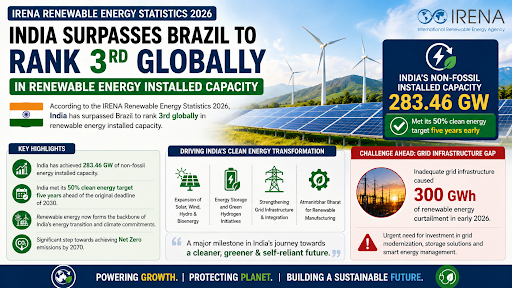
India now ranks third globally in renewable energy capacity, achieving 283.46 GW of non-fossil capacity. Although India met its 50% clean energy target five years early, inadequate grid infrastructure caused 300 GWh of renewable energy curtailment in early 2026.
Why In News?
According to the IRENA Renewable Energy Statistics 2026, India has surpassed Brazil to rank 3rd globally in renewable energy installed capacity.
|
Read all about: INDIA 3RD IN RENEWABLE ENERGY l INTERNATIONAL ENERGY AGENCY (IEA) REPORT l INDIA'S RENEWABLE ENERGY PARADOX l WHY INDIA IS A LEADER IN RENEWABLE ENERGY |
Renewable Energy Status in India
Global Standing: India ranks 3rd globally in renewable energy capacity.
Total Power Capacity: India crossed the 500 GW mark for total power capacity. As of March 2026, the total electricity generating capacity stands at 533 GW.
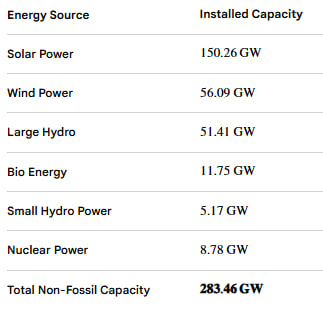
Non-Fossil Fuel Share: India achieved a total non-fossil fuel installed capacity of 283.46 GW as of March 31, 2026, including 274.68 GW from renewable sources and 8.78 GW from nuclear power.
NDC Targets: India updated the Nationally Determined Contributions (NDC) to achieve 60% non-fossil capacity by 2035, having met the 50% target for 2030 five years early.
Solar Growth: India added 44.6 GW of solar capacity in 2025-26 alone, marking a near doubling of the previous year's addition.
Energy Storage: Adani Green Energy commissioned the world's largest single-location Battery Energy Storage System (BESS) of 3.37 GWh at Khavda, Gujarat.
Government Initiatives
Solar Production Linked Incentive (PLI): Channeled government support toward measurable industrial output, expanding module capacity to 120 GW and cell capacity to 29.3 GW as of June 2025.
Battery Energy Storage Systems (BESS) VGF: Launched a Viability Gap Funding (VGF) scheme for 30 GWh of BESS with an outlay of ₹5,400 crore.
GST Reductions: Reduced GST on renewable energy components from 12% to 5%, lowering costs for PM Surya Ghar systems by up to ₹10,500.
National Policy on Geothermal Energy (2025): Established a framework for exploration and development, sanctioning five pilot projects to evaluate geothermal potential.
Electricity (Amendment) Rules 2025:
Nuclear Sector Reforms: Passed the SHANTI Bill 2025 to modernize nuclear laws and enable limited private participation.
Green Hydrogen: Released the Green Hydrogen Certification Scheme to ensure transparency and market credibility under the National Green Hydrogen Mission.
PM Surya Ghar: Muft-Bijli Yojana: Issued guidelines for the Utility Led Aggregation (ULA) model to facilitate rooftop solar installations.
Digital Tools: Launched STELLAR, an indigenous Resource Adequacy model to integrate generation and storage planning.
Small Hydro Power (SHP) Development Scheme: Approved ₹2,584.6 crore for the 2026-31 period to add 1,500 MW capacity.
Challenges in Renewable Energy Sector
Transmission Bottlenecks: India curtailed 300 GWh of renewable energy in Q1 2026 due to transmission constraints.
Execution Delays: India met only 80% of its annual transmission buildout targets over the past five years. One in four inter-state schemes is delayed by at least a year.
Manufacturing Vulnerabilities
Grid Instability: On March 30, 2026, India lost 34 GWh of clean electricity in a single day due to insufficient transmission margins.
Policy Asymmetries: Unrestricted imports for upstream components (polysilicon) alongside restrictions on modules (ALMM) created uncertainty for domestic manufacturers.
Land and Clearance Issues: Right-of-Way (RoW) disputes, forest clearances, and biodiversity restrictions (e.g., Great Indian Bustard in Rajasthan) significantly slow project execution.
Way Forward
BESS as Transmission Support: Procuring Battery Energy Storage Systems as transmission assets can provide a near-term fix for grid congestion.
Co-optimisation of Planning: Move from generation-led planning to co-optimised generation and transmission planning to ensure infrastructure is ready before plants are commissioned.
Grid-Enhancing Technologies (GETs): Deploying Dynamic Line Rating (DLR) and High-Temperature Low-Sag (HTLS) reconductoring can increase existing line capacity by 25–50%.
Decentralizing RE
Encouraging intra-state (InSTS) project deployment closer to demand centers can ease pressure on congested inter-state corridors.
Manufacturing Self-Reliance: Future PLI iterations must focus on upstream integration (polysilicon and wafers) and provide risk buffers against global price volatility.
Mandatory Co-location: Sole RE projects should be discouraged in favor of storage-linked projects to improve transmission asset utilization.
Market Signals: Implementing locational/zonal pricing can incentivize developers to build projects where power delivers the highest system value.
Conclusion
India's record renewable growth and storage advancements signal a clean power transition, however grid readiness and manufacturing integration are vital for sustainable energy goals.
Source: DDNEWS
|
PRACTICE QUESTION Q. Evaluate the role of decentralized solar schemes like PM Surya Ghar: Muft Bijli Yojana and PM-KUSUM in expanding distributed renewable energy (DRE) in India. (150 words) |
India ranks 3rd globally in Renewable Energy Installed Capacity, trailing only behind China and the USA, having recently surpassed Brazil.
As of March 31, 2026, India's total installed capacity from non-fossil fuel sources stands at 283.46 GW, which includes solar, wind, hydro, bioenergy, and nuclear power.
It is a government scheme aimed at installing rooftop solar (RTS) systems in one crore residential households by FY 2026-27, boosting India's decentralized renewable energy capacity.

© 2026 iasgyan. All right reserved