India ranks third globally with 283.5 GW of renewable capacity, exceeding Brazil. Driven by 'Panchamrit' goals and record FY26 growth, the transition boosts energy security. Success now depends on scaling BESS, fixing DISCOM finances, and resolving grid instability and supply chain gaps.
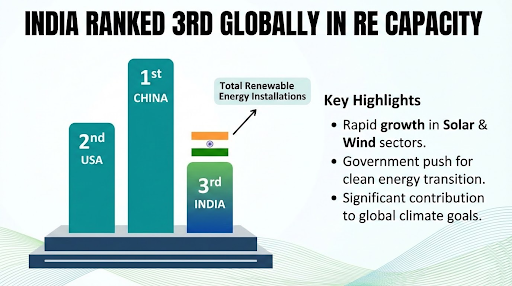
According to the Ministry of New and Renewable Energy (MNRE), India has officially become the world’s third-largest renewable energy (RE) capacity holder, trailing only China and the USA.
Policy Push & Targets: India's RE growth is anchored by its 'Panchamrit' commitments made at the international level, particularly the target to achieve 500 GW of non-fossil fuel capacity by 2030.
Decentralized Solar Revolution: The PM Surya Ghar: Muft Bijli Yojana, by aiming to solarize 1 crore households, it has transformed consumers into 'prosumers' (those who produce and consume energy), leading to a massive 8.7 GW addition in rooftop solar in 2025-26.
Financial Incentives: The government has created a favorable investment climate by:
Employment Generation: The 500 GW target is projected to create over 3.4 million jobs by 2030 in the wind and solar sectors alone. (Source: CEEW)
Energy Security: By increasing reliance on domestic RE sources, India reduces its dependence on imported coal and oil. This saves valuable foreign exchange and protects the economy from global energy price shocks.
Rural Empowerment: Schemes like PM-KUSUM enable farmers to install solar water pumps, replacing expensive diesel pumps. This increases their income, reduces agricultural emissions, and decentralizes power generation.
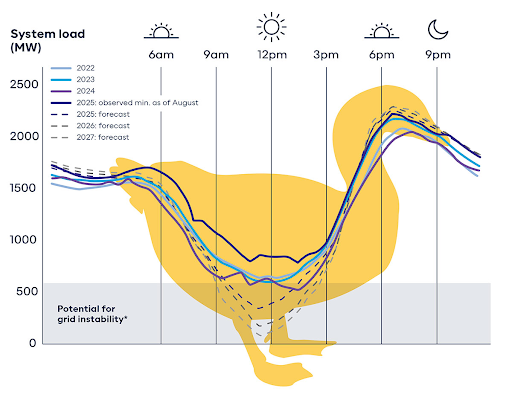
Grid Integration & 'Duck Curve': Intermittent nature of solar and wind power causes grid instability.
Supply Chain Vulnerabilities: India is heavily dependent on imports, especially from China, for critical components like solar wafers, cells, and minerals (lithium, cobalt). This poses a strategic risk to energy security.
Financial Health of DISCOMs: Power Distribution Companies (DISCOMs) are financially weak due to high losses. Their delayed payments to RE producers discourage private and foreign investment.
Land & Ecological Conflicts: Large-scale RE projects require vast tracts of land, leading to acquisition challenges. Projects can cause ecological harm, such as the threat transmission lines pose to the Great Indian Bustard in Rajasthan.
Scale Up Energy Storage: To ensure round-the-clock (RTC) power, Operationalize Battery Energy Storage Systems (BESS), by providing Viability Gap Funding (VGF) to make storage projects financially feasible.
Expedite Grid Modernization: Completing Phase-II of the Green Energy Corridor project is crucial to transmit power from RE-rich states (like Gujarat, Rajasthan) to industrial centers with high demand.
Promote a Circular Economy: With early-generation solar panels nearing their end-of-life, India must strictly enforce Extended Producer Responsibility (EPR) rules for solar and battery waste to prevent future ecological damage.
Learn from global best practices: California manages its 'duck curve' with large-scale battery storage and dynamic Time-of-Use (ToU) pricing, which encourages consumers to use more power when it is cheap and abundant.
India must integrate advanced Battery Energy Storage Systems (BESS) with a modernized Green Energy Corridor to ensure grid stability while scaling domestic manufacturing of solar cells and green hydrogen to achieve supply chain sovereignty
Source: DDNEWS
|
PRACTICE QUESTION Q. Discuss the socio-economic impacts of decentralized solar energy projects in India. 150 words |
India currently ranks 3rd globally in installed renewable energy capacity, surpassing Brazil. It trails only behind China and the United States, having reached a historic non-fossil capacity of 283.5 GW.
Introduced at the COP26 summit, India's Panchamrit commitments are five ambitious climate action goals. The most prominent target regarding energy infrastructure is achieving 500 GW of non-fossil fuel capacity by 2030.
The 'Duck Curve' refers to the steep imbalance between electricity demand and solar power generation. It occurs because solar generation peaks at mid-day but drops off at sunset, precisely when evening electricity demand surges, placing heavy stress on the traditional power grid.

© 2026 iasgyan. All right reserved