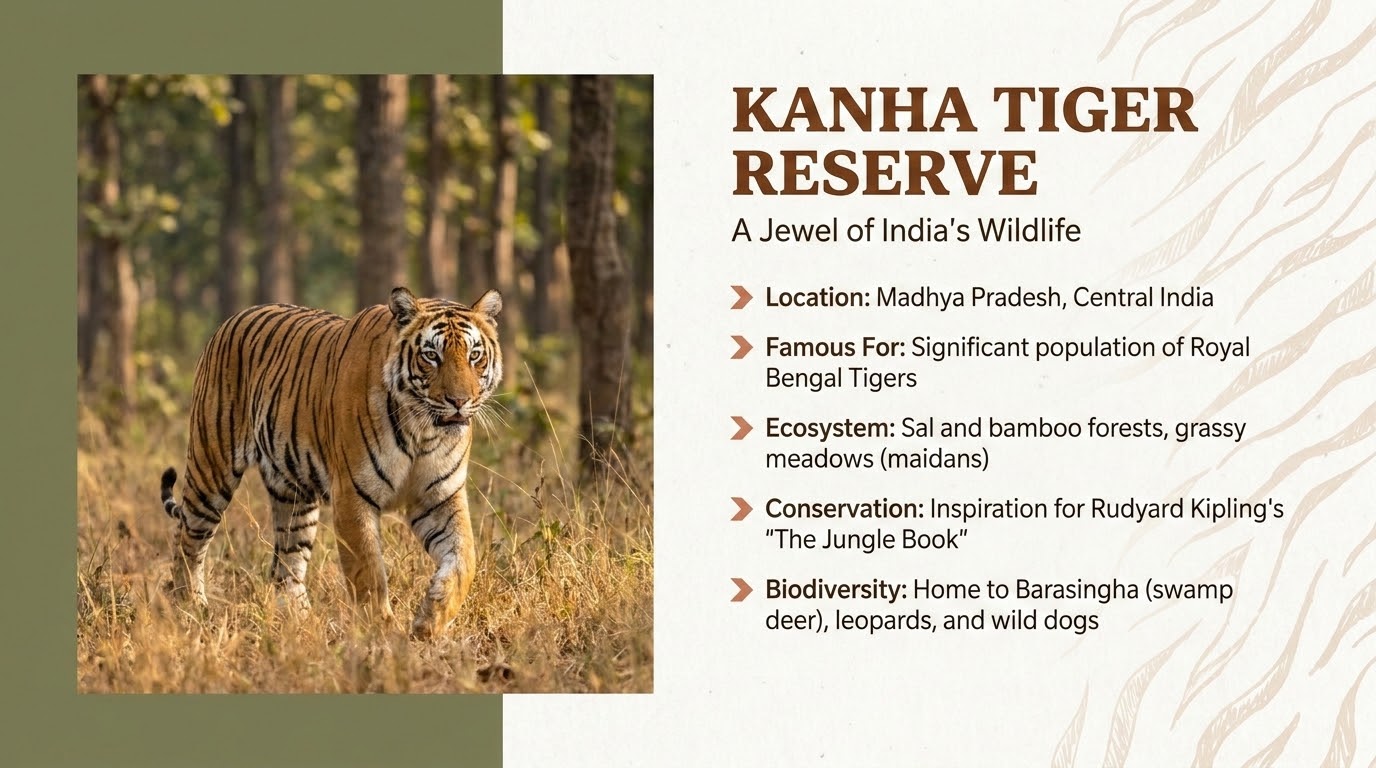
Located in Madhya Pradesh, Kanha is one of India’s largest tiger reserves and the inspiration for Kipling’s The Jungle Book. It is famous for saving the Barasingha (swamp deer) from extinction and offers diverse landscapes of lush sal and bamboo forests.
A tiger cub was found dead in Kanha Tiger Reserve, pushing the number of tiger deaths in Madhya Pradesh to 23 since January 2026.
Geography & Location
Location: In the Maikal range of the Satpuras, the reserve spans two districts: Mandla and Balaghat in Madhya Pradesh.
Area: It covers a core area of 940 sq. km and a surrounding buffer zone of 1,134 sq. km, totaling over 2,000 sq. km.
Corridors: It connects to Pench Tiger Reserve through a vital wildlife corridor and also links with the Achanakmar Tiger Reserve in Chhattisgarh.
Drainage: The reserve is part of the Narmada River catchment, with major tributaries like the Banjar, Halon, and Sulkum rivers flowing through it.
Flora
The reserve’s vegetation is largely Tropical Moist Deciduous Forest mixed with Sal (Shorea robusta) and Bamboo forests.
Key Species: Sal, Bamboo, Tendu, Jamun, Arjun, and Lendia.
Unique Feature: It is home to the Indian Ghost Tree (Kullu), known for its distinct white bark.
Meadows: The park is famous for its large, open grassy meadows (maidans), which are anthropogenic (human-created) in origin, resulting from the relocation of villages.
Fauna
Hard Ground Barasingha (Rucervus duvaucelii branderi): State Animal of Madhya Pradesh and is found exclusively in Kanha. It is the only subspecies of swamp deer that has adapted to live on hard ground.
Indian Wild Dog (Dhole): An endangered pack hunter known for its high social structure.
Other Key Mammals: Leopard, Sloth Bear, Gaur (Indian Bison), Sambhar, Chital, and the rare Mouse Deer.
Mascot: Kanha is the first tiger reserve in India to officially introduce a mascot, "Bhoorsingh the Barasingha", to spread conservation awareness.
Conservation History & Status
1879: Declared a Reserve Forest
1933: Established as a Wildlife Sanctuary
1955: Upgraded to a National Park
1973: Became one of the first nine reserves under Project Tiger.
Tribal Heritage
The forest was originally inhabited by the indigenous Gond and Baiga tribes.
Gond Tribe
The Gonds are a major tribal group, who once ruled Gondwana as a landed, settled community.
Baiga Tribe
The Baigas are a Particularly Vulnerable Tribal Group (PVTG).
SOURCE: TIMESOFINDIA
|
PRACTICE QUESTION Q. With reference to the "Baiga" tribe of Central India, consider the following statements:
Which of the statements given above is/are correct? (a) 1 and 2 only (b) 2 and 3 only (c) 1 only (d) 1, 2, and 3 Answer: d Explanation: Statement 1 is correct: The Baiga tribe is traditionally known for practicing shifting cultivation (slash-and-burn agriculture), which they locally call 'Bewar'. Statement 2 is correct: The Baiga are officially classified as a Particularly Vulnerable Tribal Group (PVTG) in India (specifically in states like Madhya Pradesh and Chhattisgarh) due to their pre-agricultural technology, declining or stagnant population, and low literacy. Statement 3 is correct: Their traditional livelihood practices strictly prohibit the use of the plough. They believe that ploughing the land is akin to scratching or tearing the breast of Mother Earth, and thus they historically relied on the axe and hoe instead. |
Kanha Tiger Reserve is globally renowned for its highly successful tiger conservation under Project Tiger and for single-handedly bringing the Hard Ground Barasingha (the State Animal of Madhya Pradesh) back from the brink of extinction.
It is strategically located in the Maikal range of the Satpura mountains, spanning the Mandla and Balaghat districts of Madhya Pradesh, and forms a critical catchment area for the Narmada River basin.
The deep forests of Kanha were originally inhabited and preserved by the Gond tribe, a historically dominant agricultural community, and the Baiga tribe, a forest-dwelling group designated as a Particularly Vulnerable Tribal Group (PVTG).
Who are the indigenous communities associated with the Kanha landscape?
The deep forests of Kanha were originally inhabited and preserved by the Gond tribe, a historically dominant agricultural community, and the Baiga tribe, a forest-dwelling group designated as a Particularly Vulnerable Tribal Group (PVTG).




© 2026 iasgyan. All right reserved