The UN-Habitat Catalogue of Solutions 2026-2029 outlines 81 strategies to combat global urban challenges, focusing on adequate housing, basic services, and climate action. It empowers governments to achieve SDG 11 through slum upgrading, multi-level governance, and localized sustainable financing.
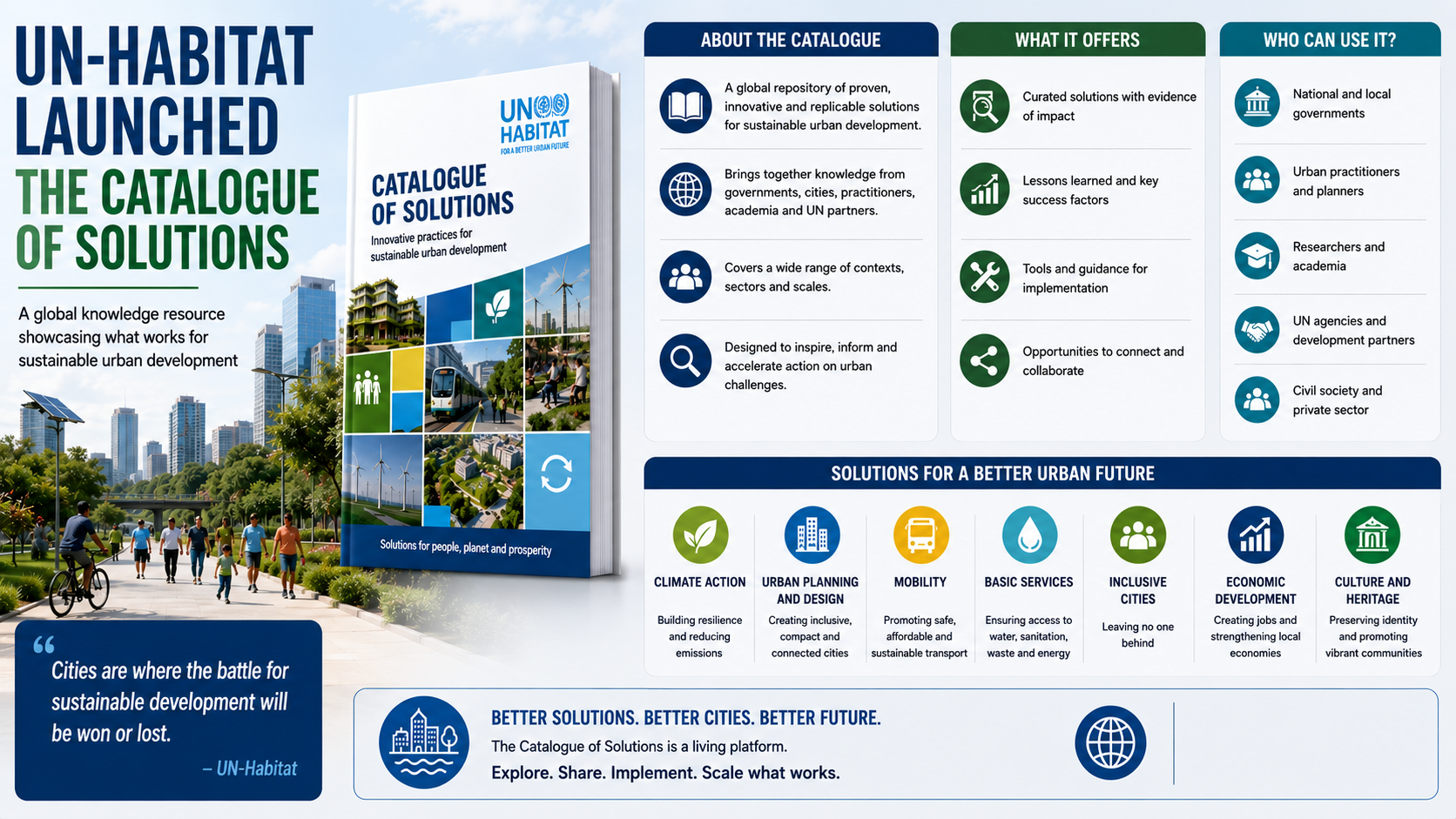
UN-Habitat released the Catalogue of Solutions 2026-2029 to support governments in addressing global crises in housing, inequality, and urban services.
What is the UN-Habitat Catalogue of Solutions?
The Catalogue of Solutions provides 81 proven tools to help governments address global housing, inequality, and urban service challenges.
Integrated with the Sustainable Development Goals (SDGs) and New Urban Agenda, this framework promotes inclusive, sustainable development through participatory governance and climate action.
Critical Affordable Housing Shortage: Insufficient low-cost options leave 2.8 billion people globally facing housing inadequacy. (Source: UN-Habitat)
Urbanization Exceeding Supply: Meeting the needs of three billion people by 2030 requires constructing 96,000 affordable units daily as cities outgrow infrastructure. (Source: UN-Habitat)
Market Commodification: Treating real estate as a financial asset instead of a basic right has inflated prices well beyond average incomes.
Climate Change and Conflict Displacement: Conflicts and extreme weather have displaced over 100 million people. Climate change may force 216 million more to migrate internally by 2050, overstretching urban housing. (Source: World Bank)
Systemic Exclusion: Marginalized groups face political and legal barriers to land ownership and secure housing rights.
Weak Governance: Poor land administration and planning prevent vulnerable populations from obtaining legal titles, fueling the expansion of informal settlements and slums.
Extreme Heat & Urban Heat Islands (UHI): Concretisation and green cover loss caused 17,767 deaths (2000-2020) due to thermal traps. (Source: NDMA)
Economic Impact: Globally Heat-led loss of 259 billion labour hours annually (2001-2020) cost the economy Rs 46 lakh crore. (Source: Duke University)
Service Deficits: Globally, 2.4 billion people lack safe water and 3.4 billion lack sanitation as urban growth outpaces infrastructure. (Source: UN-Habitat)
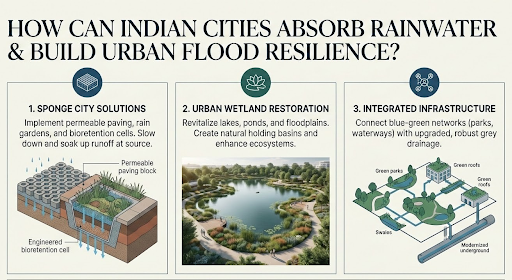
Flooding & Degradation: Wetland construction has crippled natural drainage, causing frequent urban floods.
Pollution & Mobility: Sprawl and private vehicle reliance have created critical congestion and air pollution.
Governance Fragmentation: Overlapping jurisdictions between state and local bodies often lead to delays in project execution and urban planning.
Compact City Planning: Prioritising mixed-use development and vertical growth to prevent urban sprawl and save land.
Green Transit Systems: Investing in electric mass transit, cycling tracks, and pedestrian-only zones to reduce carbon emissions.
Circular Waste Management: Implementing 100% source segregation and converting plastic waste into durable road infrastructure.
Nature-Based Solutions: Restoring urban wetlands and forests to naturally manage floodwater and reduce the "heat island" effect.
Energy-Efficient Buildings: Enforcing building codes that mandate rooftop solar and natural ventilation to lower electricity demand.
Decentralised Water Management: Scaling up rainwater harvesting and local greywater recycling to ensure water security.
Inclusive Housing: Locating affordable social housing near employment hubs to minimize long, carbon-heavy commutes.
Resilient Infrastructure: Building roads and power grids capable of withstanding extreme climate events like floods and cyclones.
Sustainable urbanization requires replacing fragmented growth with participatory, climate-resilient, and data-driven planning that ensures housing, infrastructure, and basic services for all.
Source: DOWNTOEARTH
|
PRACTICE QUESTION Q. The Waste Wise Cities Tool (WaCT), frequently mentioned in the context of sustainable waste management and circular economy, is an initiative launched by which of the following organizations? (a) United Nations Environment Programme (b) United Nations Human Settlements Programme (c) World Bank Group (d) World Economic Forum Answer: (b) Explanation: It was launched by UN-Habitat to provide a standardized methodology for cities to monitor Sustainable Development Goal (SDG), which tracks the proportion of municipal solid waste collected and managed in controlled facilities. |
The UN-Habitat Catalogue of Solutions 2026-2029 is a comprehensive global resource comprising 81 tested tools, methodologies, and frameworks designed to assist governments in addressing urban challenges related to housing, inequality, and basic urban services.
The severe deficit is driven by rapid urbanization, population growth, legal-political exclusion, and the commodification of housing markets, leaving an estimated 2.8 billion people experiencing housing inadequacy.
Endorsed by the UN Statistical Commission in 2022, the UMF harmonizes urban indicators to track progress in urban development using 77 metrics aligned with the SDGs and the New Urban Agenda.


© 2026 iasgyan. All right reserved