The "Energy Statistics India 2026" report by MoSPI highlights India’s dual narrative of rapid economic growth and accelerated green transition. Key findings include a surge in Total Primary Energy Supply, massive solar potential expansion, and reduced transmission losses.
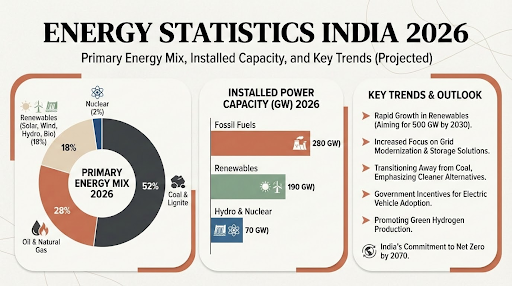
The National Statistical Office (NSO), under the Ministry of Statistics and Programme Implementation (MoSPI), has released the 33rd edition of "Energy Statistics India 2026".
This report provides a comprehensive dataset on India's energy reserves, production, consumption patterns, and installed capacity up to the Financial Year (FY) 2024-25.
The report highlights a defining characteristic of the Indian economy: Decoupling Growth from Inefficiency. While energy demand continues to rise to fuel a $5 Trillion economy ambition, the intensity of that energy use is becoming greener and more efficient.
Sectoral Production & Consumption Trends
A. Coal: The Persistent Backbone
Despite the global push for decarbonization, coal remains the bedrock of India's energy security. The data reflects a pragmatic "Phase-Down" rather than an immediate "Phase-Out."
This continued reliance highlights the Energy Trilemma—balancing security, affordability, and sustainability.
B. Petroleum & Natural Gas: The Import Challenge
The report highlights India’s vulnerability to external shocks due to high import dependence.
Rising import bill impacts the Current Account Deficit (CAD). The data validates the government's push for Ethanol Blending (E20) and Compressed Biogas (CBG) under the SATAT scheme to reduce this reliance.
C. Electricity: The Efficiency Revolution
Renewable Energy Surge: "The Star Performer"
Total Potential: India’s estimated renewable energy potential stands at 47,04,043 MW.
Installed Capacity Growth: RE capacity exploded from 90,134 MW (2016) to 2,29,346 MW (2025), registering a CAGR of 10.93%.
Solar Dominance: Solar energy accounts for 71% of the total renewable potential. Installed solar capacity crossed 132.85 GW by November 2025.
Generation: Electricity generated from renewable sources more than doubled, from 1,89,314 GWh (FY16) to 4,16,823 GWh (FY25).
Regional Skew => Over 70% of India's RE potential is concentrated in just six states: Rajasthan, Maharashtra, Gujarat, Andhra Pradesh, Karnataka, and Madhya Pradesh.
Coal Dependency vs Net Zero: With coal still supplying 79% of energy, the "Net Zero by 2070" target requires a steeper decline in coal use than currently observed.
Storage & Grid Stability: As RE capacity (variable power) grows, the lack of adequate Battery Energy Storage Systems (BESS) poses grid stability risks.
Regional Disparities: The concentration of RE potential in western/southern India could widen economic disparities with eastern states unless transmission infrastructure keeps pace.
Import Bill: The unyielding demand for oil and gas continues to export Indian wealth to oil-producing nations.
Diversification: Accelerate Green Hydrogen (National Green Hydrogen Mission) to decarbonize "hard-to-abate" industrial sectors like steel and refining.
Demand Side Management: Strengthen the PAT (Perform, Achieve, Trade) scheme and aggressively push for Energy Conservation Building Code (ECBC) compliance in the residential sector.
Grid Modernization: Invest in Smart Metering (only 22% installed vs target) and Smart Grids to manage the variable nature of solar/wind.
Distributed Generation: Expand PM Surya Ghar: Muft Bijli Yojana to reduce transmission losses and empower households as "Prosumers" (Producers + Consumers).
Energy Statistics India 2026 reveals a nation in the midst of a "Dual Transition": expanding energy access to uplift millions while simultaneously greening the supply chain.
Source: PIB
|
PRACTICE QUESTION Q. Consider the following statements regarding the "Energy Statistics India 2026" report: 1. It is published annually by the NITI Aayog. 2. Over 70% of India's total Renewable Energy (RE) potential is concentrated in just six states. Which of the statements given above is/are correct? a) 1 only b) 2 only c) Both 1 and 2 d) Neither 1 nor 2 Answer: b) 2 only Explanation: Statement 1 is incorrect. The "Energy Statistics India 2026" report is published annually by the National Statistics Office (NSO), Ministry of Statistics and Programme Implementation (MoSPI), not by NITI Aayog. Statement 2 is correct. The report highlights that more than 70% of India's total Renewable Energy (RE) potential is concentrated in six states: Rajasthan, Maharashtra, Gujarat, Andhra Pradesh, Karnataka, and Madhya Pradesh. |
It is an annual publication released by the National Statistical Office (NSO) under the Ministry of Statistics and Programme Implementation (MoSPI). It provides a comprehensive, integrated dataset mapping India's energy reserves, installed capacity, production, and consumption patterns.
The primary challenges include a deep-rooted dependency on coal for baseline power generation, high Transmission and Distribution (T&D) losses (around 17%, compared to the global 6-8% average), and the geographical skew of renewable energy potential requiring massive investments in transmission corridors.
The Energy Trilemma is a framework defined by the World Energy Council. It highlights the dual challenge facing governments to effectively balance three crucial dimensions in energy governance: ensuring energy security, providing energy equity (access and affordability), and achieving environmental sustainability.



© 2026 iasgyan. All right reserved