The NIRD & PR national study reveals severe participation fatigue in Gram Sabhas due to livelihood pressures, lack of visible outcomes, and proxy leadership like 'Sarpanch Pati'. Reinvigorating grassroots democracy requires digital inclusion, flexible scheduling, and empowering marginalized voices for transparent governance.
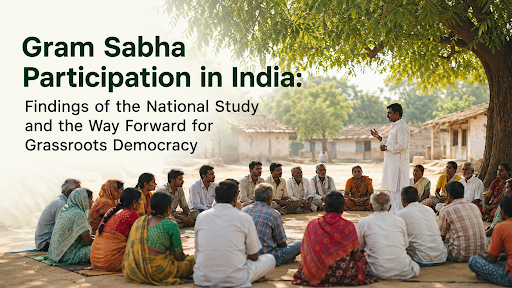
Why In News?
The NITI Aayog released a report on "Low Participation in Gram Sabha across States and UTs," prepared by the National Institute of Rural Development and Panchayati Raj (NIRD&PR) for the Ministry of Panchayati Raj.
What is a Gram Sabha?
The Gram Sabha functions as the general assembly of all registered voters residing within the territorial area of a Gram Panchayat.
Constitutional Status: It derives its authority from the 73rd Constitutional Amendment Act, 1992, specifically under Article 243A of Part IX of the Constitution of India.
Objectives: It promotes participatory democracy, ensures Panchayat accountability through social audits, facilitates local development planning, and strengthens decentralized, citizen-led governance.
Key Findings of the NIRD&PR Study
Participation Fatigue: Citizens experience a decline in motivation as 15-24% of meetings function as routine formalities rather than problem-solving platforms.
Social Exclusion: Social norms and domestic responsibilities limit female participation by 8-15%, while caste-based barriers exclude another 6-12%.
Communication Gaps: Poor awareness accounts for 25-35% of participation drops, with 67.32% of Panchayats relying on outdated manual announcements.
Geographic Variations: Remote and hilly regions face transportation barriers (4-9%) that cripple physical accessibility across the 26 States/UTs surveyed.
Trust Deficit: While 86.78% of grievances reach the Gram Sabha, only 63.29% receive formal recording and follow-up, leading to a lack of visible outcomes (18-28%).
Livelihood Pressures: Daily wage labor and migration block 40-55% of citizens, while agricultural cycles clash with meeting schedules for 30-40% of the workforce.
Infrastructure Deficits: Only 61.9% of locations provide essential physical infrastructure, and a mere 48.2% possess the digital infrastructure required for e-governance.
What are the functions of the Gram Sabha?
Development Planning: It deliberates on priorities and grants final approval for local economic and social development plans.
Beneficiary Selection: It identifies and selects beneficiaries for anti-poverty and wage employment programs.
Social Audits: It verifies the implementation and expenditure of schemes like MGNREGS, ensuring mandatory wage payments reach laborers.
Performance Monitoring: It reviews Action Taken Reports to evaluate resolutions and prevent corruption.
Resource Management: It safeguards community resources, minor forest produce, and water bodies, as empowered by the PESA Act, 1996.
Grievance Redressal: It acts as the primary forum to resolve anomalies in local service delivery and welfare schemes.
Significance
Grassroots Democracy: It empowers every voter as a decision-maker, shifting governance from a "top-down" model to a decentralized, community-centric approach.
Transparency: Mandatory social audits generate bottom-up pressure, as seen in Andhra Pradesh, where audits identified fund misuse and enabled financial recoveries.
Inclusive Development: It integrates women, Scheduled Castes (SCs), and Scheduled Tribes (STs) into policy formulation.
Community Ownership: Deliberation on resource allocation fosters a collective identity, reducing dependency on higher tiers of government.
What are the challenges faced by the Gram Sabha?
Procedural Illiteracy: Vigilance and Monitoring Committee (VMC) members often lack training on social audit mechanisms.
Elite Capture: Wealthy landlords and contractors hijack committees to secure private gains, as evidenced by case studies in Chitradurga, Karnataka.
Proxy Representation: The "Sarpanch Pati" culture suppresses female agency by allowing male family members to act as unofficial proxies.
Institutional Weakness: Panchayats lack financial autonomy and technical manpower, leading to an over-reliance on external contractors.
Structural Conflicts: Class-based clashes between cultivators and wage laborers regarding MGNREGS wages often fracture the Gram Sabha's unified voice.
What are the initiatives taken By Government to strengthen Gram Sabha?
73rd Constitutional Amendment Act: Mandates a three-tier system with 33% reservation for women and proportional representation for SCs/STs.
PESA Act, 1996: Grants absolute primacy to the Gram Sabha in Fifth Schedule Areas to protect tribal traditions.
Sashakt Panchayat Netri Abhiyan: The Ministry of Panchayati Raj promotes this campaign alongside the "Asli Pradhan Kaun?" web series to build female leadership.
Digital Tools: The government deploys the e-GramSwaraj portal, the SABHASAAR platform for recording proceedings, and the NIRNAY App for uploading outcomes.
Way Forward
Awareness Campaigns: Implement a National Gram Sabha Awareness & Mobilisation Mission and distribute Citizen Rights Handbooks.
Independent Audits: Establish state-level Social Audit Units to ensure impartiality and prevent elite interference.
Capacity Building: Utilize State Institutes of Rural Development to upgrade the financial and organizational skills of officials.
Digital Integration: Deploy hybrid participation systems, including digital notice boards and SMS alerts, to engage the public.
Inclusive Scheduling: Institutionalize livelihood-sensitive meeting times and strengthen Mahila Sabha and Ward Sabha structures.
Fiscal Devolution: State Finance Commissions (SFCs) must link the release of untied funds to the quality of civic amenities delivered.
Conclusion
To transform Gram Sabhas from mere procedural formalities into vibrant institutions of grassroots democracy, India must overcome participation fatigue by ensuring visible governance outcomes, leveraging digital inclusion, and eliminating elite capture and proxy representation. Source: PIB
|
PRACTICE QUESTION Q. "Low participation in Gram Sabha meetings undermines the spirit of decentralized democracy." Examine the causes of poor participation and suggest measures to strengthen Gram Sabha institutions in India. (250 Words, 15 Marks) |
A Gram Sabha is the foundational general assembly of all registered voters living within a village or a group of villages under a Gram Panchayat. It is established under Article 243A of the Constitution to act as the primary platform for participatory grassroots democracy.
The Gram Sabha is the permanent legislative body of the village comprising every registered adult voter. In contrast, the Gram Panchayat is the executive body consisting of elected representatives chosen by the Gram Sabha to implement development programs and manage day-to-day local administration.
It shifts governance from a top-down model to a citizen-led approach. By directly involving citizens in beneficiary selection, local planning, and social audits, it enforces strict transparency and allows marginalized communities to actively control local public expenditure.
The NIRD&PR National Study found that widespread "Gram Sabha Participation Fatigue" is driven by severe livelihood and time constraints (affecting 40-55% of the workforce), lack of visible outcomes (18-28%), poor digital and physical infrastructure, and the pervasive social exclusion of women and vulnerable groups, notably worsened by the 'Sarpanch Pati' proxy culture.





© 2026 iasgyan. All right reserved