The PESA Act, 1996 aimed to ensure tribal self-rule by empowering Gram Sabhas in Fifth Schedule Areas. Yet weak state rules, administrative apathy, legal conflicts, and poor awareness have diluted its impact. Despite judicial backing, only strong political will, capacity building, and effective implementation can realise its promise.
Copyright infringement not intended
Picture Courtesy: NEWSONAIR
The two-day Panchayats Extension to Scheduled Areas Act, 1996 (PESA) festival to be held in Visakhapatnam, Andhra Pradesh.
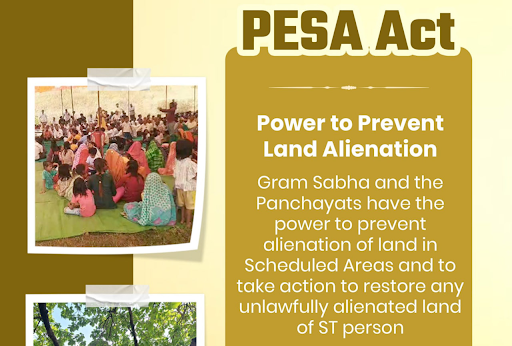
The PESA extends the provisions of Part IX of the Constitution on Panchayats to the Fifth Schedule Areas.
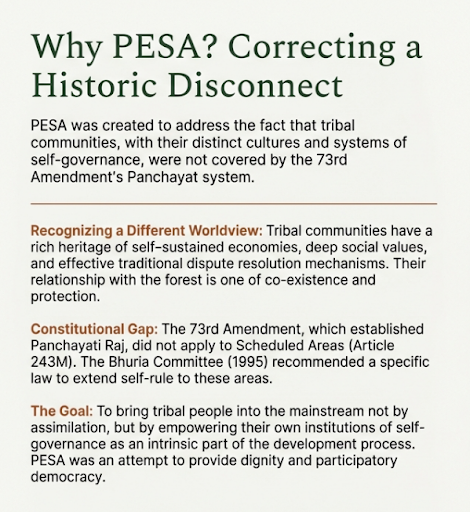
It was enacted based on the recommendations of the Bhuria Committee (1995) to establish participatory democracy and empower tribal communities by legally recognizing the authority of the Gram Sabha in managing their own affairs.
Key Objectives
Constitutional Mandate: PESA operationalizes Article 243M of the Constitution, which allows Parliament to extend Part IX to Scheduled and Tribal Areas with necessary modifications.
Core Principle: It seeks to preserve the traditional customs, cultural identity, and rights of tribal communities over community resources.
Geographical Application: Currently spread across 10 states: Andhra Pradesh, Chhattisgarh, Gujarat, Himachal Pradesh, Jharkhand, Madhya Pradesh, Maharashtra, Odisha, Rajasthan, and Telangana
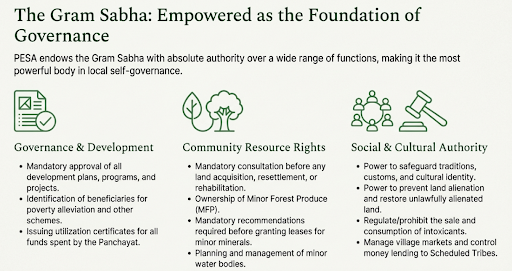
Social and Economic Development: It must approve all plans, programs, and projects for village-level development before they are implemented by the Panchayat.
Beneficiary Selection: It is solely responsible for identifying beneficiaries for poverty alleviation and other welfare programs.
Financial Oversight: It issues certificates of utilization of funds to the Panchayat for all development works.
Minor Forest Produce (MFP): It has full ownership and management rights over MFP, which includes high-value items like bamboo and tendu leaves.
Minor Minerals: Mandatory recommendation from the Gram Sabha is required before granting prospecting licenses or mining leases for minor minerals in its area.
Consultation on Acquisition: It must be consulted before any land acquisition for development projects and before the resettlement or rehabilitation of affected persons.
Social Regulation: It can regulate or restrict the sale and consumption of intoxicants (liquor) and exercise control over local money lending.
Institutional Oversight: It exercises control over local institutions and functionaries in all social sectors, including tribal sub-plans.
Legal and Administrative Gaps
Institutional Resistance
Socio-Economic and Awareness Barriers
External Pressures

SabhaSaar AI Tool: Launched in August 2025, this AI application automatically generates transparent, structured meeting minutes from audio/video recordings of Gram Sabha proceedings in local languages.
Bhashini Integration: Digital services on the eGramSwaraj portal are now available in 22 scheduled languages, helping bridge language barriers in tribal governance.
Dedicated PESA Cell: The Ministry of Panchayati Raj has established a dedicated PESA Cell to monitor implementation, coordinate with states, and provide necessary support.
PM-JANMAN Mission: The Pradhan Mantri Janjati Adivasi Nyaya Maha Abhiyan (PM-JANMAN), launched in November 2023, focuses on the holistic development of 75 Particularly Vulnerable Tribal Groups (PVTGs).
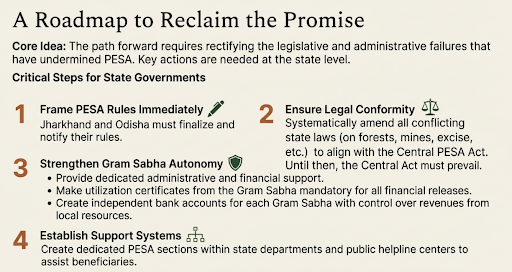
Harmonize State Laws: Governments must amend conflicting statutes, specifically the Indian Forest Act (1927) and the Land Acquisition Act, to ensure they do not override the "Competent Authority" status of the Gram Sabha.
Direct Funding: Transition from Panchayat-level funding to direct Gram Sabha Bank Accounts for tribal sub-plan funds to ensure financial autonomy.
Dedicated Manpower: Appoint dedicated PESA Coordinators and "Mobilizers" at the block level to provide technical and administrative support to traditional heads.
Localized Training: Training should be conducted in local tribal dialects rather than official state languages, utilizing visual and oral media to overcome literacy barriers.
Define 'Minor Forest Produce': Adopt the comprehensive definition of MFP as provided in the Forest Rights Act, 2006, to ensure tribals get maximum benefit.
Establish Accountability: Create a robust social audit and grievance redressal mechanism to hold officials accountable for non-compliance and to protect tribal rights.
Effective PESA Act implementation is vital for rectifying historical injustices, empowering tribal communities, achieving inclusive development, protecting tribal culture, strengthening grassroots democracy, and addressing alienation and conflict in Fifth Schedule Areas, requiring renewed political and administrative commitment.
Source: NEWSONAIR
|
PRACTICE QUESTION Q. The enactment of the PESA Act, 1996, was based on the recommendations of: (a) Sarkaria Committee (b) Balwant Rai Mehta Committee (c) Ashok Mehta Committee (d) Dileep Singh Bhuria Committee Answer: D Explanation: The enactment of the PESA (Panchayats Extension to Scheduled Areas) Act, 1996, was based on the recommendations of the Bhuria Committee (also known as the Dileep Singh Bhuria Committee). |
The Panchayats (Extension to Scheduled Areas) Act, or PESA, is a central law that extends the provisions of Part IX of the Indian Constitution (on Panchayats) to the Fifth Schedule Areas. It legally recognizes the right of tribal communities to govern themselves through their traditional Gram Sabhas.
The objective of PESA is to enable tribal self-rule by empowering the Gram Sabha (village assembly) as the main decision-making body. It aims to protect tribal culture, traditions, and control over community resources from external interference and ensure that development is participatory and culturally appropriate.
Under PESA, the Gram Sabha, which comprises all adult members of a village, is the supreme authority. It has specific powers, such as ownership of minor forest produce and mandatory consultation for land acquisition, that are not vested in regular Gram Panchayats. The elected Panchayat functions under the oversight and direction of this empowered Gram Sabha.





© 2026 iasgyan. All right reserved