NITI Aayog shifted India toward bottom-up governance and competitive federalism. To achieve Viksit Bharat @2047, it must transcend its "think tank" role, addressing fiscal limitations and state-specific aspirations while evolving into a "do tank" for deep structural reforms.
The Government of India has appointed former Chief Economic Adviser Ashok Kumar Lahiri as the new Vice-Chairperson of NITI Aayog, succeeding Suman K. Bery.
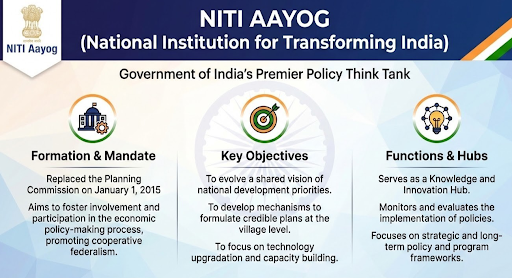
NITI Aayog (National Institution for Transforming India) is the policy "think tank" of the Government of India, established on January 1, 2015, to provide directional and policy inputs.
It is an advisory body that promotes "Cooperative Federalism" by integrating State Governments into economic policy-making, based on the principle that robust states build a strong nation.
Outdated "One Size Fits All" Model: The 65-year-old Planning Commission's centralized command-economy approach became obsolete in a globalized era where uniform plans failed to address diverse state needs.
Transition to Cooperative Federalism: Moving away from the Commission's top-down policy imposition, NITI Aayog treats states as equal partners to foster shared national priorities.
Strategic "Think Tank" Focus: To separate strategy from process, NITI Aayog serves as a knowledge hub and policy advisor, transferring the Commission's former fund-allocation powers to the Finance Ministry.
Evolution of the State's Role: As the private sector grew, the government shifted from a primary provider to a policy enabler—a flexible transition the rigid Planning Commission could not facilitate.
Adopting Bottom-Up Planning: The replacement prioritized local governance, aggregating village-level plans into national strategies rather than following a centralized center-to-state flow.
Financial Control ("Power of the Purse")
Role of States (Federalism)
Nature of Planning
Organizational Structure
Cooperative & Competitive Federalism: As a forum for structured state support, NITI Aayog treats States as equal "Team India" partners to build a stronger nation.
Policy & Strategy Formulation: It develops long-term frameworks like the 15-Year Vision and 7-Year Strategy, monitoring efficacy and making necessary mid-course corrections.
Think Tank & Knowledge Hub: As a "Knowledge and Innovation Hub," it shares best practices in sustainable development and governance with stakeholders.
Monitoring & Evaluation: The Development Monitoring and Evaluation Office (DMEO) tracks government programs to improve implementation and success rates.
Conflict Resolution: It offers a platform for the resolution of inter-sectoral and inter-departmental issues to accelerate the implementation of the development agenda.
Technological Upgradation: It focuses on technology upgradation and capacity building for the implementation of programs and initiatives.
Aspirational Districts Programme (ADP): Since 2018, ADP has targeted 112 under-developed districts, monitoring 49 indicators across themes like health, education, and infrastructure via monthly delta rankings.
Atal Innovation Mission (AIM): Promotes entrepreneurship through Atal Tinkering Labs (ATLs) in schools and Atal Incubation Centres (AICs) for startups.
SDG India Index: The first government-led sub-national measure ranking States/UTs on 16 Sustainable Development Goals to encourage peer learning.
Aspirational Blocks Programme (ABP): Targeting 500 blocks, this initiative builds on ADP to transform local governance and service delivery.
Composite Water Management Index (CWMI): A tool to assess and improve the efficiency of water resource management across States.
School Education Quality Index (SEQI): Evaluates the performance of States in the school education sector.
India Innovation Index: Examines the innovation ecosystem of Indian States and UTs to help policymakers identify challenges and strengths.
Shoonya Campaign: An initiative to promote zero-pollution delivery vehicles by working with e-commerce companies and fleet aggregators.
Women Entrepreneurship Platform (WEP): A unified access portal to support women entrepreneurs with knowledge and financial linkages.
Fiscal Health Index 2026: A newly launched annual index to assess the fiscal sustainability and health of State finances.
Structural Limitations
Funding Restrictions: NITI Aayog is an advisory entity without the power to distribute funds to State Governments. This lack of financial leverage restricts its ability to enforce strategic recommendations.
Limited Implementation Authority: Deprived of the "power of the purse," critics label it a "glorified recommendatory body" that struggles to ensure ground-level execution of its policies.
Operational Gaps: Compared to the Planning Commission, the body faces financial and staffing constraints, hindering its capacity for thorough research and effective program monitoring.
Issues with Cooperative Federalism
State Boycotts & Friction: Despite "Cooperative Federalism" mandate, NITI Aayog faces growing pushback. Chief Ministers from Tamil Nadu, Kerala, and West Bengal have boycotted meetings, alleging centralized decision-making and insufficient fiscal support.
Centralized Agenda: Critics note that while it promotes a "bottom-up" approach on paper, in practice, it functions as a vehicle for the central government's agenda, leading to accusations of politicization and bias
Mediatory Gaps: The body has failed as a mediator for Centre-State financial disputes, with this responsibility shifting to the Finance Ministry and other departments.
Functional & Implementation Challenges
Weak Implementation on Ground: A Parliamentary Standing Committee recently criticized the Ministry of Planning and NITI Aayog for poor execution and planning, noting they utilized only 35% of their 2023-24 budgets.
Data Reliability: Reliance on state-provided data for indices like the SDG Index raises concerns regarding quality and consistency, potentially biasing policy.
Private Investment Constraints: Lacking a direct role in investment influence, its impact on economic transformation remains restricted.
Financial Accountability & Budgetary Discipline
The Parliamentary Standing Committee on Finance (2024-25) highlighted NITI Aayog's poor financial management and urged reforms to improve fund efficiency.
Structural Institutional Reforms
NITI Aayog is restructuring to become implementation-focused rather than just a "think tank."
Strengthening Cooperative Federalism
Experts and state leaders advocate for a less centralized, more authentic "Team India" model.
Decentralizing Science & Innovation
A 2025 roadmap for State Science & Technology Councils focuses on decentralizing innovation.
NITI Aayog marks a shift to bottom-up governance, but its ultimate success in achieving Viksit Bharat @2047 depends on evolving from a "think tank" to a "do tank" by bridging fiscal gaps and strengthening cooperative federalism.
SOURCE: THEHINDU
|
PRACTICE QUESTION Q. Consider the following statements regarding NITI Aayog: 1. It was established through a constitutional amendment. 2. It has the power to allocate funds to states for Centrally Sponsored Schemes. 3. The Governing Council includes all Chief Ministers and Lieutenant Governors. Which of the statements given above is/are correct? a) 1 and 2 only b) 3 only c) 2 and 3 only d) 1, 2, and 3 Answer: b Explanation: Statement 1 is Incorrect: NITI Aayog (National Institution for Transforming India) was established on January 1, 2015, by an executive resolution (Cabinet resolution). It is neither a constitutional body nor a statutory body. Statement 2 is Incorrect: NITI Aayog is a policy "think tank" and does not have the power to allocate funds to states for Centrally Sponsored Schemes, a function that was held by the former Planning Commission. Statement 3 is Correct: The Governing Council of NITI Aayog is composed of the Prime Minister, the Chief Ministers of all states and Union Territories with legislatures, and the Lieutenant Governors of other Union Territories. |
The Planning Commission relied on a rigid "one-size-fits-all" approach and centralized fund allocation that ignored state diversity. It was replaced to introduce a "bottom-up" approach, foster cooperative federalism, and adapt to a market-driven economy post the 1991 reforms.
Launched in 2018, the ADP is a flagship NITI Aayog initiative aimed at transforming India's most backward districts. It focuses on targeted interventions in health, education, and infrastructure, utilizing real-time data and delta rankings to measure progress.
Critics often call it a "toothless" body since it cannot enforce policy through funding. Because it is an executive creation, it faces accusations of political partisanship. It is also criticized for bypassing local grassroots institutions and over-relying on private consultants.





© 2026 iasgyan. All right reserved