The National Commission for Women (NCW) is a statutory body protecting women's rights. Despite achievements in advocacy and awareness, it struggles with weak enforcement powers, severe resource deficits, and case backlogs, urgently necessitating comprehensive structural reforms and autonomy.
Why In News?
The National Commission for Women (NCW) raised concerns regarding the parole framework for convicts of heinous crimes against women and children.
What is the National Commission for Women?
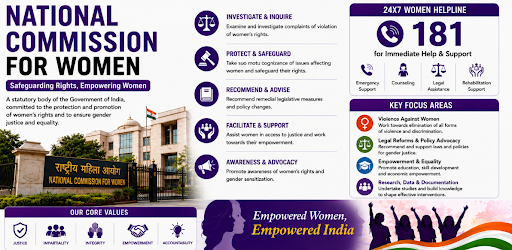
It is a statutory body established under the National Commission for Women Act, 1990 to review constitutional safeguards, facilitate grievance redressal, and advise the government on policies affecting women.
Composition and Mandate
Why NCW Demanded Stricter Measures?
Rising Cybercrimes Against Women: Surge in digital offenses, prompting the need for urgent protections against cyberbullying, deepfakes, and privacy violations.
High Pendency of Complaints: Between the years 2015-2016 and 2022-2023, only 62% of complaints received were successfully closed. (Source: Standing Committee on the Empowerment of Women)
Inadequate Digital Harassment Laws: Existing frameworks lack deterrents, necessitating harsher penalties for distributing obscene or private material and regulating cross-border content.
Lack of Binding Authority: The commission's recommendations are often ignored or diluted by government agencies because it lacks the enforcement powers necessary to penalize violators.
What Reforms NCW Has Suggested?
Amendments to Criminal Codes: Inclusion of cyberbullying and deepfakes as offenses within the Bharatiya Nyaya Sanhita 2023, and increase penalties for online grooming under the Protection of Children from Sexual Offences (POCSO) Act, 2012.
Revisions to the IT Act: Tougher penalties for digital crimes and establishing a mandatory victim compensation fund under the Information Technology Act, 2002.
Expansion of Workplace Protections: Extending the Sexual Harassment of Women at Workplace (POSH) Act, 2013 to include digital harassment and remote workplaces.
Stricter Data Protection Norms: Defining "gender-specific damage" and mandating the removal of non-consensual content under the Digital Personal Data Protection Act, 2023.
Regulation of Online Content: Strengthening the Indecent Representation of Women (Prohibition) Act, 1986 to regulate online platforms and Over-The-Top (OTT) content.
Accountability Mechanisms: Upgrading the National Commission for Women Act, 1990 to hold police accountable for implementing directives and introducing penalties for non-compliance.
Way Forward
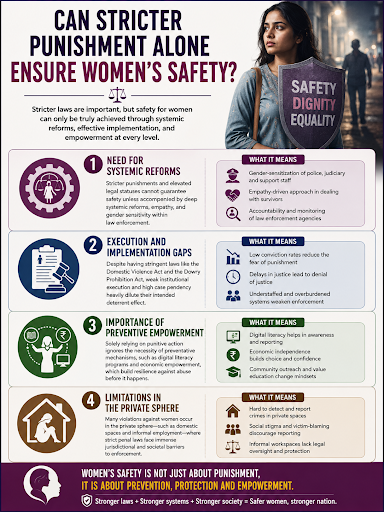
Empower with Binding Authority: Amend the National Commission for Women Act, 1990 to grant enforcement powers against violators and private entities, as recommenced by the Law Commission of India.
Ensure Financial Autonomy: Provide the commission with an independent budget, more funding, and staff to address case backlogs.
Capacitate State Commissions: Strengthen statutory ties with State Commissions for Women, mandating that states fill vacancies and provide adequate funding.
Create Integrated Coordination: Formalize protocols between the commission, police, judiciary, and NGOs to streamline responses and resolve jurisdictional overlaps.
Deploy Grassroots Resources: Launch district-level self-development centers to protect and educate women in rural areas.
Conclusion
To protect women's rights effectively, the National Commission for Women must be strengthened with binding enforcement powers, increased resources, and broader jurisdictional authority.
Source: NEWSONAIR
|
PRACTICE QUESTION Q. Consider the following statements regarding the National Commission for Women (NCW): I. It is a statutory body established under the National Commission for Women Act, 1990. II. The commission has the power to take suo motu cognizance of matters relating to the deprivation of women's rights. III. The commission enjoys penal powers to strictly punish those who violate the constitutional safeguards for women. Which of the statements given above is/are correct? A) I and II only B) II and III only C) I and III only D) I, II, and III Answer: A Explanation: Statement I is Correct: The NCW is a statutory body established in January 1992 under the National Commission for Women Act, 1990. Statement II is Correct: The Commission has the mandate to take suo motu notice (acting on its own initiative) of matters involving the deprivation of women’s rights, non-implementation of laws, or non-compliance with policy decisions. Statement III is Incorrect: While the NCW has the powers of a Civil Court for investigating matters (summoning witnesses, requiring documents), it does not have penal powers. It cannot punish or sentence anyone. It can only make recommendations to the government or suggest the filing of an FIR to the police. |
The NCW is a statutory body established in January 1992 under the National Commission for Women Act, 1990 to review constitutional safeguards, facilitate grievance redressal, and advise the government on women's rights.
The commission comprises a Chairperson, five Members, and a Member-Secretary, all nominated by the Central Government. At least one member each must belong to the Scheduled Castes and Scheduled Tribes.
The commission lacks penal powers. While it holds the powers of a civil court to summon witnesses and gather evidence, it relies on the police and judiciary to penalize violators.



© 2026 iasgyan. All right reserved