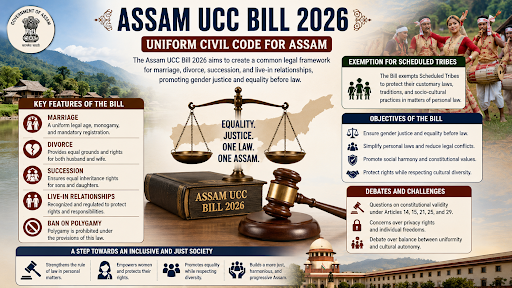
The Assam UCC Bill 2026 regulates marriage, divorce, succession, and live-in relationships while banning polygamy. It exempts Scheduled Tribes to protect customary laws, aiming for gender justice amidst debates on constitutional validity and privacy rights.
Why In News?
The Assam government introduced the Uniform Civil Code (UCC) Bill to regulate marriage, succession, and live-in relationships.
What is the Uniform Civil Code (UCC)?
It refers to a single, secular framework of personal laws intended to replace the fragmented, identity-based laws currently governing marriage, divorce, succession, and adoption in India.
Article 44: This Directive Principle of State Policy mandates that the State shall "endeavour" to secure a UCC for all citizens throughout India.
Legislative Authority: Personal law falls under Entry 5 of the Concurrent List (Seventh Schedule), granting both Parliament and State legislatures the authority to legislate.
Current State Initiatives: In the absence of a central law, states like Uttarakhand (enacted 2024), Gujarat, and Assam have moved toward state-specific codes. Goa maintains a colonial-era Portuguese Civil Code.
What are the Major Provisions of Assam’s UCC Bill (2026)?
Uniform Marriage Standards:
Compulsory Registration:
Gender-Equal Inheritance:
Regulation of Live-in Relationships
Tribal Exemptions
Arguments Supporting the UCC
Gender Justice: It targets discriminatory practices like polygamy and unequal inheritance, providing dignity for minority women.
Legal Streamlining: Codification reduces the burden on the judiciary. In Assam, 42% of civil cases involve personal law disputes.
Constitutional Desideratum: It fulfills the vision of Article 44 to integrate the nation under a shared legal framework.
Economic Impact: Regulating practices like polygamy correlates with higher female labor force participation and lower poverty rates.
Social Reform: It addresses issues like child marriage and ensures legal protections (maintenance and property rights) for all spouses.
Concerns Regarding the UCC
Fragmented Uniformity: When each state enacts a different code, it creates "differentiated uniformity," undermining the goal of a single national standard.
Privacy & Surveillance: Mandatory registration of live-in relationships is viewed by some as institutional surveillance and an intrusion into adult emotional autonomy.
Religious Freedom: Overriding practices seen as "divine command" (e.g., Quranic inheritance) may conflict with Articles 25 and 26.
The Gender Equality Paradox: Exempting tribal communities may create a "two-tier citizenship" where tribal women remain subject to patriarchal customary laws that deny land rights.
Jurisdictional Quagmire: Parallel legal systems (UCC vs tribal customary law) may lead to "forum shopping" and legal ambiguity in inter-community disputes.
Social Coercion: Opponents argue that the problem is not the lack of secular laws (like the Special Marriage Act) but social barriers that prevent women from using them.
Way Forward
Modular Uniformity: Apply core principles like gender equality and child protection universally, while allowing ceremonial and procedural variations by community.
Strengthening Existing Institutions: Improve the condition of family courts, fund legal aid, and promote the use of the Special Marriage Act 1954.
Organic Convergence: Encourage customary systems to evolve from within. For example, some Bodo village councils have already amended rules to include daughters in inheritance.
Meaningful Consultation: Ensure extensive dialogue with community organizations, religious leaders, and legal experts to gain organic legitimacy for reforms.
Focus on Substantive Justice: Prioritize protecting the vulnerable over the mere formal application of identical rules to all citizens.
Conclusion
The UCC represents a transition toward a dynamically balanced pluralism where a nation's legal system remains uniform in its principles of justice but plural in its application.
Source: NEWSONAIR
|
PRACTICE QUESTION Q. Consider the following statements regarding the Uniform Civil Code (UCC) in India:
Which of the statements given above is/are correct? A) 1 and 2 only B) 3 only C) 1 and 3 only D) 1, 2, and 3 Answer: B Explanation: Statement 1 is incorrect: Article 44 is classified under the "Liberal-Intellectual Principles" of the Directive Principles of State Policy (DPSP), not the Socialistic Principles. Statement 2 is incorrect: While Article 44 does use the phrase "throughout the territory of India," DPSPs are non-binding guidelines. The word used is "endeavour," meaning it directs the state towards a goal but does not automatically bind all states to immediately implement it. Statement 3 is correct: Like Fundamental Rights, DPSPs are non-justiciable. However, the Supreme Court has consistently held that the judiciary can—and should—read and interpret existing statutes and Fundamental Rights in light of DPSPs to prevent them from being deemed unconstitutional. |
The UCC is a proposed set of laws designed to replace the different personal laws (based on religious scriptures and customs) currently governing civil matters like marriage, divorce, succession, and adoption with one common law applicable to all Indian citizens regardless of their religion.
The UCC is mentioned in Article 44 of the Constitution, which falls under the Directive Principles of State Policy. This means it is a guiding principle for the state to establish over time, rather than a legally enforceable, immediate mandate.
Critics and minority groups worry that the UCC could infringe on their constitutionally guaranteed freedom of religion and cultural practices. They argue that India’s pluralistic and diverse society requires the preservation of distinct community identities.



© 2026 iasgyan. All right reserved