Israel’s "Yellow Line" is a unilateral, militarized buffer zone in Gaza and Lebanon. It reflects a strategic shift toward forward defense and territorial control to prevent militant infiltration, but draws international criticism for displacing civilians and violating national sovereignty.
Why In News?
Israel has escalated military ground operations, pushing troops past the "Yellow Line" in southern Lebanon.
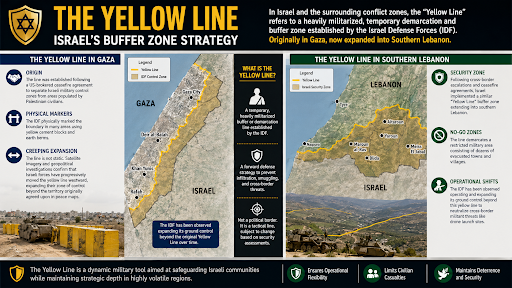
What is Yellow Line?
Military Demarcation: The Yellow Line serves as a tactical and operational boundary defined by Israeli military presence rather than diplomatic agreement.
Buffer Zone Creation: It establishes a controlled security perimeter deep within conflict territories to segregate Israeli-controlled zones from areas under adversary influence.
Flexible Boundary: Unlike fixed international borders, this line is expandable based on the intensity of the conflict and security requirements.
Exclusionary Nature: The Israel Defense Forces (IDF) treat areas behind the line as closed military zones or free-fire zones, where civilian movement is strictly prohibited or heavily restricted.
Israel has implemented the Yellow Line strategy in:
Strategic Objectives and Defense Doctrine
Forward Defense: The doctrine neutralizes threats before they reach Israel's recognized borders, pushing the conflict zone into foreign territory.
Strategic Depth: By expanding the distance between the frontline and Israeli population centers, the IDF gains additional reaction time during attacks.
Disruption of Militant Logistics: The zone aims to destroy Hezbollah and Hamas infrastructure, including tunnels and launch sites, and disrupt supply lines.
De Facto Control: While not official annexation, the strategy establishes effective territorial control, which may influence future political negotiations.
Geopolitical and Humanitarian Implications
Violation of Sovereignty: The international community and the Lebanese government view the Yellow Line as a violation of national sovereignty and international humanitarian law.
Humanitarian Crisis: Agencies classify the line as a tool for forced displacement and creeping annexation. In Gaza, it restricts residents to 42% of the territory, cutting off access to vital agricultural lands.
Violation of Ceasefires: Global watchdogs, including Office of the United Nations High Commissioner for Human Rights (OHCHR), argue that the continued military activity and "free-fire" zones around the line undermine existing truce agreements.
Cultural Loss: Demolitions within the zone have destroyed heritage sites, such as the 12th-century shrine in Chamaa and the 400-year-old Great Mosque in Bint Jbeil.
Source: REUTERS
|
PRACTICE QUESTION Q. Consider the following statements regarding the "Yellow Line" recently seen in the news:
Which of the statements given above is/are correct? (A) 1 only (B) 2 only (C) Both 1 and 2 (D) Neither 1 nor 2 Answer: (B) Explanation: Statement 1 is incorrect: The recognized international boundary between Israel and Lebanon is the United Nations-demarcated "Blue Line". The "Yellow Line" is an informal, self-declared Israeli military boundary extending several kilometers deep into southern Lebanon, and it is not an internationally recognized border. Statement 2 is correct: The "Yellow Line" signifies a unilateral buffer zone established by Israel inside southern Lebanon. It serves as a forward defensive posture where the Israeli military prohibits civilians from returning, operating much like the “Gaza Model” to prevent militant infiltration and secure the northern Israeli frontier. |
The "Yellow Line" is a military-imposed demarcation or buffer zone created unilaterally by Israeli forces deep inside conflict territories to establish a controlled security perimeter.
It was first introduced during the Gaza war in October 2025 to effectively bifurcate the Gaza Strip into Israeli-controlled areas and Palestinian areas.
Unlike conventional political borders, it is not legally recognized internationally. It is an active, flexible, and heavily militarized deployment boundary enforced by advanced surveillance and troop presence.





© 2026 iasgyan. All right reserved