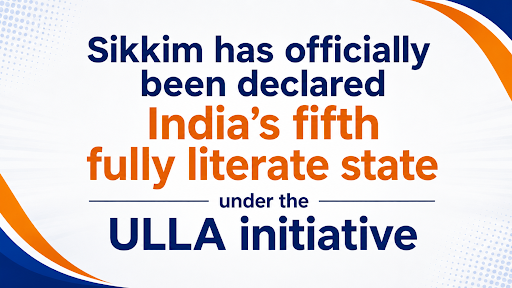
Sikkim is India's fifth fully literate state, achieving 99.82% literacy under the ULLAS scheme. Targeting adults aged 15 and above, this Ministry of Education initiative aligns with NEP 2020 by imparting foundational literacy, numeracy, and essential life skills.
Why In News?
Sikkim is declared as a fully literate state under the ULLAS initiative.
What Is the ULLAS Initiative?
The ULLAS (Understanding Lifelong Learning for All in Society) initiative is a centrally sponsored scheme launched in 2022, to implement the recommendations of the National Education Policy (NEP) 2020.
It aims to provide education to non-literates aged 15 years and above who missed formal schooling.
Objective: Empower learners with Foundational Literacy and Numeracy (FLN) and Critical Life Skills to integrate them into mainstream society.
Tagline: "Jan-Jan Saakshar" (Education for all/Mass literacy).
Key Target: Reach 5 crore learners between the financial years 2022–2027 (at a rate of 1 crore learners per year).
Primary Components (NEP 2020 Framework):
How Did Sikkim Achieve Full Literacy?
In May 2026, Sikkim was officially declared India's fifth "fully literate" state under the ULLAS framework, following Mizoram, Goa, Tripura, Himachal Pradesh.
Implementation Model: Sikkim utilized the Neo India Literacy Programme (NILP), leveraging Volunteer Teachers and Headmasters.
What Are the Constitutional and Policy Provisions Related to Literacy?
Fundamental Rights
National Education Policy (NEP) 2020: Replaces the term "Adult Education" with "Education for All." Article 21.4 emphasizes innovative government initiatives and the integration of technology to speed up literacy goals.
International Framework
Way Forward to Achieve Full Literacy in India
Volunteerism and Mass Movement: Transition literacy programs from government schemes into a community-led mass movement. This involves fostering Kartavya Bodh (a sense of social duty) among volunteers, students, and citizens.
Integration of Technology: Utilize the ULLAS App for registration and tracking of learners and volunteers.
Development of Contextual Primers: States should develop regional-language primers (like the NCERT ULLAS exemplar) that reflect local socio-cultural environments.
Institutional Support: Establish Samajik Chetna Kendras (Social Awareness Centers) for community learning.
Conclusion
India can achieve universal literacy by transforming education into a digitally-integrated mass movement that restores dignity and functional independence to every non-literate citizen.
Source: ECONOMICTIMES
|
PRACTICE QUESTION Q. Consider the following statements regarding the ULLAS (Nav Bharat Saaksharta Karyakram) scheme:
Which of the statements given above is/are correct? A) 1 and 2 only B) 2 and 3 only C) 1 and 3 only D) 1, 2, and 3 Answer: A Explanation: Statement 1 is correct: The ULLAS (Nav Bharat Saaksharta Karyakram), also known as the New India Literacy Programme (NILP), is designed to impart foundational literacy and numeracy to non-literate citizens aged 15 years and above. Statement 2 is correct: Under the ULLAS framework, a state is officially declared "fully literate" if it crosses the adult literacy rate benchmark of 95%. Statement 3 is incorrect: Sikkim is not the first state to be declared fully literate under the ULLAS framework; it achieved this milestone as the fifth fully literate state. Mizoram was the first state in India to achieve full functional literacy under the ULLAS initiative. |
ULLAS (Understanding of Lifelong Learning for All in Society), also known as the Nav Bharat Saaksharta Karyakram, is a centrally sponsored scheme aimed at imparting foundational literacy, numeracy, and critical life skills to non-literates aged 15 and above.
According to the Ministry of Education, achieving a 95% or higher adult literacy rate in a State/UT is considered equivalent to being fully literate.
As of May 2026, the five fully literate states are Mizoram, Goa, Tripura, Himachal Pradesh, and Sikkim.


© 2026 iasgyan. All right reserved