The PM SHRI scheme develops fourteen thousand five hundred schools into exemplar institutions showcasing the National Education Policy. It features green infrastructure and modern pedagogy but faces implementation challenges due to funding and branding disputes with several participating Indian states.
Why In News?
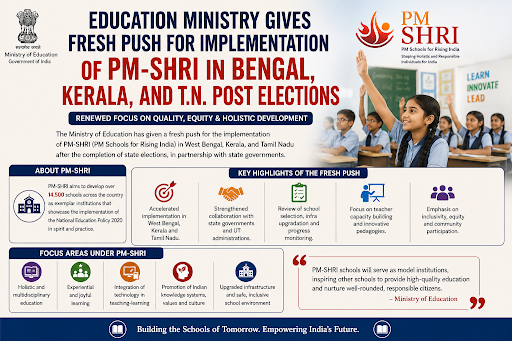
The Union Education Ministry issued reminders to West Bengal, Kerala, and Tamil Nadu to implement the PM-SHRI school transformation scheme.
What is PM SHRI?
The government launched the Pradhan Mantri Schools for Rising India (PM SHRI) in 2022 as a Centrally Sponsored Scheme.
Objectives: Upgrades over 14,500 existing schools (including Kendriya Vidyalayas, Navodaya Vidyalayas, and local body schools) into model exemplar institutions that showcase the National Education Policy (NEP) 2020.
Funding: The Centre allocated a total budget of Rs. 27,360 crore, sharing the financial burden in a 60:40 ratio with general states, a 90:10 ratio for Northeastern/Himalayan states, and 100% funding for Union Territories without a legislature.
What are the key features of the scheme?
Challenge Method Selection
The Ministry selects schools through a transparent three-stage competition, wherein states sign a Memorandum of Understanding (MoU), shortlist schools using UDISE+ data, and verify claims through physical inspections.
Innovative Pedagogy
Teachers implement experiential, holistic, integrated, and toy-based learning to build 21st-century skills and STEAM (Science, Technology, Engineering, Arts, and Mathematics) education.
Modern Infrastructure
Equips schools with smart classrooms, ICT labs, Atal Tinkering Labs, and fully resourced science laboratories.
Green Schools
Integrating environmental sustainability by installing solar panels, rainwater harvesting systems, and waste management facilities.
Quality Monitoring
The National Council of Educational Research and Training (NCERT) developed the School Quality Assessment Framework (SQAF) to track learning outcomes and evaluate teacher performance.
Language and Skill Focus
Use of the mother tongue or regional languages in foundational years and link students with Sector Skill Councils for vocational training
Why are some states hesitant to Join?
Branding and Funding Disputes
States like Punjab object to appending the "PM SHRI" prefix to school names, arguing that states still bear 40% of the financial cost.
Language Policy Concerns
Tamil Nadu rejects the scheme because it enforces the NEP's three-language formula, which the state views as the imposition of Hindi.
Ideological and Autonomy Fears
Kerala and other opposition-ruled states view the scheme as a centralising mechanism that imposes an ideological agenda and undermines state autonomy.
Duplication of State Schemes
Delhi initially declined participation, arguing that PM SHRI duplicates their successful "Schools of Specialised Excellence" and "Schools of Eminence" programs.
What challenges exist in implementation?
Federal Friction
The mandatory MoU and central branding spark political friction and threaten the principles of cooperative federalism.
Financial Strain
The Centre halted Samagra Shiksha Abhiyan (SSA) funds for states refusing to sign the MoU, which strains state education budgets.
Uniformity vs. Diversity
A rigid "one-size-fits-all" approach fails to accommodate the diverse educational models and specific regional needs of different states.
Teacher Capacity
Transforming pedagogy demands extensive teacher retraining and shifting long-standing instructional mindsets.
Scalability Hurdles
Replicating the high standards of 14,500 exemplar schools across millions of Indian schools poses massive logistical and administrative challenges.
What are the Way Forward?
Promote Cooperative Federalism
The Centre must offer greater administrative and fiscal flexibility to states, respecting local autonomy and diverse educational backgrounds.
Empower Educators
Provide sustained, high-quality continuous professional development to help teachers master NEP-aligned pedagogies.
Strengthen Monitoring
Leverage the SQAF and geo-tagging to ensure transparent, data-driven evaluation and timely course corrections.
Encourage Collaborative Participation
Involve local communities, Public-Private Partnerships (PPP), and Corporate Social Responsibility (CSR) to mobilise necessary resources.
Conclusion
The PM-SHRI scheme serves as a transformative milestone to modernise India's educational architecture by operationalising NEP 2020, but its ultimate success relies heavily on cooperative federalism and flexible state-level implementation.
Source: THEHINDU
|
PRACTICE QUESTION Q. The success of centrally sponsored educational schemes depends heavily on state cooperation. Critically analyse. 150 words |
The main objective is to upgrade over 14,500 existing government schools into "exemplar" model schools that showcase the effective implementation of the National Education Policy (NEP) 2020, serving as lighthouse institutions for nearby schools.
It is a Centrally Sponsored Scheme with a 60:40 fund-sharing ratio between the Centre and general states/UTs with legislature. For Northeastern and Himalayan states, the ratio is 90:10, and it is 100% centrally funded for UTs without a legislature.
Schools are selected through a three-stage 'Challenge Mode' process. States must first sign an MoU; then, eligible schools are shortlisted using UDISE+ data benchmarks; finally, schools compete based on criteria that are verified through physical inspection.





© 2026 iasgyan. All right reserved