The SEHAT mission integrates agriculture and public health to promote preventive healthcare. It leverages biofortified crops and the One Health approach to combat malnutrition and lifestyle diseases across India.
Why In News?
SEHAT Mission launched with the objective of building a framework for ‘Healthy Food, Healthy Farms and a Healthy India’.
What is SEHAT Mission?
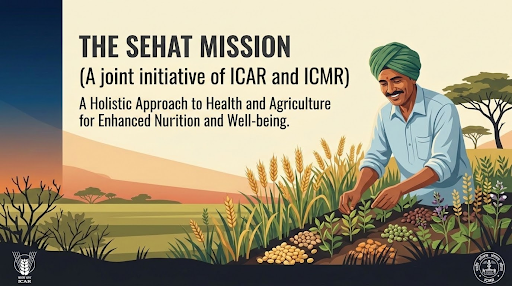
The Indian Council of Medical Research (ICMR) and the Indian Council of Agricultural Research (ICAR) jointly launch the SEHAT (Science Excellence for Health through Agricultural Transformation) mission.
The initiative aligns agricultural research with national public health priorities to build a robust framework for Healthy Food, Healthy Farms, and a Healthy India.
The mission marks a policy shift from a reactive, curative healthcare model to a proactive, preventive approach.
What are the Key Features of the SEHAT Mission?
Biofortified Crops Development
Evaluates and develops nutrient-dense crop varieties to naturally eliminate malnutrition and "hidden hunger".
Integrated Farming Systems
Promotes dietary diversification and builds farm resilience while enhancing farmer incomes.
Occupational Health Focus
Implements evidence-based interventions to minimize specific health and safety risks for agricultural workers.
NCD Prevention
Utilizes functional foods and nutritionally superior crops to combat non-communicable diseases (NCDs).
One Health Preparedness
Strengthens integrated disease surveillance, diagnostics, and research at the interconnected human-animal-environment interface.
How the Mission Benefits Citizens?
Combats the Dual Disease Burden
Addresses undernutrition alongside the rising epidemic of lifestyle diseases like diabetes, cancer, and hypertension.
Promotes "Food as Medicine"
Ensures that daily staples deliver essential nutrients directly, turning everyday agricultural output into a natural health intervention.
Safeguards Agricultural Workers
Protects farmers from hazardous working conditions, pesticide exposure, and imbalanced chemical use.
Enhances Rural Livelihoods
Helps rural families achieve balanced diets by integrating crop cultivation with animal husbandry, fisheries, and beekeeping.
Drives Indigenous Innovation
Reduces reliance on imported technologies by generating low-cost, high-quality, and scientifically validated indigenous health solutions.
What are the Challenges in Implementation?
Breaking Institutional Silos
Overcoming the historical isolation between agricultural production systems and medical research institutions to ensure collaboration.
Ensuring Public Acceptance
Challenges of shifting long-standing dietary habits to encourage the widespread consumption of traditional grains like kodo millet, jowar, and ragi.
Validating Outcomes
Generating clinical evidence to prove the health benefits of biofortified crops, as the absence of clinical trials currently limits public acceptance.
Scaling One Health Infrastructure
Securing compliance with biosecurity measures and expanding Biosafety Level (BSL-3/4) laboratories to manage zoonotic disease threats.
What Should Be the Way Forward?
Adopt a "Whole-of-Government" Strategy
Integrate science, policy, and implementation mechanisms to ensure the mission functions as a unified system.
Revive Traditional Dietary Principles
Promote the ancient Indian philosophical concepts of "Hitbhuk, Mitbhuk, and Ritubhuk" (eating beneficial, balanced, and seasonal food) to build a cultural foundation for public health.
Implement Outcome-Based Funding
Link financial resources to measurable public health outcomes and strict accountability.
Strengthen Inter-Sectoral Surveillance
Operationalize integrated public health laboratories and utilize predictive modeling for early disease warning at the human-animal interface.
Conclusion
The SEHAT Mission aims to transform the Indian public health system by integrating agricultural innovation with preventive healthcare to build a well-nourished, disease-resilient society.
Source: PIB
|
PRACTICE QUESTION Q. With reference to the 'SEHAT Mission', consider the following statements:
Which of the statements given above is/are correct? (a) 1 only (b) 2 only (c) Both 1 and 2 (d) Neither 1 nor 2 Answer: A Explanation: Statement 1 is correct: The SEHAT Mission is a collaborative initiative launched jointly by ICAR and ICMR. Statement 2 is incorrect: The objective is to shift from a reactive/curative model to a proactive/preventive model using agriculture and nutrition, not building hospitals. |
The SEHAT (Science Excellence for Health through Agricultural Transformation) Mission is a national program aimed at integrating agricultural policy with preventive healthcare objectives to deliver measurable public health outcomes.
The mission is a joint initiative led by the Indian Council of Medical Research (ICMR) and the Indian Council of Agricultural Research (ICAR).
The mission marks a decisive shift from a reactive and curative healthcare model to a proactive, preventive, and holistic approach by aligning agricultural production with the nutritional needs of the population.





© 2026 iasgyan. All right reserved