The CBI lacks statutory status, facing political pressure through annual extensions and delayed prosecution sanctions. Granting robust statutory backing via a dedicated Act will ensure structural independence and institutional integrity.
Why in the news?
The Appointments Committee of the Cabinet (ACC) approved a one-year extension for Central Bureau of Investigation (CBI) Director Praveen Sood.
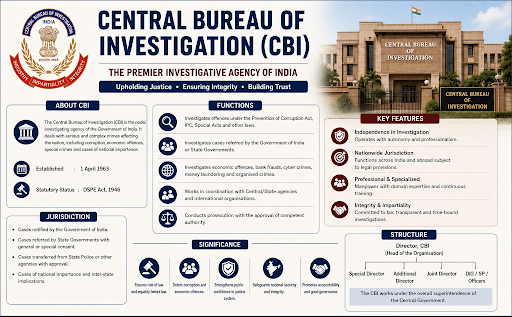
About Central Bureau of Investigation
The Government established the CBI in 1963 through a Home Ministry resolution following the recommendations of the Santhanam Committee.
The CBI derives its powers from the Delhi Special Police Establishment Act, 1946 and operates under the jurisdiction of the Ministry of Personnel, Public Grievances and Pensions.
The agency functions as India's premier investigative body to tackle corruption by public servants, economic crimes, and special crimes.
What is the Process for Appointment of the CBI Director?
A high-powered selection committee evaluates candidates and chooses the CBI Director.
The law guarantees a minimum two-year tenure for the Director to ensure effective administration without job insecurity.
DSPE Amendment Act 2021 => Government holds the authority to extend the Director's tenure "in public interest" for one year at a time, up to a maximum of five total years.
Functions of the CBI
Anti-Corruption: Investigating cases of bribery, misconduct, and corruption involving employees of the Central Government and Public Sector Undertakings (PSUs).
Economic Crimes: Probing major financial frauds, bank scams, and violations of fiscal laws (e.g., customs, income tax, foreign exchange) in consultation with relevant departments.
Special Crimes: Handling serious conventional crimes with national or international ramifications, such as organized crime, terrorism, kidnapping, and murder.
Interpol Coordination: Acting as the "National Central Bureau" of Interpol in India to coordinate international police cooperation and fugitives' extradition.
Suo Motu Investigation: The CBI can suo motu (on its own) investigate offenses only within Union Territories. In states, it requires the consent of the state government or a direct order from the Supreme Court or a High Court.
What are the Concerns about CBI Autonomy?
Political Interference
The Supreme Court openly criticizes the CBI as a "caged parrot" that merely repeats its master's voice, highlighting the need to eliminate illegitimate external pressures.
Tenure Extensions
Annual, incremental extensions of the Director's tenure compromise autonomy by incentivizing leaders to display loyalty to the ruling government.
Selection Process Friction
The Leader of the Opposition recently registered strong dissent during the selection process, alleging institutional capture and the denial of 360-degree candidate appraisal reports.
Weak Statutory Base
The agency lacks a dedicated legislative act; the Gauhati High Court previously ruled the CBI unconstitutional because a mere executive resolution creates it, though the Supreme Court stays this ruling.
Structural Dependence
The CBI is not a statutory body; it relies on the Ministry of Home Affairs for staffing (IPS officers on deputation) and the Law Ministry for legal counsel, leaving it vulnerable to manipulation via transfers and postings.
Withdrawal of General Consent
Several states have withdrawn "general consent" for the CBI, forcing the agency to seek permission on a case-by-case basis, which delays investigations and politicizes federal cooperation.
Financial Dependence
The CBI lacks an independent budget and relies on the government for funds, which limits its operational freedom.
Exemption from RTI
The agency is exempt from the Right to Information (RTI) Act, which reduces public accountability and transparency regarding its functioning.
How Can Investigative Agencies be Strengthened?
Enact a Dedicated CBI Act: Replace the DSPE Act with a new "Central Bureau of Intelligence and Investigation Act" to give the CBI statutory status equivalent to the Election Commission of India.
Financial Autonomy: Create a dedicated consolidated fund for the agency so it is not dependent on government approvals for daily operations or infrastructure upgrades.
Independent Oversight: Place the agency under the supervision of an independent body (like the Lokpal) or a parliamentary committee rather than a government ministry to insulate it from executive influence.
Dedicated Cadre: Reduce reliance on deputation by recruiting a permanent cadre of officers and specialists (cybersecurity, forensics, accounting) to ensure continuity and specialized expertise.
Umbrella Organization: Establish an independent umbrella institution to bring various central agencies (CBI, Enforcement Directorate) under one roof for better coordination and legislative oversight.
Separation of Wings: Separate the investigation wing from the prosecution wing to ensure objective decision-making, as recommended by the 2nd ARC.
Conclusion
Ensuring the CBI's operational autonomy and statutory backing remains essential to transform it from a vulnerable executive tool into an impartial, uncaged institution that strictly upholds the rule of law.
Source: THEHINDU
|
PRACTICE QUESTION Q. With reference to the jurisdiction of the Central Bureau of Investigation (CBI), consider the following statements:
Which of the statements given above is/are correct? A) 1 only B) 2 only C) Both 1 and 2 D) Neither 1 nor 2 Answer: B Explanation: Statement 1 is incorrect: Under Section 6 of the Delhi Special Police Establishment (DSPE) Act, 1946, the Central Bureau of Investigation (CBI) cannot automatically investigate crimes within a state's territorial jurisdiction. It mandatorily requires either "general" or "case-specific" consent from that specific state government to operate there. Statement 2 is correct: The Constitutional Courts—the Supreme Court and the High Courts—possess the power to order a CBI probe into a crime anywhere in the country. When a judicial order is passed by these courts, the requirement for state government consent under the DSPE Act is entirely dispensed with. |
The government appoints the CBI Director based on the explicit recommendation of a selection committee comprising the Prime Minister, the Chief Justice of India, and the Leader of the Opposition in the Lok Sabha.
The law guarantees a minimum two-year tenure for the CBI Director to ensure leadership stability and operational independence.
The CBI derives its power to conduct investigations strictly from the Delhi Special Police Establishment Act, 1946.





© 2026 iasgyan. All right reserved