The recurring NEET-UG paper leaks expose structural vulnerabilities within the National Testing Agency. Resolving this credibility crisis requires enforcing the Public Examinations Act, 2024, implementing the Radhakrishnan Committee recommendations, and building a secure, technology-driven, statutory testing ecosystem.
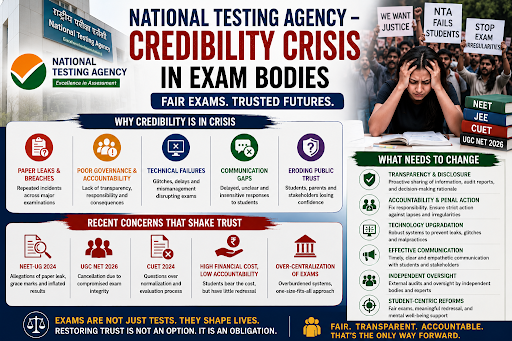
The National Testing Agency (NTA) faces a credibility crisis due to paper leaks, grace mark controversies, and institutional failures in major exams.
The Ministry of Education established the National Testing Agency (NTA) in 2017 as a specialized, autonomous, and self-sustained organization.
The NTA functions as a registered Society under the Indian Societies Registration Act of 1860.
The agency conducts high-stakes undergraduate and postgraduate entrance assessments, including JEE-Main, NEET-UG, CUET, and UGC-NET.
The agency suffers from repeated paper leak controversies, such as the NEET-UG 2026 leak.
Digital platforms facilitate the circulation of leaked "guess papers" via WhatsApp and Telegram, compromising examination integrity.
The NTA causes frequent delays in declaring CUET results, which disrupts university academic sessions and exerts unnecessary psychological pressure on students.
The examination system experiences a continuous pattern of administrative failures, including impersonation scams, organized cheating rackets, proxy candidates, and grace mark controversies.
The NTA lacks sovereign accountability and administrative teeth because it operates as a "legal lightweight" society rather than a constitutional or statutory body.
The agency handles an overstretched workload, with exam registrations increasing from 67 lakh in 2019-20 to over 122 lakh by 2023-24. (Source: Dr. K. Radhakrishnan Committee)
A heavy reliance on deputation and contractual staff prevents the NTA from building a permanent, specialized cadre dedicated to psychometrics, cyber security, and secrecy.
The "Mega-Exam" model creates catastrophic single-point failure risks, where testing over 20 lakh students on a single day amplifies logistical vulnerabilities.
The agency outsources tasks like printing, warehousing, and transportation to private third-party vendors, creating multiple human touchpoints for potential leaks.
The NTA ignored suggestions to transition away from physical paper chains, continuing to conduct offline exams despite experts recommendations for encrypted digital delivery.
The agency's "Zero Error, Zero Tolerance" policy failed during on-ground execution, exposing gaps in GPS-tracked transport and CCTV surveillance protocols.
Digital infrastructure gaps restrict the NTA from scaling Computer-Based Testing (CBT) securely, forcing reliance on private cyber-café-style setups that invite technical glitches and lab-based hacking syndicates.
Compromised and blacklisted vendors continue to secure examination contracts in different states by changing their operational names, exploiting the lack of a centralized regulatory database.
Transform the NTA into a statutory National Examination Authority equipped with judicial oversight, advanced technological safeguards, and independent accountability.
Implement the “DIGI-EXAM” model, utilizing Aadhaar-linked authentication, biometrics, and AI-driven identity verification to weed out impersonators.
Shift to Computer-assisted Secure Pen-and-Paper Testing (CPPT), where centers digitally receive and directly print encrypted papers under strict security protocols, as recommended by the Dr. K. Radhakrishnan Committee.
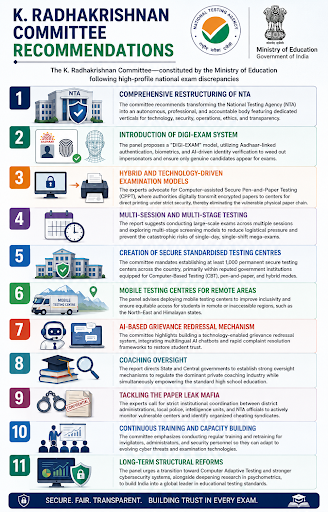
Conduct multi-session and multi-stage testing for large-scale exams to reduce logistical pressure and enhance evaluation fairness.
Strictly enforce the Public Examinations (Prevention of Unfair Means) Act, 2024, which mandates 3 to 10 years of imprisonment and heavy fines up to Rs 1 Crore for organized examination crimes.
Create a nationwide database of blacklisted firms to permanently block compromised entities from securing future testing contracts.
India must implement technological upgrades, strict legal safeguards, and systemic overhauls to eliminate exam leaks, and restore public trust in educational meritocracy.
Source: BUSINESS-STANDARD
|
PRACTICE QUESTION Q. Examine the structural and statutory limitations of the National Testing Agency (NTA) that contribute to frequent examination crises in India. 150 words |
The National Testing Agency (NTA) is a specialized, autonomous organization established to conduct major entrance assessments such as NEET-UG, JEE-Main, and CUET. The agency functions as a registered society under the Indian Societies Registration Act of 1860 rather than a statutory body.
Authorities cancelled the NEET-UG 2026 examination following confirmed allegations of paper leaks and the widespread circulation of materials matching the actual question paper, which affected over 2.2 million aspirants (Source: Central Bureau of Investigation Records).
The Act is a central legislation designed to combat organized cheating in public exams. It mandates prison terms ranging from 3 to 10 years and fines up to Rs 1 Crore for organized examination crimes.






© 2026 iasgyan. All right reserved