CBSE’s nationwide rollout of the digital On-Screen Marking system caused disruptions due to technical glitches, blurred scans, and portal failures. This highlights the urgent need for robust pilot testing and transparent, secure digital governance and evaluation frameworks.
The Central Board of Secondary Education (CBSE) is facing public backlash following widespread technical glitches and evaluation discrepancies in its newly implemented digital On-Screen Marking (OSM) system for Class 12 board exams.
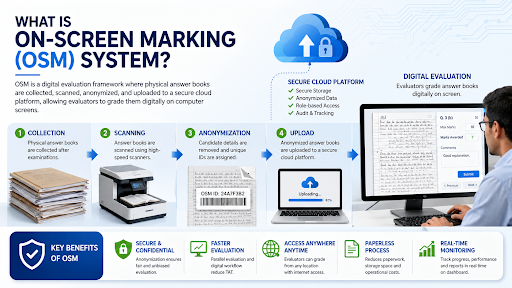
The On-Screen Marking (OSM) system operates as a digital evaluation framework that assesses handwritten examination papers on computer screens instead of relying on manual grading.
Educational boards replace the physical packing, shipping, and red-pen grading of answer scripts with a process where they collect, scan, anonymize, and upload the booklets onto a secure cloud platform.
Evaluators access this monitored portal to review and mark the digitized scripts, establishing OSM as a globally accepted assessment practice.
Data Anonymization: Board authorities mask student roll numbers and barcode identifiers with a secret code before uploading to prevent examiner bias.
Secure Digitization: Officials transport the physical answer books to regional offices, scan them using specialized equipment, and upload the copies to a centralized digital portal.
Digital Canvas Grading: Examiners log into the portal under video surveillance and utilize digital tools to add ticks, cross out answers, and allocate step-wise marks directly on the screen.
Mandatory Step Completion: The software forces evaluators to mark every single step and answer; the system blocks the final submission if examiners miss any section.
Auto-Tabulation: The digital platform automatically calculates the total marks by aggregating question-wise scores, entirely removing the need for manual mathematical counting.
Eradicating Manual Errors: Boards implement OSM to completely eliminate human totaling and tabulation errors inherent in traditional physical evaluation.
Ensuring Standardization: The digital transition standardizes the marking scheme, making the evaluation process highly objective and transparent.
Removing Regional Disparity: The code-independent nature of the system allows boards to send papers anywhere for evaluation, ensuring consistent and fair assessment across diverse geographic regions.
Accelerating Evaluation Cycles: Administrators utilize digital frameworks to compress the processing window, aiming to reduce the evaluation cycle.
Addressing Subjectivity: Authorities adopt digital systems to resolve systemic, long-standing issues such as hurried evaluation, unchecked responses, and unexplained mark variations.
Scanning and Digitization Failures: Many Students receive blurred answer sheets, missing pages, and mismatched copies belonging to other candidates.
Severe Technical Glitches: Evaluators report that the OSM interface freezes frequently (especially when using the 'Undo' button), fails to save progress automatically, and permits marks to be entered against blank pages.
Algorithmic Anomalies: The software displays severe calculation bugs; for instance, score increases by Additional Head Examiners sometimes reflect as negative deductions in the final system.
Infrastructure Collapse: Heavy web traffic and denial-of-service cyberattacks trigger severe server congestion, portal disruptions, and payment gateway failures.
Cybersecurity Vulnerabilities: Ethical hackers easily expose improperly configured cloud storage systems, access master passwords, and bypass OTP verifications, thereby compromising sensitive examination files.
Implement the National Digital Evaluation Model (NDEM): Supply encrypted digital copies of answer scripts to students free of cost before evaluation begins, enabling students to verify completeness and readability.
Mandate Extensive Pilot Testing: Execute rigorous dry runs, stress testing, and phased implementations across regional offices before authorizing nationwide rollouts.
Strengthen Digital Infrastructure: Fortify cybersecurity safeguards, upgrade server capacities to handle extreme traffic, and establish highly reliable scanning facilities.
Incorporate AI Quality Assurance: Supplement OSM with AI-driven assessment analytics to serve as an intelligent quality assurance layer without replacing human professional judgment.
Enhance Capacity Building: Invest in examiner training, centralized moderation, and strict vendor accountability to prevent future systemic failures.
To secure the credibility of India's examination system, policymakers must execute digital reforms through the transparent National Digital Evaluation Model, prioritizing robust cybersecurity, rigorous pilot testing, and uncompromising accountability.
Source: THEHINDU
|
PRACTICE QUESTION Q. With reference to the On-Screen Marking (OSM) system introduced by CBSE, consider the following statements:
Which of the statements given above is/are correct? A) 1 only B) 2 only C) Both 1 and 2 D) Neither 1 nor 2 Answer: B Explanation: Statement 1 is incorrect: In the CBSE On-Screen Marking (OSM) system, physical answer scripts are not manually evaluated on paper. Instead, the physical booklets are centrally scanned, digitized, and uploaded to a secure digital platform. Teachers then log into the portal to assess the scanned answer copies directly on computer screens. Statement 2 is correct: A primary objective of introducing the OSM system is to completely eliminate human and manual totting errors. The software automatically tabulates and calculates the final marks awarded by evaluators for each response, vastly increasing accuracy and streamlining the evaluation. |
OSM is a digital evaluation framework where physical answer books are collected, scanned, anonymized, and uploaded to a secure cloud platform, allowing evaluators to grade them digitally on computer screens.
CBSE introduced OSM to modernize its evaluation pipeline, eliminate manual totaling and tabulation errors, accelerate evaluation cycles, and make the marking process more standardized, objective, and transparent.
The Union Government transferred top CBSE officials, ordered an inquiry by a high-powered committee into the procurement of OSM services, and engaged IITs and public sector banks to resolve the ongoing portal and payment glitches.






© 2026 iasgyan. All right reserved