The Right to Be Forgotten, rooted in Article 21 and DPDP Act 2023, empowers individuals to de-index outdated digital records. The Delhi High Court balances this informational privacy against open justice, protecting individuals from permanent digital stigmatization.
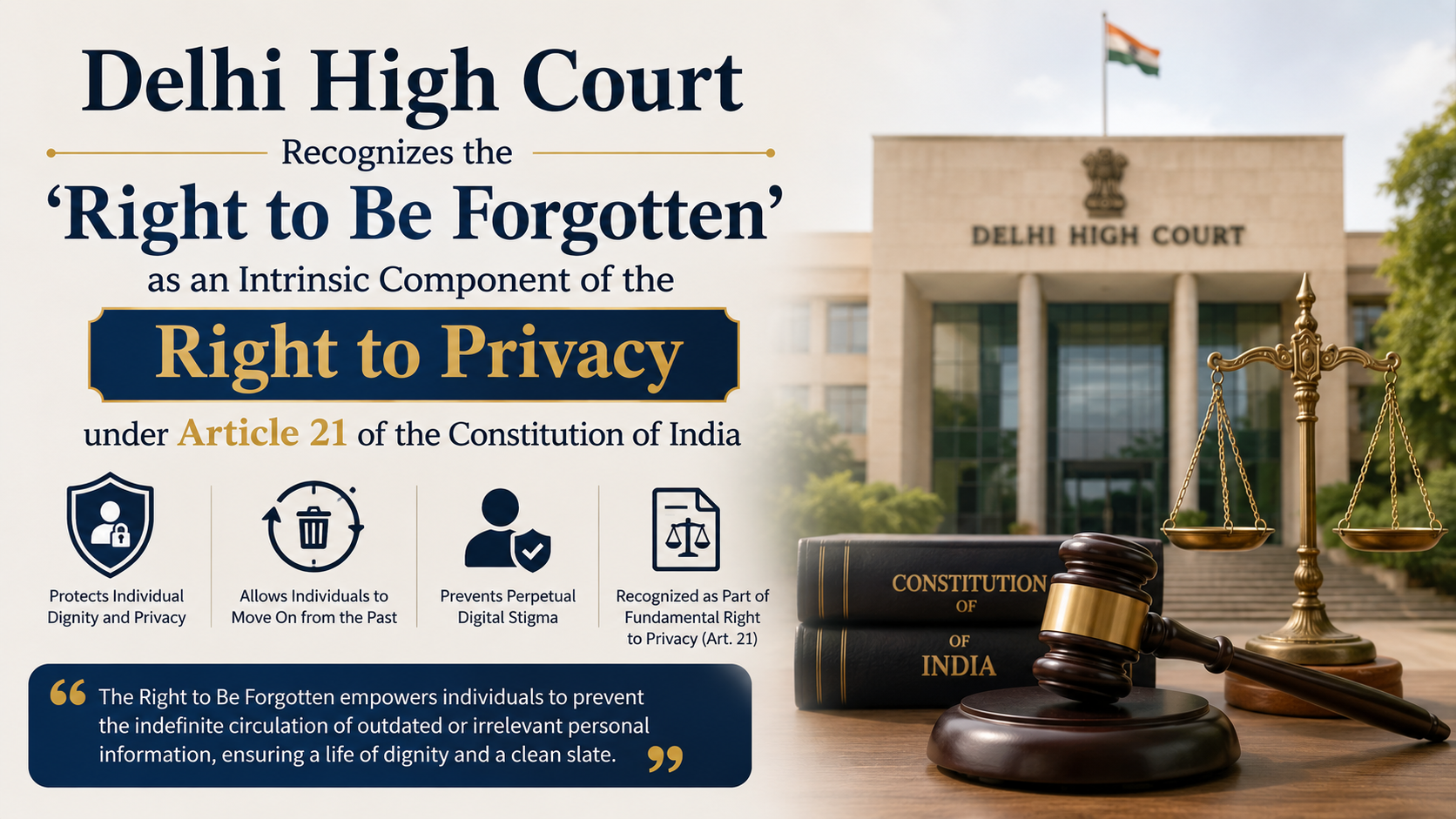
The Delhi High Court recognizes the 'Right to Be Forgotten' (RTBF) as an intrinsic component of the Right to Privacy under Article 21 of the Indian Constitution
|
Read all about: Right to be Forgotten |
The Right to Be Forgotten (RTBF) is an individual's right to demand the removal, de-indexing, or masking of personal information from public digital platforms and search engines when that data no longer serves a legitimate public purpose.
The Supreme Court recognizes this right as an intrinsic part of informational privacy and informational self-determination under Article 21 of the Indian Constitution, as established in the Puttaswamy Judgment (2017).
The Delhi High Court mandates that platforms like Google and Indian Kanoon must disable name-based search functionality for acquitted individuals or private dispute parties to prevent permanent digital stigmatization.
RTBF is not an absolute right; it requires balancing against competing constitutional values like the freedom of expression, historical preservation, and the principle of open justice.
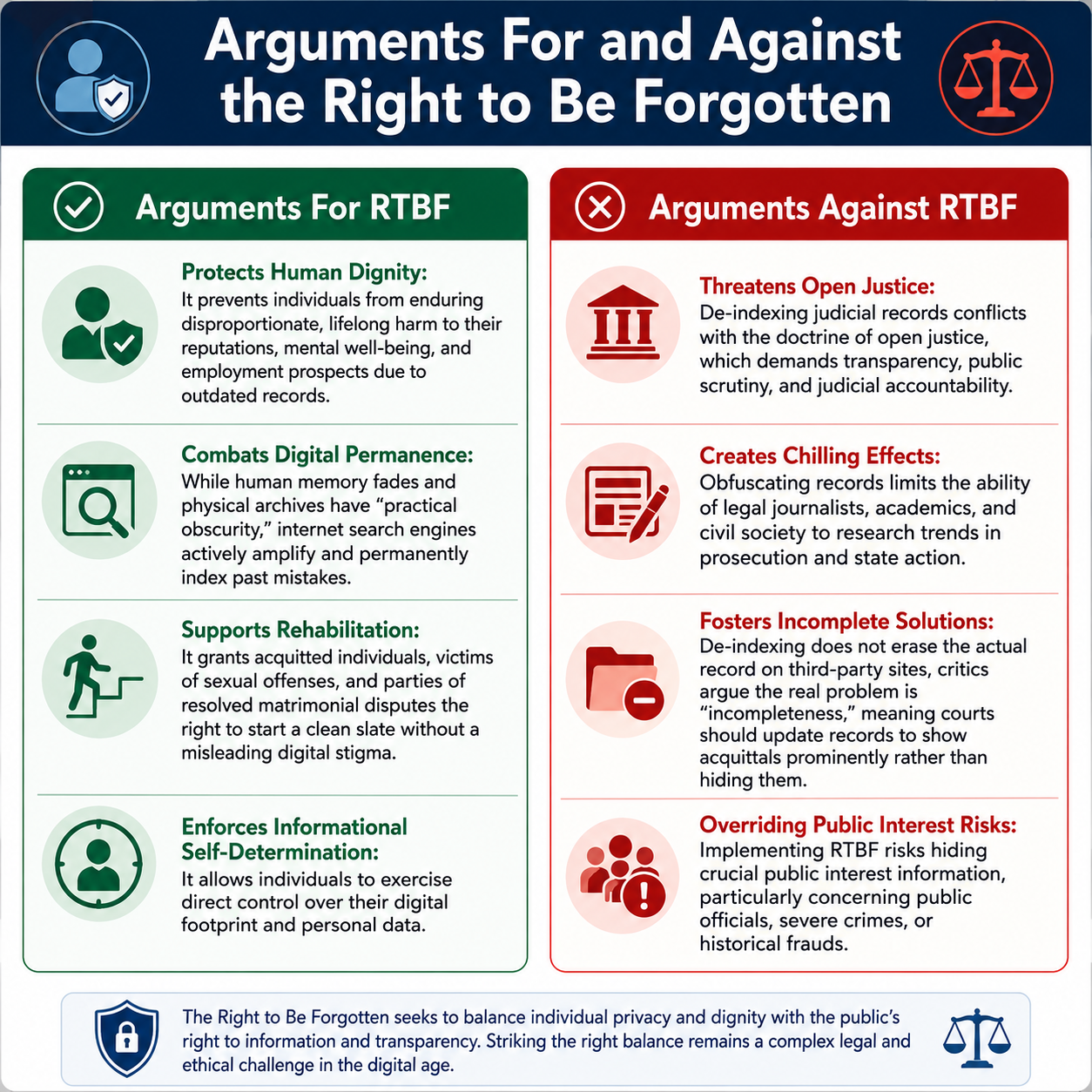 What Challenges Limit the Implementation of RTBF in India?
Lack of Statutory Framework
India has no comprehensive law for RTBF. While the Digital Personal Data Protection Act (DPDPA) 2023 allows erasure, the Data Protection Board is currently non-operational.
Privacy vs Open Justice
Courts face difficulty balancing individual digital privacy with the public’s Right to Know and the need for accessible judicial records.
Technical and Global Hurdles
The internet's "permanent memory," fueled by AI and replication, means de-indexing from one domain cannot ensure global data removal from all servers.
Judicial Balancing
As RTBF is not absolute, courts must use a strict proportionality test to distinguish private erasure needs from matters of public interest.
Define Proportionality Guidelines
The Supreme Court should establish clear criteria for RTBF, distinguishing between the privacy rights of private citizens in minor cases and the public interest regarding public figures.
Ensure Contextual Accuracy in e-Courts
The e-Courts Mission Mode Project must require legal portals to show full case histories, including acquittals, to prevent the public from seeing only incomplete accusations.
Operationalize the Data Protection Board
Constitute the Data Protection Board under DPDPA 2023 to offer citizens efficient administrative data erasure, reducing High Court burdens.
Adopt the Right to Contextualisation
Follow European models requiring search engines to add context (e.g., "subsequently acquitted") to results, balancing public records with individual dignity.
The Right to Be Forgotten demands a delicate constitutional balance between an individual's fundamental right to informational privacy and the democratic necessity of open justice, requiring the operationalization of the DPDP Act 2023 to provide a robust, structured remedy.
Source: ECONOMICTIMES
|
PRACTICE QUESTION Q. "The Right to be Forgotten reflects the growing importance of informational privacy in the digital age." Critically examine. 150 words |
RTBF empowers individuals to demand the removal or de-indexing of outdated, irrelevant, or stigmatizing personal data from internet search engines and public platforms.
The Supreme Court recognizes it as an intrinsic component of the Right to Privacy under Article 21, following the Puttaswamy Judgment (2017),.
Courts deny de-indexing for individuals convicted of serious crimes (e.g., against women/children) or matters involving a breach of public trust, because public interest outweighs individual privacy.




© 2026 iasgyan. All right reserved