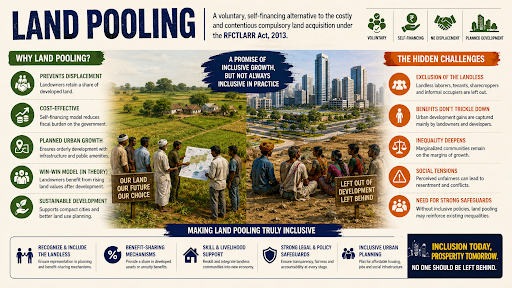
Land pooling has emerged as a voluntary, self-financing alternative to the costly and contentious compulsory land acquisition under the RFCTLARR Act 2013. While it prevents displacement, it excludes landless laborers and marginalized communities from sharing urban development benefits.
Why In News?
Rajasthan's new schemes highlight land pooling as a critical, though debated, alternative to the RFCTLARR (Right to Fair Compensation and Transparency in Land Acquisition, Rehabilitation and Resettlement Act) 2013.
What Is Land Pooling?
Land Pooling is an alternative land procurement strategy where landowners voluntarily assemble their fragmented land parcels and transfer their ownership rights to a development authority.
The development authority designs a new layout and builds essential urban infrastructure on the assembled land.
The authority returns a reconstituted, serviced portion of the land back to the original owners in proportion to their initial holdings.
The government retains a specific share of the land to recover development costs and provide public amenities like roads, parks, and housing for the poor.
|
Case Study: Gujarat Town Planning (TP) Scheme Model
|
How Does Land Pooling Differ From Traditional Land Acquisition?
|
Parameter |
Land Pooling Scheme (LPS) |
Traditional Land Acquisition (LARR Act 2013) |
|
Nature of Procurement |
The government facilitates voluntary and participatory land assembly. |
The government exercises eminent domain to compulsorily acquire land. |
|
Form of Compensation |
The authority returns a share of developed land with highly appreciated market value. |
The government pays one-time monetary compensation and provides Rehabilitation & Resettlement (R&R) benefits. |
|
Displacement |
The policy prevents physical displacement, allowing owners to remain in the same vicinity. |
The process often causes forced displacement, requiring complex relocation and rehabilitation. |
|
Upfront Financial Cost |
The government faces negligible upfront costs, making the model financially self-sustaining. |
The government bears upfront financial burden due to high cash compensation payouts. |
|
Level of Conflict |
The system reduces land conflicts by making landowners partners in development. |
The process generates heavy litigation and social resistance from unwilling landowners. |
|
Post-Project Wealth |
Landowners capture the incremental wealth generated by urban infrastructure. |
Landowners lose the opportunity to benefit from the post-development land value appreciation |
What Are The Benefits Of Land Pooling?
Benefits for the Landowners
Increases Land Value: Landowners receive a hike in land prices because the development authority changes the land-use plan and builds high-quality public infrastructure.
Prevents Displacement: The scheme keeps landowners in their original vicinity, preventing the social and emotional trauma associated with forced relocation.
Converts Scattered Parcels: The authority transforms irregular, fragmented farmlands into regular, easily accessible, and fully serviced urban plots.
Provides Better Infrastructure: Landowners gain access to premium infrastructure, including modern roads, parks, and utilities.
Exempts Capital Gains Tax: The central government often provides capital gains tax exemptions for individuals transferring their land under state pooling schemes.
Benefits for the Government
Eliminates Upfront Costs: The government saves resources, as it does not pay exorbitant cash compensation to landowners.
Reduces Litigation and Conflict: The voluntary nature of the scheme minimises judicial delays and social protests that paralyze infrastructure projects.
Boosts Municipal Revenues: The government earns higher property taxes and registration revenues due to the exponential increase in real estate prices.
Fosters Social Capital: The cooperative process builds trust and public-private cooperation between citizens and the state machinery.
What Challenges Limit The Success Of Land Pooling?
Excludes the Marginalized
The policy systematically ignores landless laborers, tenants, and Dalits, denying them the benefits of land value appreciation and pushing them into deeper poverty.
Suffers from Poor Land Records
States struggle with inaccurate, manual land records, as discrepancies between revenue records and actual ground conditions severely delay scheme preparation.
Faces the Risk of Elite Capture
The model enables large, politically connected landholders to secure premium plots, while developers and intermediaries exploit vulnerable small owners.
Shows Limited Applicability
The mechanism fails in densely built-up urban cores, tribal belts governed by PESA, and areas lacking contiguous land parcels.
Lacks Robust Grievance Redressal
Authorities fail to establish effective, accessible grievance redressal mechanisms and lack stringent penalty clauses for long project delays.
Operates with Weak Institutional Capacity
Implementing agencies lack the necessary technical personnel, urban planners, and financial managers to execute complex pooling schemes efficiently.
Lacks Transparency in Valuation
The system exhibits limited transparency regarding land valuation, often ignoring the proportionality principle when determining contribution ratios.
HOW CAN INDIA STRENGTHEN THE LAND POOLING FRAMEWORK?
Enact Model Legislation
The central government must draft a Model Town Planning Legislation to standardize contribution ratios, cost recovery, and timelines across diverse state governance systems.
Accelerate Record Digitization
States must implement the Digital India Land Records Modernisation Programme (DILRMP) to guarantee accurate, geo-referenced cadastral maps before initiating large-scale pooling.
Integrate Livelihood Support
Policymakers must mandate rehabilitation, skill training, and livelihood support for landless labourers and Dalits to make urban expansion truly inclusive.
Establish Dedicated Town Planning Cells
Urban Local Bodies must build robust institutional capacity by employing dedicated urban planners, GIS analysts, legal officers, and financial managers.
Implement Scientific Land Valuation
Planners must utilize GIS-based, scientific land valuation methods to assess economic and spatial attributes, ensuring equitable and proportional contribution ratios.
Mandate Strict Deadlines and Penalties
Legislatures must enforce strict, legally binding timelines for scheme execution and introduce penalty provisions for authorities that delay delivering reconstituted plots.
Create Multi-Layered Grievance Systems
Authorities must set up transparent, easily accessible grievance redressal mechanisms to resolve landowner conflicts.
Ensure Project Continuity
Lawmakers must deploy statutory safeguards, such as escrow accounts for compensation and super-majority legislative approval requirements, to protect pooling projects from political instability and sudden policy reversals.
CONCLUSION
India must transform the land pooling framework into a legally robust, transparent, and inclusive mechanism that equitably integrates marginalized communities while driving sustainable urban development.
Source: THEHINDU
|
PRACTICE QUESTION Q. Critically examine the efficacy of the Land Pooling Scheme (LPS) as an alternative to the compulsory land acquisition. 150 words |
It is an urban development strategy where landowners voluntarily surrender their fragmented land parcels to an authority, which provides infrastructure and returns a reconstituted, serviced plot of higher value to the original owners.
Land pooling is a voluntary, participatory, and self-financing model that avoids displacement, whereas land acquisition is a compulsory process driven by eminent domain that often results in the uprooting of communities and high upfront government costs.
It is a central legislation that replaced the colonial 1894 Land Acquisition Act to ensure fair compensation, mandatory Social Impact Assessments (SIA), and comprehensive rehabilitation and resettlement (R&R) for affected families.






© 2026 iasgyan. All right reserved