

National Technology Day 2026 celebrates India's 38th rank in the Global Innovation Index. Focused on "Responsible Innovation for Inclusive Growth," it honors the 1998 Pokhran tests.
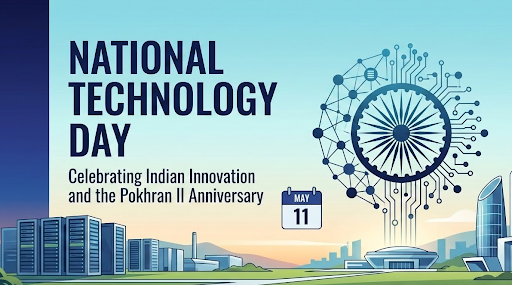
India observes National Technology Day every year on May 11 to commemorate the anniversary of the 1998 Operation Shakti (Pokhran-II) nuclear tests.
Origin
Theme and Focus for 2026
Theme: “Responsible Innovation for Inclusive Growth”. The theme highlights the ethical and sustainable use of technology and aims to bridge rural-urban economic gaps.
Key focus areas include Responsible Artificial Intelligence (AI), inclusive healthcare, agriculture innovation, and digital governance to ensure technology benefits every citizen.
Global Innovation and Startup Ecosystem
India secures the 38th position in the Global Innovation Index 2025 and ranks 6th in global intellectual property (IP) filings.
World's 3rd largest startup ecosystem, over 2 lakh recognised startups as of December 2025, with nearly half emerging from Tier-II and Tier-III cities.
Government funds research through the ₹1 Lakh crore Research, Development and Innovation (RDI) Scheme to incentivize private sector participation in deep-tech and sunrise sectors.
Established the Anusandhan National Research Foundation (ANRF) to transform the R&D ecosystem and fund high-impact research areas.
Space Exploration and Deep Sea Missions
ISRO achieved a historic milestone in 2023 when the Chandrayaan-3 mission soft-landed near the lunar south pole at Shiv Shakti Point.
In 2025, India became the 4th nation to master space docking via the SpaDeX mission.
Wing Commander Shubhanshu Shukla became the first Indian on the International Space Station (ISS) in 2025, conducting microgravity research during the Axiom-4 mission.
ISRO and NASA launched the NISAR satellite in 2025, the world's first dual-frequency synthetic aperture radar for disaster management and earth observation.
Future plans include the Gaganyaan crewed space mission and deep-sea exploration at 6,000 metres using the indigenous MATSYA submersible.
Semiconductors and Indigenous Microprocessors
The Union Budget 2026–27 introduced India Semiconductor Mission (ISM) 2.0 with a ₹1,000 crore provision to push for semiconductor self-reliance and achieve advanced 3-nanometre and 2-nanometre technology nodes by 2029.
Tata Electronics is building India's first commercial semiconductor fab in Dholera, Gujarat.
Centre for Development of Advanced Computing (C-DAC) launched DHRUV64, a fully indigenous 64-bit microprocessor based on the open-source RISC-V architecture, designed to power 5G infrastructure and IoT devices securely.
Nuclear Capabilities and Defence Indigenisation
India advances its Three-Stage Nuclear Power Programme as the Prototype Fast Breeder Reactor (PFBR) at Kalpakkam nears completion, aiming to tap extensive thorium reserves.
The Indian Navy solidified India’s Nuclear Triad with successful deterrence patrols by the INS Arihant.
Defence indigenization continues with the Tejas LCA, the INS Vikrant carrier commissioning, and enhancements to the BrahMos cruise missile.
Source: THEHINDU
|
PRACTICE QUESTION Q. Consider the following statements about India's technological and nuclear milestones:
Which of the statements given above is/are correct? a) 1 and 2 only b) 2 and 3 only c) 1 and 3 only d) 1, 2, and 3 Answer: d Statements: Statement 1 is correct: National Technology Day was officially declared by Prime Minister Atal Bihari Vajpayee in 1999 to celebrate the Pokhran-II nuclear tests (Operation Shakti) that took place on May 11, 1998. Statement 2 is correct: The official theme for 2026 is "Responsible Innovation for Inclusive Growth". It focuses on ensuring that advancements like AI and deep-tech are ethical, accessible, and beneficial to all sections of society, including rural populations. Statement 3 is correct: India's first successful nuclear test was indeed Smiling Buddha (Pokhran-I), conducted in 1974. |
National Technology Day is observed annually on May 11 to honor the successful Pokhran-II nuclear tests (Operation Shakti) conducted in 1998, as well as the successful test flight of the indigenous Hansa-3 aircraft.
The theme for 2026 is “Responsible Innovation for Inclusive Growth,” which emphasizes the ethical use of technology, bridging the rural-urban divide, and ensuring innovations benefit all citizens.
As of 2025-2026, India ranks 38th in the Global Innovation Index, 6th in global patent filings, 3rd in scientific research publications, and holds the 3rd largest startup ecosystem in the world.






© 2026 iasgyan. All right reserved





%20iasgyan&imgurl=https%3A%2F%2Fiasgyan.sgp1.cdn.digitaloceanspaces.com%2Fimages%2Fscience_1.png&imgrefurl=https%3A%2F%2Fwww.iasgyan.in%2Fdaily-current-affairs%2Ffast-breeder-reactor-advances-indias-three-stage-nuclear-programme&docid=lEPM_py5Kt_v2M&tbnid=luCn_aHX-WJoqM&vet=12ahUKEwiIprmEkrGUAxWlTGcHHSuhApsQnPAOegQIGhAB..i&w=512&h=286&hcb=2&ved=2ahUKEwiIprmEkrGUAxWlTGcHHSuhApsQnPAOegQIGhAB)