The FCRA Amendment Bill and Rules 2026 drastically tighten Indian state control over NGO foreign funding. They introduce a Designated Authority for asset seizure, strictly limit operational geographies, eliminate renewal grace periods, and heighten financial transparency to shield national sovereignty.
Why In News?
The Ministry of Home Affairs (MHA) introduced the notification of amended FCRA Rules, 2011 to mandate strict operational disclosures, establish a Designated Authority for asset seizure, and eliminate grace periods for license renewals.
What is Foreign Contribution Regulation Act (FCRA)?
The Government of India enacts the original Foreign Contribution Regulation Act (FCRA) in 1976 during the Emergency to prevent foreign interference in internal democratic processes.
Objectives: The Act functions as a national watchdog to regulate the acceptance and utilization of foreign contributions, prohibiting activities detrimental to national interest, electoral integrity, and social harmony.
Evolution: Parliament replaces the 1976 Act with the FCRA 2010. Subsequent amendments in 2016, 2018, and 2020—which reduced administrative expense limits from 50% to 20% and banned sub-granting—precede the 2026 Amendment Bill.
Scope: The law mandates compliance from all individuals, charitable trusts, societies, and Section 8 companies. It strictly prohibits journalists, judges, government servants, and electoral candidates from receiving foreign funds.
Key Provisions of FCRA
Registration: NGOs secure FCRA registration from the MHA, valid for five years. Currently, 15,000 to 16,000 organizations receive approximately ₹22,000 crore annually.
Prior Permission Route: Entities without permanent registration utilize this route to receive fixed sums from designated donors for specific projects.
Banking Mandates: Organizations must receive all foreign contributions in a single designated account at the State Bank of India (SBI), New Delhi Main Branch.
Penalties: The 2026 framework imposes a 30% fine on misused amounts or ₹1 lakh, whichever is higher.
Recent Amendments in FCRA Rules
Revised Disclosure: Applicants must select objectives from a government-defined schedule. The rules exclude "proselytisation" from cultural and religious categories and require disclosure of all social media accounts and publications.
Designated Authority: This state-appointed body assumes control of foreign-funded assets (e.g., schools, hospitals) upon license cancellation, redirecting proceeds to the Consolidated Fund of India.
Reasonable Activity Threshold: NGOs must spend at least ₹10 lakh from foreign contributions on core activities over two financial years to qualify for renewal.
Automatic Cessation: Registrations expire immediately upon the due date, removing all grace periods.
Key Functionary Liability: The definition expands to include company directors, partners, Karta of a Hindu Undivided Family (HUF), and trustees, who face personal liability for offenses.
Significance of FCRA
National Security: The state uses the FCRA to protect sovereignty against foreign-funded destabilization and separatist movements.
Financial Transparency: Strict banking and Donor Advised Funds (DAF) disclosure norms allow the government to map foreign capital flows and prevent money laundering.
Legal Liberalization: The 2026 Bill reduces the maximum imprisonment for violations from five years to one year.
Criticisms and Concerns
Civil Society Impact: Critics argue the law cripples the social sector, which contributes 2% of India’s GDP and employs 27 lakh people. The government has cancelled approximately 22,000 licenses between 2014 and 2026.
Administrative Burden: The "death by paperwork" phenomenon, including ₹300 fees per additional state/purpose, burdens grassroots organizations.
Constitutional Debates: Experts argue the asset-takeover clause violates Article 300A (property rights) and Article 19(1)(c) (Right to form Associations). The UN Special Rapporteur notes that the prior authorization regime conflicts with Article 22 of the International Covenant on Civil and Political Rights (ICCPR).
Federalism: The requirement for state police to seek MHA approval before investigating FCRA cases undermines state autonomy.
Supreme Court’s Views
Noel Harper vs Union of India (2022): The Supreme Court upholds the 2020 amendments, ruling that the state holds the authority to regulate foreign contributions to safeguard sovereignty.
Judicial Stance: The Court clarifies that receiving foreign donations is not an absolute fundamental right.
Future Scrutiny: Analysts expect challenges to the 2026 Bill regarding proportionality and minority institutional autonomy under Article 30.
Way Forward
Administrative Timelines: The Union Government must establish binding, transparent timelines for license renewals to prevent automatic cessation due to bureaucratic backlogs.
Digital Monitoring: The state should leverage data-driven tracking to verify donor paths rather than relying on blanket asset seizures.
Philanthropic Autonomy: The government must balance oversight with the operational needs of groups working in child protection, tribal welfare, and healthcare.
Judicial Oversight: Lawmakers should amend the Bill to require High Court or independent judicial approval before the permanent vesting of NGO assets.
Conclusion
The FCRA 2026 framework fortifies India's financial boundaries against illicit foreign interference, but it requires structural judicial safeguards to prevent the bureaucratic strangulation of genuine developmental civil society.
Source: THEHINDU
|
PRACTICE QUESTION Q. Consider the following statements regarding the Foreign Contribution (Regulation) Amendment Rules, 2026:
Which of the statements given above is/are correct? A) 1 only B) 1 and 2 only C) 2 and 3 only D) 1, 2, and 3 Answer: A Explanation: Statement 1 is correct: An NGO is deemed to have undertaken "reasonable activity" for the purpose of renewal or for preventing the cancellation of its FCRA registration only if it has utilized at least ₹10 lakh of its foreign contribution on its declared activities over the preceding two financial years. Statement 2 is incorrect: The rules (and previous FCRA amendments) heavily restrict or prohibit the sub-granting of foreign funds to other organizations to prevent unauthorized secondary transfers. Statement 3 is incorrect: The definition of a "key functionary" was explicitly expanded under the new rules to include the Karta of a Hindu Undivided Family (HUF), alongside directors, partners, and trustees. |
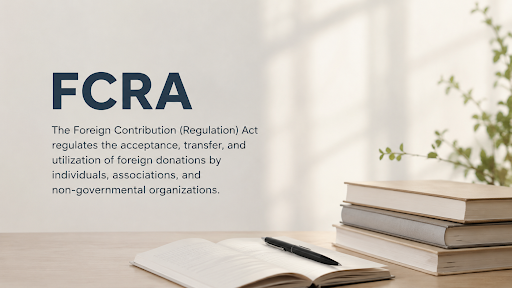
The Foreign Contribution (Regulation) Act (FCRA) is a law administered by the Ministry of Home Affairs to regulate the acceptance, transfer, and utilization of foreign donations by individuals, associations, and non-governmental organizations.
The government regulates foreign funding to prevent illicit external influence over domestic politics, block financial support for conversions through coercion, and ensure foreign resources do not compromise internal security, national interest, or sovereignty.
The newly notified June 2026 FCRA Rules mandate that NGOs choose activities from narrow, pre-defined state-wise schedules, pay separate fees per territory, disclose all social media accounts, explicitly exclude foreign-funded proselytization, and spend a minimum of ₹10 lakh over two years to prevent license stagnation.
The rigid legal framework heavily penalizes violations with a minimum ₹1 lakh fine, restricts administrative overhead spending to a maximum of 20%, bans sub-granting funds to other agencies, and blocks key functionaries from operating if they are associated with political content.




© 2026 iasgyan. All right reserved