

The Foreign Contribution (Regulation) Amendment Bill, 2026, seeks to shift management of foreign-funded assets from regulatory oversight to a state-controlled vesting system.
The Foreign Contribution (Regulation) Act regulates the acceptance and utilisation of foreign contribution by individuals, associations, and companies in India.
Objective: Ensure foreign inflows do not adversely affect national interest, public order, or national security.
Foreign Contribution includes donation/transfer of any currency, security, or article (beyond specified value) by a foreign source (foreign governments, agencies, foreign companies, foreign citizens, etc.).
Enacted during the Emergency (1976) to regulate foreign donations to political parties and organisations.
Defined foreign contribution broadly; lacked robust enforcement mechanisms.
No sunset clause — registration valid indefinitely (no renewal requirement).
Introduced 5-year validity for registration certificates (mandatory renewal).
50% cap on administrative expenses from foreign contributions.
Separate FC bank account mandatory.
Prohibition on foreign funding for political parties, election candidates, judges, legislators, and news broadcasters.
New provisions for suspension and cancellation of registration.
Management of assets of defunct/cancelled organisations introduced (Section 15).
Reduced administrative expenses cap from 50% to 20%.
Mandated receipt of foreign funds ONLY through designated SBI branch in New Delhi.
Aadhaar linkage mandatory for office-bearers.
Prohibition on transfer of foreign contribution to other organisations (except with prior government approval).
Suspension period extended from 90 to 180 days.
Retrospective cancellation power given to government for violations.
Central Government notifies a "Designated Authority" (officer/authority under MHA) to manage foreign contributions and assets.
The Authority enjoys powers of a Civil Court (summoning, evidence, discovery of documents) under the Code of Civil Procedure, 1908.
The Authority and its Administrator deemed "Public Servant" under Bharatiya Nyaya Sanhita, 2023.
Upon cancellation, surrender, or cessation of FCRA registration, all foreign contribution and assets created therefrom provisionally vest in the Designated Authority from the date of cancellation.
"Deemed cessation" introduced: Registration automatically ceases if:
Assets created partly from foreign funds and partly from other sources also vest wholly — unless the organisation proves a distinct/ascertainable portion came from non-foreign sources.
During provisional vesting, the Authority/Administrator:
Organisation may apply for fresh registration/renewal/restoration within prescribed time to reclaim assets.
Assets permanently vest in the Designated Authority if:
Disposal modes for permanently vested assets:
No key functionary of the affected organisation can acquire interest in disposed assets.
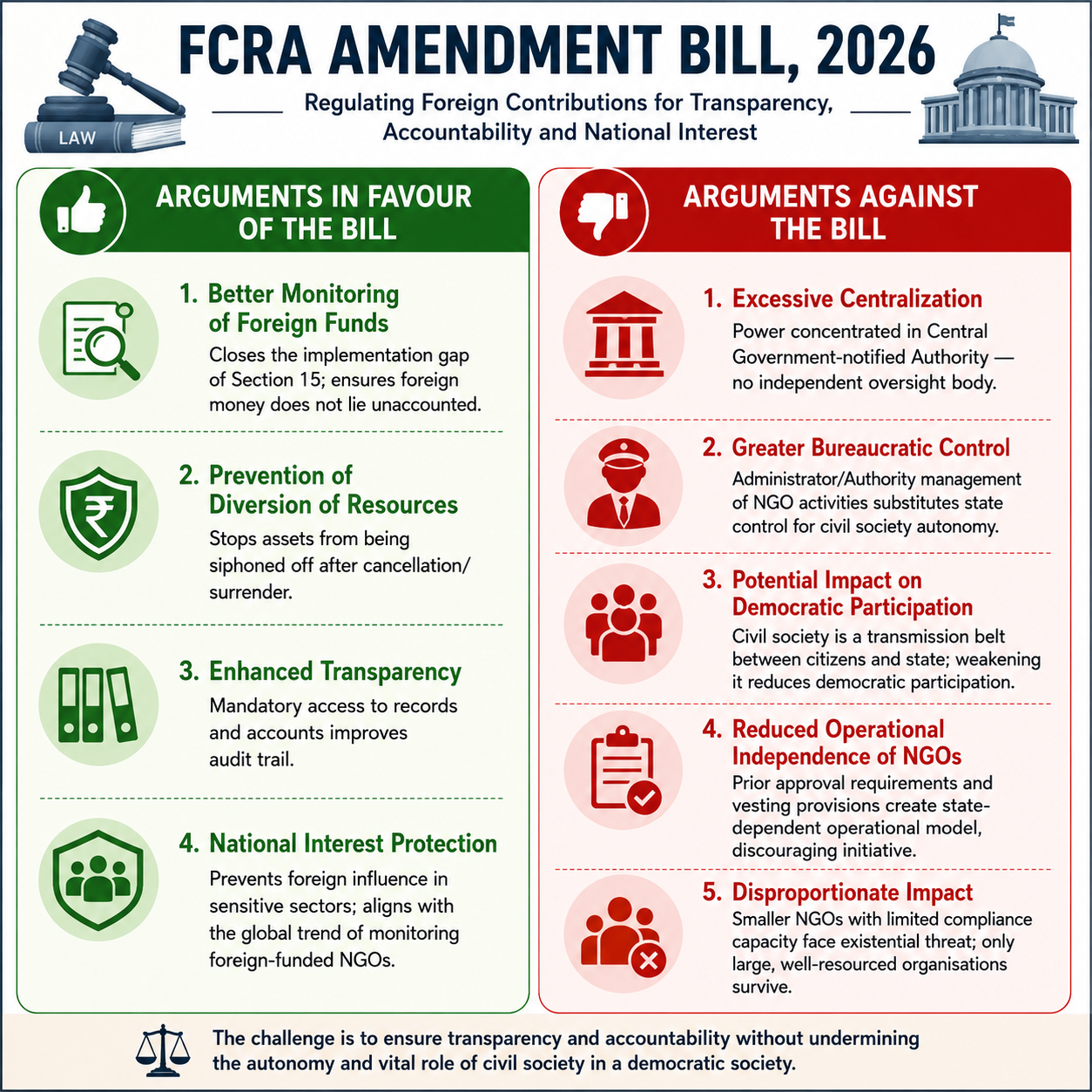
Government argues the Bill closes a legal gap — Section 15 (since 2020) provided for vesting but no authority was ever notified to implement it.
Prevents diversion of foreign funds for activities against national interest.
Mandates strict compliance by key functionaries — full access to books, records, premises, bank accounts to the Authority.
Prior Central Government approval required before any State agency/law enforcement investigates FCRA complaints.
Ensures assets built with foreign money are utilised for public purposes even after organisation shuts down.
Aligns with broader trend of tightening civil society oversight amid concerns over foreign interference in domestic affairs.
Designated Authority is notified by Central Government — raises concerns over executive overreach.
Authority has extensive powers with limited judicial oversight during provisional vesting.
Automatic deemed cessation on non-renewal disproportionately impacts smaller NGOs with limited legal capacity.
Prior approval for asset transfer even during suspension paralyses organisational functioning.
As of March 2026, over 21,900 non-governmental organizations (NGOs) have lost their FCRA licenses; Bill threatens remaining 15,000 registered NGOs.
Civil society fears shrinking democratic space and reduced foreign donor confidence.
No timeline prescribed for Authority to pass initial vesting order — creates prolonged uncertainty.
Appeal lies to the District Judge within 90 days — but no interim relief mechanism specified.
Permanent vesting without compensation raises Article 300A concerns (right to property).
Reverse burden on NGOs to prove non-foreign funding for mixed-source assets.
Judicial intervention restricted — civil courts cannot attach/seize vested assets except under FCRA provisions.
 Way Forward
Government should distinguish between genuine compliance failures and deliberate violations — proportionality principle must apply.
Self-regulatory mechanisms and third-party audits can enhance transparency without state takeover.
Replace government-notified Authority with a multi-stakeholder body including civil society representatives, retired judges, and domain experts.
Parliamentary committee review of Authority's functioning to ensure accountability.
Mandatory timeline for Authority to pass vesting orders (currently absent).
Presumption in favour of the organisation for mixed-source assets (instead of reverse burden).
Interim relief mechanism before appellate courts during provisional vesting.
Adopt risk-based regulation: Stricter scrutiny for politically sensitive funding; lighter touch for health, education, and development sectors.
Consultation with civil society before framing rules under the Amendment.
Ensure Article 300A compliance: Provide compensation or restoration pathway for permanently vested assets of compliant organisations.
The FCRA Amendment Bill, 2026 shifts from regulation to control over civil society, and while national security and accountability are legitimate state objectives, the Bill risks eroding constitutional freedoms unless balanced by robust safeguards, independent oversight, and proportionate enforcement.
Source: THEHINDU
|
PRACTICE QUESTION Q. Discuss the role of NGOs in India's development and how recent regulatory changes affect their operational autonomy. (250 words) |
The FCRA Amendment Bill, 2026 is a legislative proposal introduced in the Lok Sabha on March 25, 2026, that expands government oversight by introducing a comprehensive statutory framework to supervise, manage, and permanently seize assets generated from foreign funds when an organization's registration lapses.
The statutory framework regulates foreign money by mandating proactive registration with the Ministry of Home Affairs, forcing all inflows through a designated State Bank of India account, and prohibiting news publishers, judges, and political entities from accepting overseas funding.
While the 2010 framework focused on tracking monetary cash flows, the 2026 amendments transition to sweeping physical asset control, allowing the state to permanently transfer or sell an NGO's built infrastructure if its registration is canceled.
The legislation heavily impacts non-profits by introducing an automatic "cessation" trigger under Section 14B, meaning organizations instantly lose their operational status and asset control if their renewal applications are delayed or remain pending.
© 2026 iasgyan. All right reserved