The Ashtalakshmi Growth Model transforms Northeast India into a central economic engine. By leveraging the HIRA connectivity model, PM-DevINE funding, and the "Act Fast" policy, India actively integrates the region with Southeast Asia while boosting organic agriculture and green energy.
Why In News?
Prime Minister Narendra Modi officially declares the eight Northeastern states as the "Ashtalakshmi," designating them as the primary engines for India's future economic prosperity.
What is the Ashtalakshmi Growth Model?
Strategic Vision: The model transitions the Northeast from a historically marginalized security frontier into a central strategic growth engine, aligning with the Viksit Bharat 2047 mandate.
Evolution of Policy: The strategy evolved from the trade-focused "Look East" Policy (1991) to the security-integrated "Act East" Policy (2014), culminating in the execution-driven "Act Fast" Policy (2026).
Regional Convergence: The model integrates eight states—Assam, Arunachal Pradesh, Manipur, Meghalaya, Mizoram, Nagaland, Tripura, and Sikkim—under a unified developmental framework.
Funding Mechanism: The government deploys the Prime Minister's Development Initiative for North East Region (PM-DevINE), utilizing an aggressive ₹6,600 crore budget to bridge critical social and infrastructural gaps.
Why is Northeast India Called Ashtalakshmi?
Cultural Symbolism: The government maps the eight manifestations of Goddess Lakshmi onto the eight states: Arunachal Pradesh (Dhana Lakshmi/hydropower), Assam (Dhanya Lakshmi/tea and oil), and Sikkim (Aishwarya Lakshmi/eco-tourism).
Geopolitical Cornerstone: The region shares over 5,400 kilometers of international borders with China, Myanmar, Bangladesh, Bhutan, and Nepal.
Resource Wealth: The terrain holds approximately 60% of India’s total national hydropower potential and hosts globally recognized biodiversity hotspots in the Eastern Himalayas.
Key Pillars of the Ashtalakshmi Growth Model
Connectivity Infrastructure: The HIRA Model (Highways, I-ways, Railways, Airways) drives growth. The National Highways network expanded by 51%, growing from 10,905 km in 2014 to over 16,207 km by 2025. Iconic projects include the Bogibeel Bridge, the Sela Tunnel (13,000 feet), and the 141-metre-tall Noney Bridge.
Tourism Development: The state commercializes pristine ecology through sustainable models, supported by infrastructure like the Bagdogra-Sikkim Expressway.
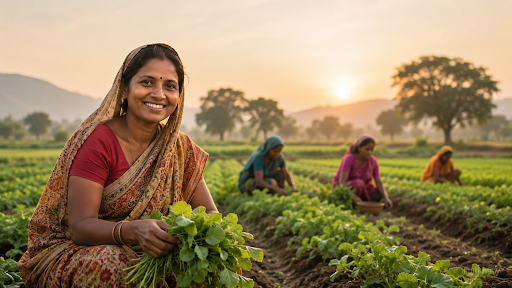
Agriculture and Agri-Processing: The Mission Organic Value Chain Development for North East (MOVCD-NER) converted 2.36 lakh hectares to organic farming, benefiting 2.70 lakh farmers. Inland fish production surged by 68% to 6.78 lakh tonnes in 2024-25.
Skill Development: The government operates 110 Industrial Training Institutes (ITIs) and 622 Atal Tinkering Labs, alongside green skill programs like Suryamitra and Jal Urjamitra.
Trade and Investment: The Tata Semiconductor Facility in Jagiroad, Assam, marks a shift toward advanced electronics. Border Haats (e.g., Kamalasagar) formalize grassroots trade.
Green Growth: The 2,880 MW Dibang Multipurpose Hydropower Project and the 1,656 km North East Gas Grid provide clean energy and fuel security.
Significance for Northeast India
Employment Generation: Industrialization of bamboo and food processing, combined with digital BPOs, creates localized jobs.
Regional Integration: The UDAN Scheme increased operational airports from 9 in 2014 to 17 in 2026, reducing reliance on the Siliguri Corridor.
Economic Diversification: The region shifts from subsistence farming to tech-enabled services, ethanol production, and critical mineral processing.
Border Security: Capital injection into border villages creates demographic buffers against infiltration and external aggression.
Linkages with Act East Policy
ASEAN Gateway: The model positions the Northeast as a $3.5 trillion ASEAN economic gateway.
Transnational Corridors: The Kaladan Multi-Modal Transit Transport Project and the India–Myanmar–Thailand (IMT) Trilateral Highway establish vital land and water routes to Southeast Asian markets.
Supply Chain Integration: Integrated Check Posts (ICPs) at nodes like Moreh slash customs friction and integrate local industries into global supply chains.
Challenges
Infrastructure Gaps: Over 60% of remote hill districts lack all-weather roads and reliable power.
Geographical Constraints: High seismic vulnerability and annual Brahmaputra flooding inflate project costs.
Investment Deficit: The Inner Line Permit (ILP) acts as an administrative deterrent to private capital.
Security Overhang: Ethnic conflicts and the 2021 Myanmar military coup disrupt administration and cause refugee influxes.
Ecological Sensitivity: Massive infrastructure projects threaten biodiversity and risk downstream water disputes.
Way Forward
Public-Private Partnerships: State governments must attract private investment to move beyond total reliance on PM-DevINE.
Logistics Enhancement: Expanding the Krishi UDAN scheme ensures perishable organic crops reach international markets.
Sustainable Development: Implementing the Jal Jeevan Mission (JJM) 2.0 framework and solar micro-grids allows for utility independence without forest destruction.
Resolving Security Deadlocks: Accelerating political dialogues and the gradual withdrawal of the Armed Forces (Special Powers) Act (AFSPA) will stabilize the investment climate.
Conclusion
The Ashtalakshmi Growth Model decisively transforms India's Northeast from an isolated, insurgency-prone frontier into a highly integrated, economically vibrant, and strategically dominant bridge to the Indo-Pacific.
Source: PIB
|
PRACTICE QUESTION Q. Evaluate the strategic and geopolitical significance of the 'Ashtalakshmi Growth Model' in the context of India's 'Act East' policy and its counter-strategy against Chinese encirclement. 250 words |
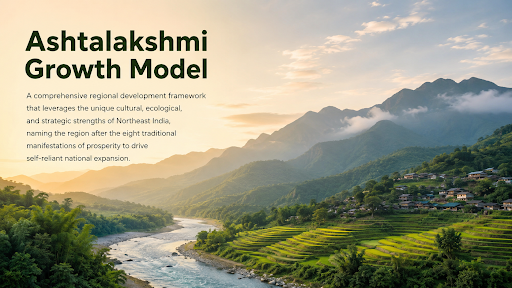
The Ashtalakshmi Growth Model is a comprehensive regional development framework that leverages the unique cultural, ecological, and strategic strengths of Northeast India, naming the region after the eight traditional manifestations of prosperity to drive self-reliant national expansion.
The model covers the eight distinct Northeastern states, which comprise Arunachal Pradesh, Assam, Manipur, Meghalaya, Mizoram, Nagaland, Sikkim, and Tripura.
The framework anchors the Act East Policy by transforming an isolated frontier into India's natural land gateway to ASEAN economies, fast-tracking transboundary infrastructure like the India–Myanmar–Thailand Trilateral Highway, and fostering deep cross-border trade linkages.
The primary goals are to dismantle geographical remoteness via mega-engineering connectivity projects, scale up high-value organic agriculture and green energy generation, maximize the commercial value of local GI-tagged products, and foster sustainable livelihoods to achieve national economic integration.




© 2026 iasgyan. All right reserved