Jal Jeevan Mission 2.0 extends the Har Ghar Jal goal to 2028 with ₹8.7 lakh crore, shifting focus to sustainable water service delivery. It introduces the Sujalam Bharat digital system for transparency but faces challenges like corruption, data gaps, and weak local maintenance capacity.
Copyright infringement not intended
Picture Courtesy: INDIANEXPRESS
Context
The Union Cabinet has approved the extension of the Jal Jeevan Mission (JJM) till December 2028 with an enhanced outlay of about ₹8.7 lakh crore.
|
Read all about: SIGNIFICANCE OF JAL JEEVAN MISSION l JAL JEEVAN MISSION REMAINS A PIPE DREAM |
What is the Jal Jeevan Mission (JJM)?
It was launched in August 2019, to provide safe and adequate drinking water through individual household tap connections to every rural home in the country.
Core Objectives & Targets
Har Ghar Jal: Providing a Functional Household Tap Connection (FHTC) to all rural households.
Service Level: Aims to supply at least 55 litres of potable water per capita per day.
Timeline Extension: Originally targeted for 2024, now extended to December 2028 under JJM 2.0 to ensure 100% coverage and focus on structural reforms.
Priority Areas: Focuses on water-scarce regions, quality-affected areas (arsenic/fluoride), and public institutions like schools and Anganwadi centres.
Key Features
Community-Led Approach
Implemented as a "Jan Andolan" (people’s movement) where local communities, through Pani Samitis or Village Water & Sanitation Committees (VWSCs), plan and manage their own water systems.
Sustainability
Mandates measures like rainwater harvesting, groundwater recharge, and greywater management (reuse of wastewater) to ensure long-term water security.
Empowerment
At least 50% women members are required in Pani Samitis; women are also trained to test water quality using Field Testing Kits (FTKs).
Digital Monitoring
Uses the JJM Dashboard for real-time tracking, IoT sensors for measuring water supply, and the Sujalam Bharat digital framework for mapping assets.
Key Reforms under Jal Jeevan Mission 2.0
Enhanced Financial Outlay
The total mission outlay has been increased to ₹8.70 lakh crore, with an additional allocation of ₹1.51 lakh crore.
Extended Timeline
The deadline for providing tap water connections to all 19.36 crore rural households has been extended to December 2028.
Digital Governance
Introduction of 'Sujalam Bharat', a national digital framework to map the entire water supply chain from source to tap, ensuring transparency and real-time monitoring.
Strengthened Local Governance
Empowering Gram Panchayats (GPs) and Village Water & Sanitation Committees (VWSCs) through the "Jal Arpan" initiative to take ownership of commissioning and maintaining water schemes, ensuring community accountability.
How JJM Transformed Rural India?
Improved Public Health: Universal tap water access can prevent an estimated 400,000 diarrheal deaths annually. (Source: WHO)
Empowerment of Women ('Nari Shakti')
The mission reduces the drudgery of fetching water, saving women a collective 5.5 crore hours daily, which can be used for education, economic activities, and self-development. (Source: WHO)
Economic Growth & Employment
JJM is projected to create 59.9 lakh person-years of direct employment and 2.2 crore person-years of indirect employment. (Source: ILO Study)
Reduced Child Mortality
Research by Nobel laureate Prof. Michael Kremer suggests that providing safe water could reduce mortality among children under five by nearly 30%, potentially saving 136,000 lives annually.
What are the Challenges Hampering the Mission Success?
Rural tap water coverage jumped from 17% in 2019 to over 81% by early 2026, marking progress, yet critical hurdles remain. (Source: PIB)
Corruption and Irregularities
Widespread issues of inflated contracts and use of substandard materials have been reported, leading to action against hundreds of officials and contractors across 15 states. (Source: Indian Express)
Functionality and Data Gaps
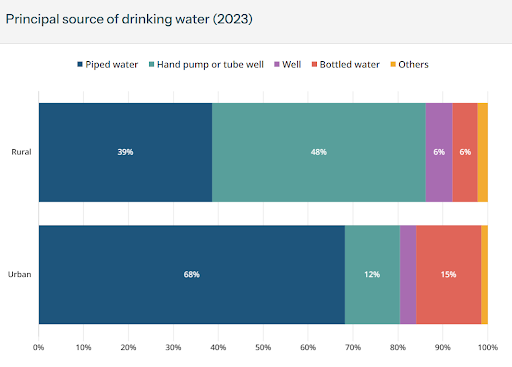
A gap exists between reported connections and actual functionality. An NSSO Survey report found only 39% of rural households used taps as their primary water source, questioning the reliability of official dashboard data.
Sustainability of Water Sources
Depleting groundwater levels and contamination (arsenic, fluoride) pose a long-term threat to the viability of water supply schemes.
Operation & Maintenance (O&M)
Gram Panchayats, tasked with O&M, often lack the financial resources and technical capacity to function effectively as local water utilities.
Way Forward
Strengthen Institutional Capacity
Build the financial and technical capabilities of Gram Panchayats and VWSCs through targeted training in O&M, financial management, and water quality monitoring.
Ensure Source Sustainability
Integrate JJM with schemes like MGNREGS and Atal Bhujal Yojana for water conservation, rainwater harvesting, and aquifer recharge.
Implement Strict Monitoring
Institutionalize independent, third-party audits to verify the functionality of connections, not just their installation. Leverage the 'Sujalam Bharat' portal for public accountability.
Prioritize Water Quality
Empower communities with Field Testing Kits (FTKs) for regular testing at the local level and strengthen laboratory infrastructure to build public trust.
Adopt a 'User Pays' Principle
Implement a rational and equitable water tariff structure to generate revenue for O&M, promoting a sense of value and ownership among consumers.
Learn from Global Best Practices
Performance-Based Financing (Vietnam)
Linking payments to contractors with the quality and timeliness of results, a model known as Program for Results (PforR), incentivized efficiency and mobilized private sector participation. (Source: World Bank).
Community Ownership & User Fees (Asia)
Early establishment of Water User Committees and adopting a "user pays" principle are crucial for promoting ownership and ensuring financial self-sustainability for O&M. (Source: Asian Development Bank)
Decentralized Water Management
The WHO's Water Safety Plan (WSP) approach empowers communities to manage their water supplies from source to tap, enhancing local problem-solving and preventing waterborne diseases.
Conclusion
Jal Jeevan Mission 2.0's success requires shifting from infrastructure to sustainable service delivery. Digital oversight, community empowerment, and sound financial planning are key to securing rural water supply.
Source: INDIANEXPRESS
|
PRACTICE QUESTION Q. Consider the following statements regarding the funding pattern of the Jal Jeevan Mission: 1. For Himalayan and North-Eastern States, the fund sharing ratio between Centre and State is 90:10. 2. For Union Territories, the Central Government provides 100% of the funding. 3. For other states, the fund sharing ratio is 60:40. Which of the statements given above are correct? A) 1 and 2 only B) 2 and 3 only C) 1 and 3 only D) 1, 2, and 3 Answer: A Explanation: Statement 1 is correct: For Himalayan and North-Eastern States, the fund sharing ratio between the Centre and the State is indeed 90:10. Statement 2 is correct: For Union Territories (UTs), the Central Government provides 100% of the funding. Statement 3 is incorrect: For other states (general category), the fund sharing ratio is 50:50, not 60:40. |
JJM 2.0 aims to provide a Functional Household Tap Connection (FHTC) to every rural household by December 2028, shifting its focus from just creating infrastructure to ensuring sustainable and reliable water service delivery.
'Sujalam Bharat' is a uniform national digital framework being established under JJM 2.0. It will digitally map the entire water supply chain, from the source to the household tap, to enhance transparency, monitoring, and accountability.
The mission faces several challenges, including corruption and financial irregularities, discrepancies between reported and functional connections, issues with water quality and source sustainability, and the limited technical and financial capacity of local bodies for long-term operation and maintenance (O&M).


© 2026 iasgyan. All right reserved