The Jal Jeevan Mission has rapidly expanded tap water infrastructure in rural
India, achieving near-universal coverage of household connections. However,
recent assessments show that actual water supply, reliability, and quality lag
behind coverage figures, with many households not receiving regular or safe
water. Issues such as groundwater depletion, weak operation and
maintenance, and water contamination remain key challenges. The focus now
needs to shift from infrastructure creation to ensuring sustainable, reliable, and
community-managed rural drinking water services.
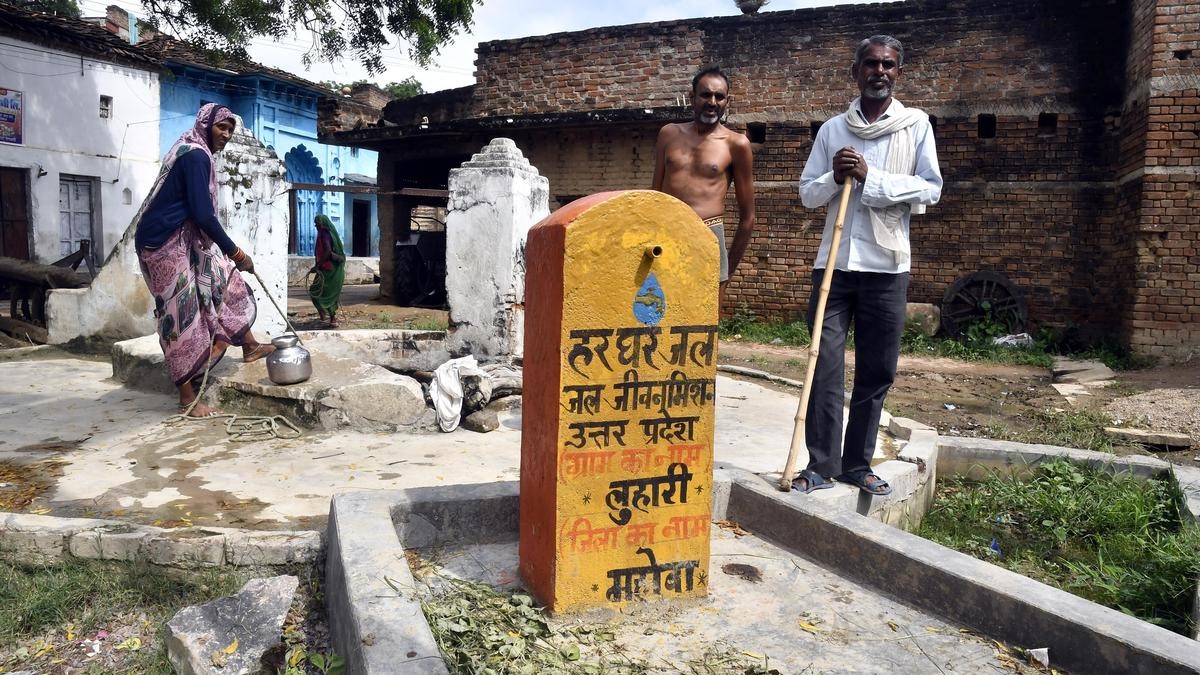
Copyright infringement not intended
Picture Courtesy: The Hindu
Context:
A recent Functionality Assessment Survey commissioned by the Ministry of Jal Shakti shows that while tap connections under the Jal Jeevan Mission have reached very high coverage levels, but actual usage, reliability, and water quality remain significant concerns.
|
Must Read: JAL JEEVAN MISSION | |
Background:
The Jal Jeevan Mission was launched on 15 August 2019 with the goal of ensuring Functional Household Tap Connections (FHTCs) for every rural household. It seeks to transition villages away from dependence on handpumps and tanker supply toward reliable piped drinking water, thereby improving public health and reducing the time and physical burden of water collection, particularly for women. The mission follows a decentralised, community-led approach in which Gram Panchayats and local water committees play a central role in planning and managing village water systems. The nodal ministry responsible for its implementation is the Ministry of Jal Shakti.
Objectives of Jal Jeevan Mission
Key Features of JJM
Components of the Mission
Funding Pattern
Key highlights of the functionality assessment report on the Jal Jeevan Mission:
High infrastructure coverage: About 98% of surveyed rural households reported having a tap connection under the mission.
Gap between coverage and usage: Only 83% of households had water flowed from their tap at least once in the seven days prior to the survey, showing that infrastructure does not always translate into service delivery.
Shortfall in prescribed supply: Around 80% of households reported receiving the mandated 55 litres per capita per day (LPCD), which means one-fifth of households are not getting adequate quantity.
Water quality concerns: Laboratory testing showed that only 76% of households received water meeting standards for E. coli, total coliform, and pH levels, indicating public health risks in several areas.
Overall functionality lower than coverage: When availability, regularity, and quality were considered together, only 76% of households were found to be receiving fully functional tap water services.
Wide inter-state variation: Some States and UTs reported very high levels of availability and satisfaction, while others like Bihar, Uttar Pradesh, and Nagaland showed significantly lower levels of regular water flow.
Survey limited to ‘Har Ghar Jal’ villages: The assessment covered only villages already certified as having full tap coverage, suggesting that functionality gaps may be even larger in non-certified villages.
Major challenges facing the Jal Jeevan Mission:
Infrastructure - service delivery gap: Although tap connections have expanded rapidly, many households do not receive water regularly, showing that infrastructure creation has outpaced reliable service delivery.
Inadequate water quantity: Several households are not receiving the prescribed 55 litres per capita per day, as seasonal shortages and limited source capacity affect the consistency of supply.
Water quality issues: Water quality remains a serious concern in many areas due to contamination from E. coli, coliform bacteria, fluoride, arsenic, and salinity, reflecting gaps in treatment, testing, and last-mile monitoring.
Source sustainability concerns: The mission faces long-term sustainability challenges because many schemes depend heavily on groundwater, which is declining in several regions, while climate variability is affecting recharge and surface water availability.
Operation and maintenance weaknesses: Local institutions such as Gram Panchayats and Village Water & Sanitation Committees often lack the technical expertise and financial resources needed for timely repair and maintenance of pumps, pipelines, and storage systems.
Energy dependence: Rural water supply systems rely on electricity for pumping, and frequent power shortages or high energy costs disrupt regular water delivery.
Key measures for strengthening Jal Jeevan Mission:
Conclusion:
The Jal Jeevan Mission has made remarkable progress in expanding tap water infrastructure across rural India, but recent findings show that coverage alone is not enough. Ensuring regular supply, safe water quality, and sustainable sources must now become the central focus. Strengthening local capacity, improving monitoring, and deepening community ownership will be crucial to transform infrastructure into reliable service delivery and secure long-term rural water security.
Source: The Hindu
|
Practice Question Q. The Jal Jeevan Mission has significantly expanded rural tap water infrastructure, yet concerns remain regarding functionality, reliability, and water quality. Examine. (250 words) |
The mission aims to provide every rural household with a Functional
Household Tap Connection that delivers safe and adequate drinking water on
a regular basis.
It refers to the service benchmark that each person in a rural household
should receive 55 litres of potable water per day through a tap connection.
The scheme is implemented by the Ministry of Jal Shakti in coordination
with state and local governments.



© 2026 iasgyan. All right reserved