Description
Copyright infringement not intended
Picture Courtesy: PIB
Context
In 2025, the Ministry of Petroleum & Natural Gas (MoPNG) focused on affordable energy, increasing domestic output, improving infrastructure, promoting cleaner fuels, and enhancing national energy security, guided by Access, Efficiency, Sustainability, and Security.
Ministry of Petroleum & Natural Gas (MoPNG) Achievements/ initiatives in 2025
Updates of Pradhan Mantri Ujjwala Yojana (PMUY)
- Beneficiary Expansion: The number of PMUY beneficiaries has crossed 10.35 crore households, improving women's health and reducing indoor air pollution (Source: PIB).
- Targeted Subsidy: To ensure affordability, the government provides a targeted subsidy of ₹300 per 14.2 kg cylinder for up to 12 refills annually to PMUY beneficiaries. (Source: PIB)).
- Simplified Enrolment: The process to get a new connection has been simplified. Applicants now only need to submit a single 'Deprivation Declaration', making the scheme more inclusive and accessible.
- Consumer Safety First: A nationwide Basic Safety Check campaign was conducted, with Oil Marketing Companies (OMCs) conducting free safety inspections at customer homes to promote safe LPG handling.
Modernizing Retail Outlets
- Digital Payments: Over 98% of retail outlets are now equipped with digital payment facilities, promoting a cashless economy. (Source: PIB)
- Door-to-Door Delivery: Fuel accessibility has been improved in remote areas through the deployment of mobile fuel dispensers (bowsers).
- Wayside Amenities: Under the APNA GHAR initiative, amenities for truckers are being developed along highways to improve road safety and driver welfare.
Developing a Gas-Based Economy: One Nation, One Grid
The government is expanding natural gas infrastructure to increase its share in the primary energy mix from the current 6% to 15% by 2030 (Source: MoPNG).
- National Gas Grid: The operational natural gas pipeline network has expanded from about 15,340 km in 2014 to over 25,429 km. (Source: ANI).
- Unified Pipeline Tariff: This "One Nation, One Tariff" model standardizes gas transportation charges across the country, making the fuel more affordable and promoting balanced regional development.
- City Gas Distribution (CGD): The CGD network provides Piped Natural Gas (PNG) for homes and Compressed Natural Gas (CNG) for vehicles.
Promoting Biofuels and Sustainable Energy
Biofuels are a key pillar of India's strategy to reduce import dependency and decarbonize the transport sector.
Key Biofuel Initiatives
- India has achieved 20% ethanol blending in petrol five years ahead of target, marking a major step in clean energy transition.
- Compressed Bio Gas (CBG):
- The SATAT (Sustainable Alternative Towards Affordable Transportation) initiative promotes the production of CBG from waste and biomass.
- A mandatory Compressed Biogas (CBG) Blending Obligation (CBO) for the City Gas Distribution (CGD) sector (CNG/PNG) from FY 2025-26.
- India has set indicative blending targets for SAF in international flights: 1% by 2027 and rising to 5% by 2030 (Source: MoPNG).
- This move aims to reduce carbon emissions from the aviation sector.
Reforms in the Upstream Sector (Exploration & Production)
To boost domestic oil and gas production and attract investment, the government has implemented significant policy reforms.
- Hydrocarbon Exploration and Licensing Policy (HELP): This policy replaced the earlier NELP. Its key features include:
- A single license for exploring and producing all forms of hydrocarbons.
- A simple revenue-sharing model instead of the complex profit-sharing model.
- Marketing and pricing freedom for produced crude oil and natural gas.
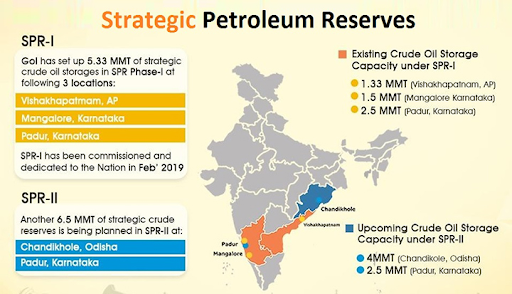
- Strategic Petroleum Reserves (SPR): India is moving toward a target of approximately 22 to 25 days of emergency oil coverage, up from the current 9.5 days provided by its three existing facilities.
- Current Infrastructure (Phase I): Managed by Indian Strategic Petroleum Reserve Limited (ISPRL), these facilities have a total capacity of 5.33 Million Metric Tonnes (MMT) located at Vishakhapatnam (1.33 MMT), Mangaluru (1.5 MMT), and Padur (2.5 MMT).
- Expansion Plans (Phase II): The government has approved two additional "commercial-cum-strategic" facilities totaling 6.5 MMT.
- Chandikhol, Odisha: Planned 4 MMT capacity.
- Padur, Karnataka: Planned 2.5 MMT expansion.
- Future Roadmap: ISPRL plans to triple reserves to 15 MMT over the next decade, with additional proposed sites at Bikaner (Rajasthan), Mangalore (Karnataka), and Bina (Madhya Pradesh).
Source: PIB
|
PRACTICE QUESTION
Q. Evaluate the role of biofuels, particularly ethanol and compressed bio-gas (CBG), in reducing India's import dependency and achieving its climate commitments. 150 words
|
Frequently Asked Questions (FAQs)
As of 2025, adult women from poor households who do not already have an LPG connection are
eligible. Applicants must belong to specific categories like SC/ST, PMAY beneficiaries, or provide a
"Deprivation Declaration".
PAHAL (Pratyaksh Hanstantrit Labh) is the world's largest Direct Benefit Transfer system. Consumers
buy LPG cylinders at the market price, and the subsidy is then transferred directly into their Aadhaar-
linked bank accounts.
The Sustainable Alternative Towards Affordable Transportation (SATAT) initiative encourages
entrepreneurs to set up Compressed Bio-Gas (CBG) production plants. The produced CBG is purchased
by Oil Marketing Companies (OMCs) to be sold as a green automotive fuel.