The Jal Jeevan Mission provides rural households with safe tap water, focusing on source sustainability, quality, and community management. While progressing, it faces challenges including O&M, water quality, and ensuring the long-term functionality of connections.
Copyright infringement not intended
Picture Courtesy: PIB
The Minister of State for Jal Shakti in the Rajya Sabha said that States/UTs have received over 17,000 complaints of "irregularities" and "poor work quality" in Jal Jeevan Mission projects, with Uttar Pradesh accounting for about 84%.
|
Read all about: JAL JEEVAN MISSION: STATUS, CHALLENGES WAY FORWARD |
It was launched in 2019, under the Ministry of Jal Shakti, to provide safe and adequate drinking water to every rural household in India.
Core Objective & Vision
Universal Access: Supply a minimum of 55 litres of potable water per capita per day (LPCD) to every rural household through a Functional Household Tap Connection (FHTC).
Holistic Approach: Integrates source sustainability measures like rainwater harvesting, groundwater recharge, and greywater management for long-term water security.
People's Movement: Create a 'Jan Andolan' (people's movement) for water, making it a community-managed programme.
Key Features of the Mission
Decentralized Implementation: The mission empowers local communities by making Pani Samitis or Village Water & Sanitation Committees (VWSCs) responsible for planning, implementing, managing, operating, and maintaining the in-village water supply systems. These committees must have at least 50% women members.
Community Contribution: Communities contribute 5% to 10% of the capital cost in cash, kind, or labour, fostering a sense of ownership. This contribution is 5% for hilly, forested, and NE states.
Focus on Water Quality: Emphasis is placed on regular water quality testing in accredited laboratories and training community members, especially women, to use Field Test Kits (FTKs).
The financial sharing pattern
|
Area |
Centre's Share |
State's Share |
|
Himalayan & North-Eastern States |
90% |
10% |
|
Other States |
50% |
50% |
|
Union Territories (UTs) |
100% |
0% |
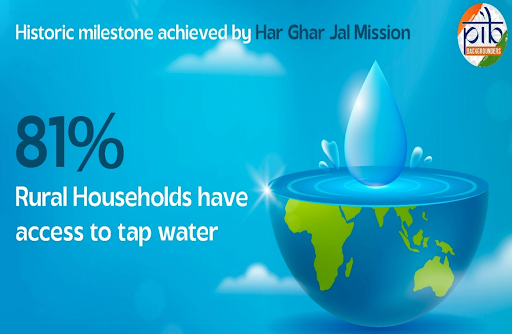
As of early November 2025, the Jal Jeevan Mission (JJM) has achieved significant progress, providing tap water connections to over 15.75 crore (81.37%) rural households across India.
Eleven States and Union Territories have achieved full (100%) tap water coverage in all rural households:
Tap water supply has been ensured in over 66% schools and 60% Anganwadi centres. (Source: PIB)
The mission, initially aiming for 100% coverage by 2024, has been extended until December 2028.
Between 2021 and 2023, the Ministry of Jal Shakti received over 17,000 complaints of financial irregularities and poor workmanship, indicating major systemic issues in the state's project execution and oversight, and a gap in accountability..
The long-term success of JJM is threatened by inadequate focus on water source sustainability due to over-reliance on over-exploited groundwater and weak Operation and Maintenance (O&M) capacity in Gram Panchayats and Pani Samitis.
The mission tests for bacteria and common chemicals but often neglects emerging threats like uranium and other radioactive pollutants, which are not uniformly monitored, creating a major public health risk in affected regions.
Strengthen Accountability: Impose penalties on states for irregularities and change the funding mechanism from lump-sum to scheme-wise releases to enhance accountability.
Focus on 'Functionality': Shift focus from simply counting connections to ensuring functionality. Using IoT-based sensors for real-time monitoring of water flow and quality can help track service delivery accurately.
Integrate Source Sustainability: Convergence of schemes like the Atal Bhujal Yojana (for groundwater management) and MGNREGA (for creating water conservation assets) to ensure source sustainability.
Empower Local Institutions: Build the financial and technical capacity of Pani Samitis through dedicated training and support, enabling them to effectively manage O&M and set viable water tariffs.
Expand Water Quality Surveillance: Water quality testing must be expanded to include emerging contaminants relevant to specific regions, with mandatory testing and public disclosure of reports.
To achieve the long-term success of the Jal Jeevan Mission, the focus must shift to improving poor asset quality, strengthening operation and maintenance, ensuring functional service delivery beyond just connectivity, and renewing accountability, community empowerment, and source sustainability.
Source: THE HINDU
|
PRACTICE QUESTION Q. Discuss the role of decentralized, community-managed institutions like 'Paani Samitis' in ensuring the success of large-scale infrastructure projects like the Jal Jeevan Mission. 150 words |
The main goal of the Jal Jeevan Mission is to provide a Functional Household Tap Connection (FHTC) to every rural household in India, ensuring a supply of at least 55 litres of potable water per capita per day on a long-term basis.
Paani Samitis, also known as Village Water and Sanitation Committees (VWSCs), are sub-committees of the Gram Panchayat responsible for planning, implementing, managing, and maintaining the in-village water supply systems under JJM. They must have at least 50% women members.
The biggest challenges include widespread issues of poor work quality and financial corruption, a significant gap between installed tap connections and their actual functionality, lack of focus on water source sustainability, and weak capacity of local bodies for long-term operation and maintenance (O&M).



© 2026 iasgyan. All right reserved