The ₹28,840 crore Modified UDAN Scheme (2026–36) shifts from short-term routes to permanent infrastructure and VGF support. While promoting Atmanirbhar Bharat through indigenous aircraft, its long-term success depends on tackling ATF taxes and structural regulatory constraints for Viksit Bharat.
Why In News?
The Cabinet approved a revamped Regional Connectivity Scheme (UDAN) with a ₹28,840 crore outlay, extending subsidy periods to 5 years.
What is UDAN?
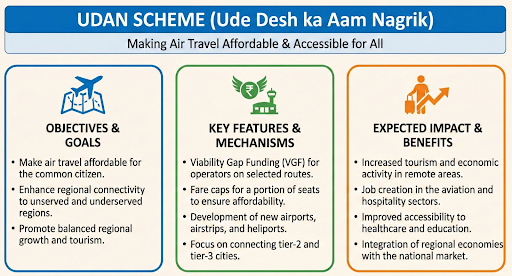
UDAN (Ude Desh ka Aam Nagrik) is a component of the National Civil Aviation Policy (NCAP) 2016, designed to make air travel affordable for the common citizen and connect unserved and underserved airports in Tier-2 and Tier-3 cities.
The Core Objective
The scheme aims to democratize the skies by bridging the gap between metropolitan hubs and smaller regional towns.
Evolution of the Scheme
How It Works (The Mechanism)
To ensure flights are affordable yet profitable for airlines, the scheme uses a two approach:
The Latest Update: Modified UDAN (2026–2036)
In March 2026, the Union Cabinet approved the "Modified UDAN" to address the issue of routes shutting down after the initial subsidy period ended.
Current Status & Impact
Related Sub-Schemes
Significance of the UDAN Scheme
Boost to GDP: Every ₹100 spent on air transport contributes ₹325 to the wider economy, and every 100 jobs in air transport support 610 other jobs in the economy. (Source: International Civil Aviation Organization)
Tier-2 & Tier-3 Growth: By connecting smaller cities like Jharsuguda, Darbhanga, and Hubli, the scheme decentralizes industrial growth from metros to regional hubs.
Tourism Development: Direct connectivity to heritage and religious sites (e.g., Kushinagar, Hampi) reduces travel time, significantly increasing foreign and domestic tourist footfall.
Medical Emergencies: Regional connectivity and the new push for 200 helipads provide a lifeline for "Air Ambulances" in hilly terrains like Uttarakhand and Arunachal Pradesh.
North-East Connectivity: Acts as a strategic tool for the "Act East Policy," integrating remote border states with the mainland and providing faster troop and resource movement if required.
What are the challenges faced by the UDAAN scheme?
High Route Mortality Rate: Sustainability of routes once the subsidy ends.
Infrastructure & Technical Constraints: Building an airport is only half the battle; maintaining high-tech operations is the other.
Financial Health of Regional Carriers: Several small airlines that won UDAN bids (e.g., Air Odisha, Air Deccan, TruJet) struggled with high operating costs and thin margins, eventually shutting down. (Source: DGCA)
"Ghost" Airports & Underutilization: Out of the 100+ airports revived, several see fewer than two flights a week, leading to high Operation & Maintenance (O&M) costs with zero revenue. (Source: Airports Authority of India)
Land Acquisition: While the Centre provides funds, the State Governments often struggle with land acquisition and environmental clearances, leading to project delays. (Source: NITI Aayog)
Competition from Railways: Rapid expansion of Vande Bharat Express trains offers a cheaper, "center-of-city to center-of-city" alternative for 400–500 km distances, directly competing with UDAN's target 1-hour flights.
Way Forward
Enhancing Infrastructure Stability
Night Landing Facilities: Prioritizing the installation of Instrument Landing Systems (ILS) at all regional airports to allow 24/7 operations, increasing the daily "utilization rate" of aircraft.
Greenfield Synergy: Ensuring that the 100 new airports planned under the 2026 expansion are integrated with PM Gati Shakti for seamless multi-modal connectivity (Road/Rail to Airport).
Financial & Operational Sustainability
Rationalizing ATF Taxes: Encouraging all states to cap Value Added Tax (VAT) on Aviation Turbine Fuel (ATF) at 1-4% for regional flights to lower operating costs for airlines.
Direct Budgetary Support: Ensuring the timely release of the ₹28,840 crore outlay to prevent the cash-flow crises that previously led to the bankruptcy of small carriers.
Niche Fleet Development
Leasing Incentives: Providing tax breaks or easier norms for leasing small aircraft (19-70 seats) and helicopters through GIFT City, Gujarat, to reduce the shortage of regional-friendly planes.
Domestic Manufacturing: Leveraging the Modified UDAN funds to procure indigenous HAL Dornier and HAL Dhruv units, creating a self-reliant regional aviation ecosystem.
"Hub and Spoke" Integration
Network Planning: Instead of isolated routes, the Ministry should promote a "Hub and Spoke" model where regional flights are timed to feed into international/trunk flights at major hubs like Delhi, Mumbai, and Jewar.
Focus on Last-Mile
Sagarmala Linkage: Accelerating the development of Water Aerodromes to connect island territories and coastal tourist spots, making aviation a true alternative to slow sea transport.
Conclusion
UDAN is a classic example of Cooperative Federalism, where the Centre (VGF/Policy) and States (Land/Tax concessions) work together. While it has successfully "put the common man in the air," its future success depends on the transition of these regional routes into self-sustaining commercial businesses.
Source: pib
|
PRACTICE QUESTION Q. "While the UDAN scheme has successfully increased the number of operational airports in India, infrastructural and operational bottlenecks continue to hinder its full potential. Elaborate. 10 words |
The Modified UDAN Scheme is an upgraded version of India's Regional Connectivity Scheme, approved for the period 2026-27 to 2035-36. With a massive outlay of Rs. 28,840 crore, it aims to shift focus from merely initiating short-term routes to ensuring long-term infrastructural sustainability and financial viability for regional aviation.
The scheme actively fosters domestic manufacturing by mandating the procurement of indigenous aircraft to reduce import dependence. Specifically, it requires the purchase of two HAL Dhruv helicopters for Pawan Hans and two HAL Dornier fixed-wing aircraft for Alliance Air.
Regional airports typically have lower passenger footfalls compared to metropolitan hubs. Consequently, they struggle to generate non-aeronautical revenues from sources like duty-free shops and large retail outlets, leading to high daily operating losses. The modified scheme addresses this by providing dedicated O&M funding.


© 2026 iasgyan. All right reserved